

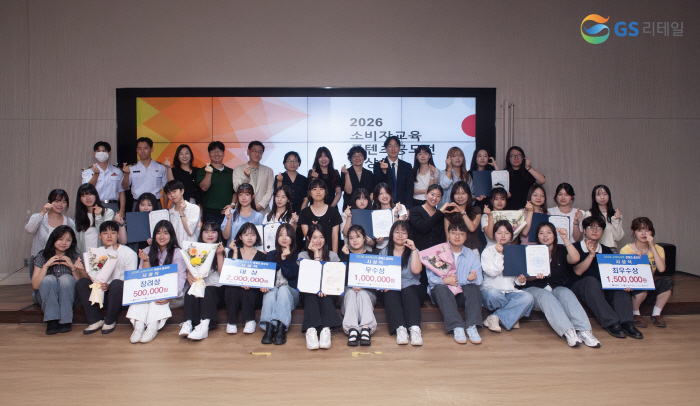
The awards ceremony for the 2026 Consumer Education Content Contest was held on the 19th at the Seoul Public Interest Activity Support Center.
Sponsored by GS Retail, the Korea Fair Trade Commission (KFTC), and the Korea Consumer Agency, and organized by the Korea Consumer Education and Support Center (KOINCE), this year's contest focused on protecting consumer rights under the theme, "Consumer Rights Redefined in the Age of Algorithms." It highlighted the right to know, the right to demand explanations, and the right to choose or refuse. Shopping recommendation algorithms offer personalized convenience, but they have also been criticized as a marketing tactic that hinders rational consumer choice and encourages impulse buying and overspending.
A total of 523 college and graduate students took part in the contest, which ran for two weeks in May, submitting 209 entries, including 81 videos and 128 card news pieces. One grand prize winner, awarded the Chairman’s Award of the Korea Fair Trade Commission, one top prize winner each for the Chairman of the Korea Consumer Agency Award and the GS Retail Home Shopping BU Chairman's Award, and 14 final winners in categories including excellence, encouragement, and creator awards were selected. The winning teams received a total of 10 million won in prize money and certificates.
The grand prize-winning entry, "Did One Search Get Me Taken Over by Recommendation Algorithms?" by Min So-eun and Jo Seo-yoon, creatively explored how recommendation algorithms affect consumer choices and how consumers can control them on their own. The top prize-winning entry, "[Judgment] In the Age of Algorithms, Who Owns the Choice?" by Shin Ji-eun and three others, used the case of a job seeker to vividly and entertainingly recreate the "filter bubble" phenomenon, in which algorithms provide only biased information. Another top prize winner, "Hansel and Cookies: Preventing Dark Patterns" by Nam Ha-eun and three others, explained how to set cookies for privacy protection and how to avoid dark patterns. The award-winning works will later be used as educational materials by the Consumer Education Support Center and shared through online channels such as YouTube.
Heo Nam-joon, head of the Business Support Division at GS Retail, said, "As AI and algorithm technologies increasingly influence the overall consumer environment, it has become more important to raise awareness and understanding of consumer rights." He added, "We will continue a range of Environmental, Social, and Governance (ESG) activities to promote consumer rights and expand a healthy digital consumption culture."
Kim So-hyung, Sportschosun compact@sportschosun.com