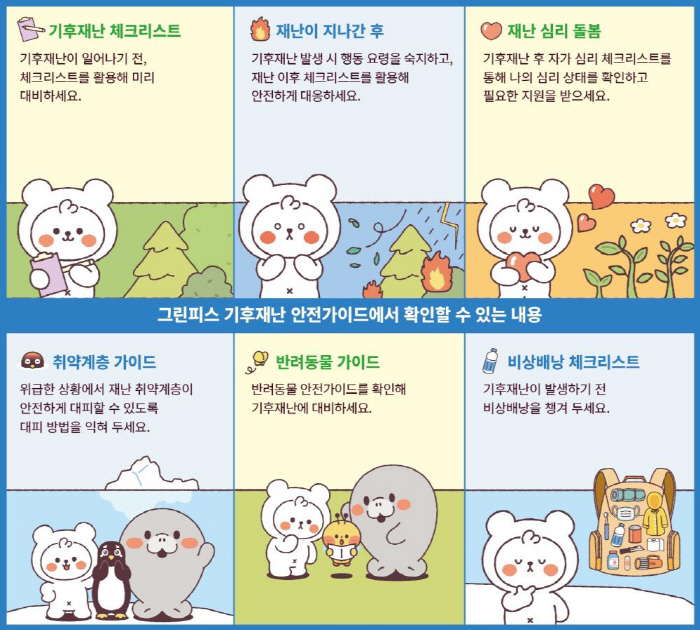


[Sportschosun Jang Jong-ho] Greenpeace recently published the "Climate Disaster Safety Guidebook," which outlines response measures for each stage of a disaster.
The guidebook includes everything from a checklist of preparations to make before a disaster to response rules for when one occurs. It also covers safety checks for recovering daily life afterward, psychological care methods, and ways to find government or community support.
First, the guidebook lays out the action steps people should know in advance before a disaster strikes. These include making an emergency contact network, packing an emergency bag, checking nearby shelters, and assigning family roles ahead of time.
In the section on assigning family roles in advance, it advises deciding beforehand who will be responsible for shutting off gas and electricity, and who will take care of pets. It says each person should carry out their assigned role when a disaster occurs. The appendix also provides detailed instructions, along with visual materials, on packing an emergency bag and creating an emergency contact network.
The response guidelines section covers rules that apply to all disasters, as well as action steps for each type. Along with general safety rules, it explains in detail how to respond to heat waves, heavy rain, floods, typhoons, wildfires, cold waves, and heavy snowfall.
It also includes information needed for a healthy return to everyday life after a disaster. The guidebook offers specific safety checks, such as checking for gas leaks after returning home, and methods for assessing one’s own mental state. Through the "Disaster Psychology Self-Checklist" in the guidebook, individuals can review their wounds and stress after a disaster has passed and seek help from experts. It also explains how to find government or community support.
Greenpeace said of the guidebook, "We created it to serve as a compass that helps citizens protect themselves and their neighbors in response to increasingly frequent climate disasters," adding, "We have gathered step-by-step response measures, from disaster preparedness checklists to guidance during an event and post-disaster safety and psychological care, and we hope more people will prepare for climate disasters through this guidebook."
More details about the "Climate Disaster Safety Guidebook" are available on the Greenpeace website. Greenpeace also plans to distribute the guidebook for educational use to schools near disaster-hit areas, including flood-stricken Sancheong County and Yeongdeok, which suffered wildfire damage.
Jang Jong-ho, bellho@sportschosun.com