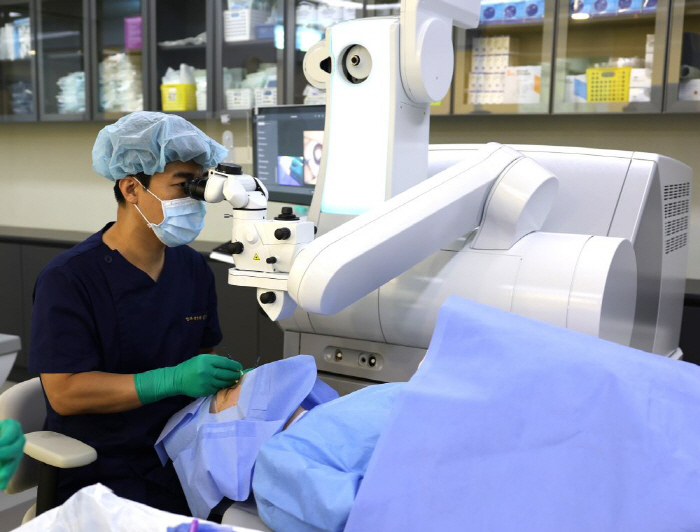


[Sportschosun, Jang Jong-ho] As inquiries about vision correction surgery from college students surge ahead of the summer break, SMILE Pro is emerging as the only option for patients with nystagmus, who have long been left in a blind spot for vision correction.
Nystagmus affects about one in every 1,000 people and causes the eyes to move rapidly and repeatedly without the person's control.
For that reason, conventional procedures such as LASIK and LASEK, which require the eye to be precisely fixed during surgery, have long been considered a relative contraindication. The involuntary movement of the eyes can interfere with accurate laser delivery and raises the risk of decentration or irregular astigmatism.
Kim Boogi, director of Onnuri Smile Ophthalmic Clinic, presented the SMILE Pro procedure for patients with nystagmus and its clinical results at ASCRS, the globally respected ophthalmology conference held in Washington, D.C.
Kim's research team performed SMILE Pro on a total of eight patients, or 16 eyes, with nystagmus. As a result, 87% of patients maintained or even improved their corrected vision after surgery, while the average degree of decentration was just 0.25 mm, which is extremely small. Most notably, there were no surgical complications at all, despite the procedure being a highly demanding specialized operation.
The medical team cited three reasons SMILE Pro is useful for myopic patients with nystagmus: the speed of the VISUMAX 800 system used to perform the surgery, its highly precise eye-tracking capability, and the surgeons' manual control expertise in managing it.
Among current vision correction procedures, SMILE Pro is the fastest. Even compared with conventional SMILE surgery, the operation time is shorter, with laser exposure taking only about 10 seconds. Because patients with nystagmus keep moving their eyes regardless of their will, the longer the surgery takes, the greater the risk of suction loss, in which the eye loses fixation. SMILE Pro completes laser delivery in just 10 seconds, before the eye begins to shake in earnest, reducing psychological burden and improving surgical stability.
In addition, patients with nystagmus often experience both side-to-side eye movement and rotational motion. OcuLign software, built into the BizMax 800 system used for SMILE Pro, detects subtle ocular cyclotorsion and decentration in real time and automatically corrects them. In other words, even if the eye moves slightly, the laser follows that movement precisely and delivers energy to the correct astigmatic axis and center point, greatly reducing concerns about postoperative glare and irregular astigmatism.
Just as important as advanced equipment is the skill of the surgeon who operates it. Kim's team published the world's first paper in 2017 reporting successful SMILE surgery in patients with nystagmus.
At the conference, Kim said, "We were able to improve the surgical success rate by combining techniques that identify the point where the patient's eye tremor is temporarily minimized, manually control the head position, repeatedly check and proceed only when the eye movement pattern matches the degree of decentration rather than relying on a single docking, and carefully monitor the degree of ocular cyclotorsion in real time through a monitor."
Jung Young-taek, director of Jeonju Onnuri Eye Hospital, said, "For patients with nystagmus, vision correction surgery is more than a matter of appearance or convenience. It has therapeutic meaning that can change quality of life." He added, "In the past, many people were discouraged after being told that surgery was impossible because their eyes shook. But with the more advanced SMILE Pro and the medical team's refined expertise, we can now safely offer an alternative."
Jung added, "As summer break approaches, college students who want to get rid of uncomfortable glasses and contact lenses should not give up if they have hesitated about surgery because of a special condition or corneal factors. Consulting a specialist may open up new possibilities."
Jang Jong-ho, Sportschosun, bellho@sportschosun.com