

[Sportschosun] Reporter Jang Jong-ho: The rising popularity of Pickleball, a new sport that combines tennis, badminton and table tennis, is spreading from overseas to South Korea.
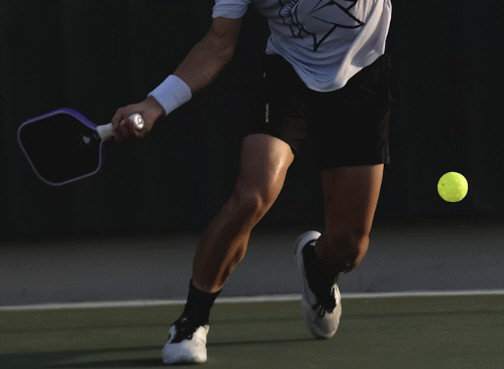
Pickleball is a racket sport played on a court smaller than a tennis court, with a net in the middle and a perforated plastic ball exchanged between players.
Overseas, the sport drew wider public attention after being known as a longtime favorite of Microsoft founder Bill Gates, and in South Korea, more people are trying it as the number of clubs and tournaments continues to grow.
According to the Korea Pickleball Association, there are more than 100 Pickleball clubs nationwide and the number of players is estimated to exceed 10,000. Anyone can pick it up and enjoy it quickly, but because it involves repeated swings and frequent quick changes of direction, injury prevention also requires attention.
Kim Yoo-geun, director of Bupyeong Himchan Hospital, said, "Pickleball is a sport with strong exercise benefits, but because it involves repeated swings and the characteristics of a racket sport that mainly uses one arm, pain can develop in the elbow, shoulder or wrist." He added, "For middle-aged and older adults, muscles are often overused or used incorrectly, making it easier for pain to develop in the tendon areas where muscles attach to bone."
◇ Helps improve cardiorespiratory endurance, agility and balance... Watch out for elbow and shoulder injuries
The biggest advantage of Pickleball is its low barrier to entry. The court is small and the ball moves relatively slowly, so beginners can get started easily. As players rally, they repeatedly walk, move forward and backward, shift side to side, lower their bodies and change direction, which also helps improve cardiorespiratory endurance, agility and balance. Because it is easy to enjoy as doubles, middle-aged and older adults can gain both social interaction and physical activity.
However, because Pickleball involves holding a paddle with one hand and swinging repeatedly, stress can easily build up in the elbow, shoulder and wrist. In addition, sudden changes in direction or lowering the body to return the ball can strain the knees, ankles and lower back.
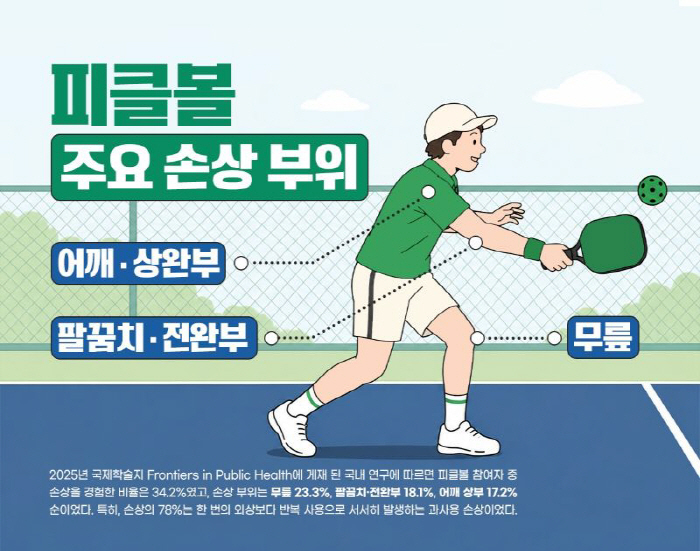
According to a Korean study published in the 2025 international journal Frontiers in Public Health, 34.2% of Pickleball participants had experienced an injury. The most common injury sites were the knee at 23.3%, the elbow and forearm at 18.1%, and the shoulder and upper arm at 17.2%. Notably, 78% of the injuries were overuse injuries that developed gradually through repeated use rather than a single traumatic event.
A common pain people may experience in Pickleball is lateral epicondylitis, commonly known as tennis elbow. This condition occurs when the outer tendon that wraps around the bone from the elbow to the hand suffers tiny injuries from repeated use. Gripping the paddle tightly and repeating backhand motions, or hitting the ball with the wrist bent backward, increases the strain on the outer tendon. If it hurts when pressing near the bone on the outside of the elbow, or if pain appears when bending the wrist backward while making a fist, tennis elbow may be suspected. The pain sometimes extends to the wrist, and if it does, rest should be taken until the pain disappears.
Rotator cuff injuries in the shoulder also require caution.
Compared with other racket sports, Pickleball involves fewer powerful serves or overhead motions, but it still uses the shoulder and arm a great deal for returns and other shots, and it includes many movements that raise the shoulder. Pain can occur when the rotator cuff, which stabilizes the joint as the shoulder moves, becomes weakened. In middle-aged and older adults, the rotator cuff tendons are often already weakened by degeneration, so even small repeated stresses can cause pain. If the front or side of the shoulder hurts when lifting the arm, if the pain worsens at night, or if it becomes difficult to move the arm behind the back, a rotator cuff disorder should be considered.
◇ Warm up thoroughly and control your workout volume
To reduce the risk of injury, it is important to stretch with a variety of movements before exercising.
Simply rotating the fingers and wrists lightly is not enough. It is better to warm up for 5 to 10 minutes with light walking or jogging in place, then do shoulder rolls, torso rotations and wrist stretches. In addition, doing light forearm-strengthening exercises within a manageable range, such as slowly bending and straightening the wrist while holding a light dumbbell or water bottle, or lifting and lowering the wrist with the palm facing down, can help reduce the strain placed on the tendons around the elbow.
Equipment choice is also important. If the paddle is too heavy or the grip does not fit the hand well, the burden on the wrist and elbow increases. If the wrist is weak or there is a history of lateral epicondylitis, a wrist brace or elbow strap can help reduce the strain. However, such supports should be used only as an aid to reduce repeated impact and excessive movement, not as a way to keep playing through pain.
For those who are just starting Pickleball, it is safer to keep matches short and avoid playing continuously for long periods. In particular, middle-aged and older adults should watch for pain on the outside of the elbow after exercise, night pain in the shoulder and swelling around the joints. If these symptoms appear, they should not be dismissed as simple muscle soreness. Instead, it is necessary to reduce the intensity and frequency of exercise and receive an accurate diagnosis.
Kim Yoo-geun, director of Bupyeong Himchan Hospital, advised, "Pain often develops not from one major impact, but from the buildup of stress on tendons and joints through repeated movements." He added, "When starting Pickleball, focus more on form and workout volume than on winning. With warm-up exercises such as stretching, forearm strengthening and enough rest, you can enjoy the sport in a healthy way."
Reporter Jang Jong-ho bellho@sportschosun.com