

[Sportschosun Reporter Jang Jong-ho] Eulji Foundation is marking its 70th anniversary this year.
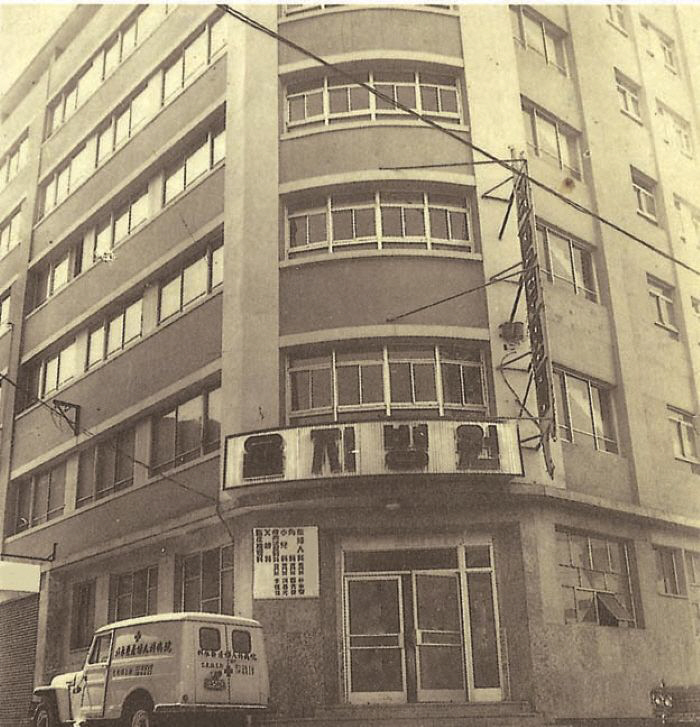
It began in 1956, when the scars of war were still visible in everyday life and medical infrastructure was barely in place.
At the time, medical care was not a matter of choice but of survival. Hospitals were more than places of treatment; they were the front line supporting the nation and society.
The history of Eulji Foundation began on that front line and has continued alongside the course of modern and contemporary Korean medicine.
This article looks back on Eulji Foundation’s past, present, and future.
◇From the ruins of war to medical care for the public
Founded in 1956, when the wounds of war had yet to heal, Eulji Foundation has grown alongside the history of modern Korean medicine.
It was an era when hospitals were in desperately short supply and medical care was a matter of survival, not choice. Eulji Foundation’s beginning was not simply the establishment of an institution, but the building of a medical pillar needed by the nation and society.
Park Jun-young, chairman of Eulji Foundation, described this 70th anniversary as "not a time to look back on the past, but a moment to reflect on what role medicine and education have played for the nation and its people." He added, "Eulji Foundation’s path is not a record of outward growth, but a process of asking and answering where medicine should stand when society needs it most."
◇Established not just as a hospital, but as a medical safety net
Eulji Foundation’s 70-year history is less a story of the growth of a large medical institution than a record of how medicine can take root in local communities.
Its hospital network, spanning the Seoul metropolitan area and regional cities, was not simply an expansion in scale. It was a deliberate effort to fill medical gaps in each region.
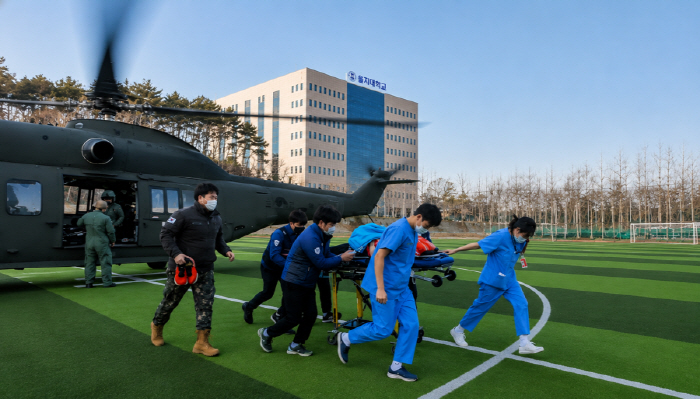
Its affiliated hospitals have strengthened emergency, critical, and essential care to match the medical conditions and needs of each region. In particular, building an emergency patient transport system and securing critical care capacity have been directly tied to the lives of local residents.
More recently, the center has built an integrated care system that links medical information between hospitals, allowing patients to undergo surgery at the hospital they want and receive follow-up care and aftercare at a medical institution within their daily living area.
This model has been praised for improving both access to care and continuity of treatment. It is also seen as an example of patient-centered medicine, with significance that extends beyond medical quality to the lives of patients and their families.
◇Medicine that has been on the scene in every crisis
Eulji Foundation’s medical teams have shown their presence not only in ordinary times, but also in moments of crisis.
During the spread of infectious diseases, as well as various disasters and emergencies, medical staff have always remained on the front lines. Recently, a nurse on parental leave drew national attention after rescuing a patient with epilepsy who suffered an emergency on board an aircraft.
Such cases are seen as more than individual acts of dedication. They reflect an organizational culture and education system that has long placed human life first. Behind each medical worker’s decision lies the foundation’s long-standing philosophy of treating medicine as a mission.
Park said, "Medicine is completed by people before it is completed by systems or policies," adding, "The reason Eulji’s medical staff do not hesitate in moments of crisis is that we have long taught that medicine is a responsibility for the public good, not private gain."
◇The power to sustain medicine begins with education
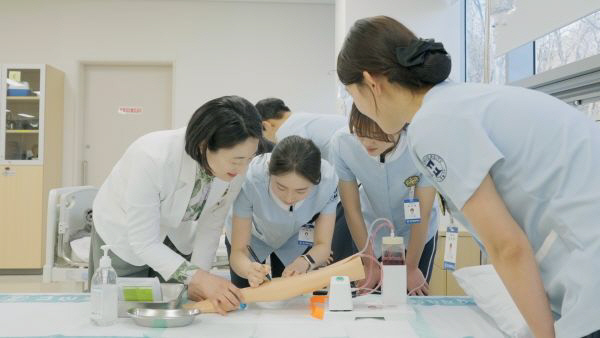
Another pillar of Eulji Foundation is education. To ensure the sustainability of medicine, the foundation has regarded "nurturing people" as one of the core responsibilities of a medical institution.
Through its medical school, nursing college, and college of health sciences, Eulji University has trained field-oriented medical and health professionals. That has become a foundation supporting regional and national healthcare.
The structure in which clinical care, education, and research are organically connected rather than separated is the basis of Eulji Foundation’s medical model.
If hospitals are places that save lives today, universities are places that prepare the lives of tomorrow. The belief that medicine remains sustainable only when healthcare and education work together has guided the foundation for the past 70 years.

◇The meaning behind the slogan, "70 Years Thanks to You, 100 Years Together"
Eulji Foundation has chosen "70 Years Thanks to You, 100 Years Together" as the slogan for the 70th anniversary of Eulji University Medical Center. It reflects gratitude to the Eulji family, as well as to the public and local communities, while also declaring that the future of medicine can no longer be pursued alone.
The medical environment is becoming increasingly challenging, with the arrival of a super-aged society, regional disparities in healthcare, concerns over the collapse of essential medical services, and the normalization of infectious diseases.
In times like these, the role of medicine becomes even clearer. Eulji Foundation says it will continue to seek answers at the side of local communities and the public for the next 100 years as well.
Park said, "Eulji Foundation’s 70 years are not the history of a hospital, but a record of how medicine and education have responded when the nation and society faced hardship," adding, "We will continue to be the medical institution that thinks first and steps back last in the face of the people’s lives."
Seventy years of standing by local communities and the public. Eulji Foundation’s medicine is still on the front lines today, and at its center remains the core value of "love for humanity and respect for life."
Jang Jong-ho, bellho@sportschosun.com