

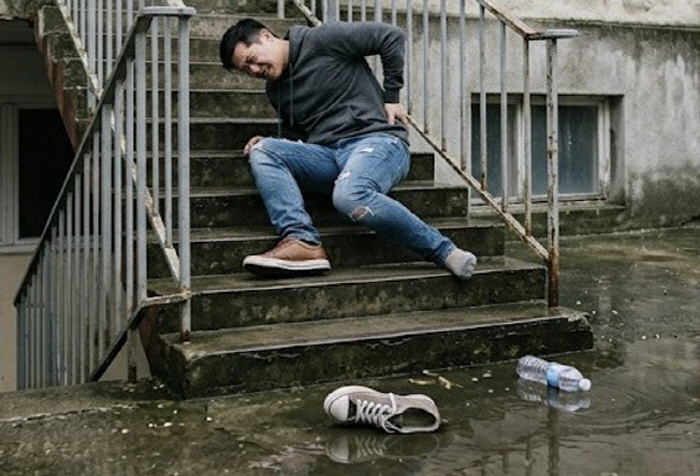
[Sportschosun, Reporter Jang Jong-ho] In summer, there is another danger to watch for besides heat-related illnesses: falls. As the rainy season and heavy downpours make indoor and outdoor floors slippery, accidents are common not only in bathrooms, stairways and parking lots, but also on sidewalk blocks and crosswalks.
The risk is even higher in summer because slippers and sandals do not provide enough support for the feet.
Falls are not limited to simple bruises. They can lead to fractures, ligament injuries and spinal damage. For older adults, who often have reduced balance, weaker muscles and lower bone density, even a relatively minor slip or impact can cause a vertebral compression fracture, so extra caution is needed.
Falls are considered one of the leading causes of injury that threaten the health of older adults. According to the KDCA's 2023 Discharge Injury Statistics, falls accounted for 51.6% of all hospitalized injury cases, the largest share. Older adults also showed a relatively high hospitalization rate from falls, making it important for people with osteoporosis or reduced bone density to be especially careful about possible vertebral compression fractures after a fall.
The spine is divided, based on its mechanical structure, into the anterior column, middle column and posterior column. A vertebral compression fracture occurs when pressure is applied to the front of the vertebral body, which bears most of the body's weight, causing the vertebral body to lose height.
Vertebral compression fractures usually occur when bones have become weak due to osteoporosis. They can happen from a relatively minor fall or even ordinary daily movements. They are common among older adults with reduced bone density, but they can also occur without osteoporosis if the spine is subjected to strong external force, such as in a traffic accident or a fall from height.
When a vertebral compression fracture occurs, localized pain appears at the fracture site. The pain tends to worsen when walking, standing for long periods, rising from a seated position or bending forward. If compression fractures occur in multiple vertebrae, the vertebral bodies may gradually collapse, making it difficult to straighten the back and causing kyphotic deformity, in which the upper back curves forward.
Based on the patient's symptoms and medical history, doctors perform a physical examination, X-rays, CT scans and MRI scans. Treatment is determined by comprehensively considering the severity of the fracture, the patient's age and underlying conditions such as osteoporosis. In general, conservative treatment such as bed rest, medication, physical therapy and braces is tried first. If pain persists, additional treatment may be considered at the specialist's discretion.
Jung Dong-moon, head of the Spine Center at Daedong Hospital and a neurosurgeon, said, "In summer, the risk of falls rises because of the rainy season and heavy downpours," adding, "Older adults with weakened muscle strength and balance can suffer vertebral compression fractures, hip fractures, wrist fractures and head injuries even from relatively minor falls, so they need to be especially careful."
He also advised, "It is not uncommon for people to mistake back pain after a fall for simple muscle pain or a sprain and miss the right time for treatment," and added, "If a vertebral compression fracture is left untreated, the pain can become chronic or the vertebral body can continue to deform, so if the pain persists, it is important to visit a medical institution and receive an accurate diagnosis."
In summer, it helps to wipe away moisture immediately in areas where water tends to collect, such as bathrooms, restrooms and entryways, and to install non-slip mats. On rainy days, people should wear shoes with non-slip features or footwear that provides stable support, and take shorter steps and walk slowly on wet roads or slopes. They should also avoid having their view blocked by an umbrella and refrain from using a smartphone while walking.
When using stairs, it is best to hold the handrail, and at night, choose well-lit routes whenever possible and move only after checking the surroundings carefully. Regular exercise to maintain lower-body strength and balance can also help. For people with osteoporosis, regular checkups and proper treatment to manage bone health may help prevent vertebral compression fractures.
Jang Jong-ho, Reporter bellho@sportschosun.com