

[Sportschosun, Reporter Jang Jong-ho] A new brain tumor treatment may be on the horizon, one that could greatly reduce the side effects of cancer therapy while delivering drugs more effectively.
A joint research team led by Seung-Ho Yang of the Department of Neurosurgery at The Catholic University of Korea, Seoul St. Mary's Hospital, Sung-Min Park of POSTECH's Department of Convergence Information Technology Engineering, and Won Jong Kim of POSTECH's Department of Chemistry said it developed a new drug delivery method that administers anticancer nanoparticles through the nose and then precisely guides them to malignant brain tumors using a magnetic field. In animal models, the approach produced significant survival benefits.
Glioblastoma is the most common type of primary malignant brain tumor in adults and accounts for about 65% of all primary malignant central nervous system tumors. It is a difficult-to-treat cancer. According to the Korea Central Cancer Registry (KCCR), about 1,000 people in South Korea are newly diagnosed each year. Even with standard treatment, average survival is only about 15 months. Statistics from the National Cancer Information Center also show a very poor prognosis, with a 10-year survival rate of just 5.3%.
The key drug currently used to treat glioblastoma is Temozolomide, an oral medication. It is known to have low treatment efficiency after administration and to cause systemic side effects such as immunosuppression. The main reason is the blood-brain barrier (BBB), which biologically protects the brain and blocks drug penetration. The research team began by trying to overcome this limitation in drug delivery.
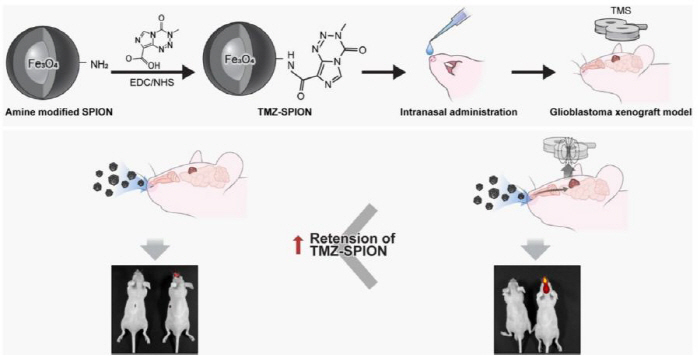
The team focused on combining two ideas. First, the olfactory nerve, which is directly connected to the brain, can serve as a natural pathway from the nose to the brain tissue. Second, magnetic nanoparticles can have their movement controlled by an external magnetic field. The researchers synthesized a complex called TMZ-SPION by binding Temozolomide to superparamagnetic iron oxide nanoparticles (SPION) about 56 nanometers in size. They then administered it through the nose and designed a method to guide it to the brain tumor site using transcranial magnetic stimulation (TMS).
In cell experiments, the TMZ-SPION complex showed tumor cell-killing effects comparable to those of the existing drug. Electron microscopy also confirmed that the nanoparticles were evenly distributed even inside the nuclei of tumor cells. In animal experiments, the team tracked survival for 90 days in glioblastoma model mice after administering the complex. Median survival was 27 days in the control group, 51 days in the complex-only group, and 72 days in the group that received the complex followed by transcranial magnetic stimulation. Compared with the untreated control group, survival was extended by about 2.7 times in the combined-treatment group and by about 1.9 times in the group that received the complex alone.
One particularly notable point was the dosage. The drug dose used in the combination group was only about 5.6% of the standard oral dose, or roughly one-eighteenth. Even so, the treatment produced a substantial survival benefit. LC-MS/MS testing, which can measure drug concentrations in brain tissue with extreme precision through liquid chromatography-tandem mass spectrometry, also showed that drug concentrations in the brain parenchyma were significantly higher in the treated group than in the untreated group. This objectively demonstrated that transcranial magnetic stimulation substantially improved drug delivery to and retention in the brain.
Seung-Ho Yang, who serves as director of the Gamma Knife Center at Seoul St. Mary's Hospital and president of the Korean Society for Nanomedicine, said, "This method, which combines a noninvasive nasal delivery route with transcranial magnetic stimulation, is considered clinically meaningful because it can effectively bypass the blood-brain barrier while greatly reducing the side effects of existing cancer treatments, including systemic immunosuppression." He added, "We hope it can help turn glioblastoma into a disease that can be managed long term."
The study was published in the international journal Drug Delivery and Translational Research.
Jang Jong-ho, bellho@sportschosun.com