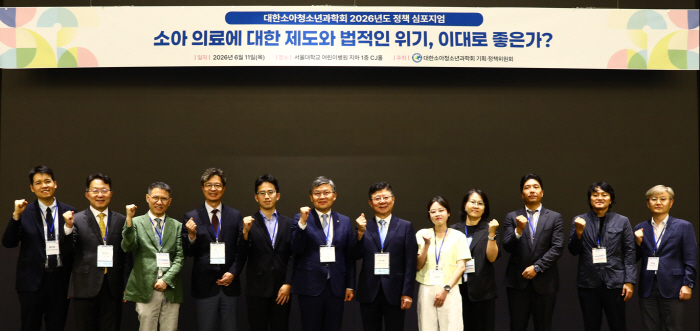


[Sportschosun Reporter Jang Jong-ho] The Korean Pediatric Society held its 2026 policy symposium on the 11th at CJ Hall on the basement level of Seoul National University Children's Hospital, under the theme, "Are the legal and institutional crises in pediatric care acceptable as they are?"
The symposium was organized to directly address the growing legal disputes, shortages of essential medical resources, and weakening foundation for pediatric care in the field, while exploring institutional and legislative improvements.
In recent years, pediatric care providers have faced increasing legal burdens related to medical accidents, while critics say there are still not enough safeguards and institutional standards that fully reflect the unique characteristics of pediatric patients.
As a result, pediatric practice has become more constrained, support for residents has declined, and gaps in regional and emergency pediatric care have widened. Instability in the supply of essential medical equipment and medicines has also deepened the crisis on the ground.
In the first session, which focused on "Legal and Institutional Challenges in Pediatric Care," attorney Hanseop Song of Kim & Chang discussed "Legal disputes in pediatric care: Searching for a new normal." He examined the growing legal disputes and criminal liability burdens tied to medical accidents in pediatric practice, and stressed the need for separate legal and institutional standards that take into account the limited symptom expression and rapid disease progression of pediatric patients.
He also pointed to actual court rulings and controversial cases involving pediatric treatment, saying that it is difficult to ensure both patient safety and the sustainability of pediatric care by placing excessive responsibility on individual medical staff alone. He proposed seeking a new standard, or a "new normal" for pediatric care, that balances patient rights and the stability of medical practice.
Bae Geon-i, a researcher at the Korea Legislation Research Institute (KLRI), then presented "Legislative Measures to Strengthen the Pediatric Care System," calling for fact-finding surveys, information systems, and statutory plans to build a sustainable pediatric health care system.
The second session addressed the crisis in the supply of essential pediatric medical resources under the theme "The Crisis in the Supply of Essential Pediatric Medical Resources." Professor Lee Sang-yoon of Seoul National University College of Medicine noted that rising import costs, a strong won, logistics delays, dependence on a small number of suppliers, and regulatory burdens could all lead to disruptions in the supply of essential pediatric medical equipment and directly affect patient care.
As possible solutions, participants discussed a national stockpiling system, streamlined approval procedures for essential medical devices, support for pediatric indication approvals, and incentives to maintain low-demand medical devices.
Professor Eun Ho-seon of Yonsei University College of Medicine explained in a presentation titled "The Crisis in the Supply of Essential Pediatric Medicines" that low reimbursement rates, rising raw material costs, low usage volumes for pediatric medicines, weaknesses in manufacturers and distribution channels, and insufficient government monitoring and response systems are all contributing to the problem.
He especially emphasized that essential pediatric medicines are structurally vulnerable to supply disruptions because they are often administered in small, weight-based doses and are used in relatively low volumes overall.
During the comprehensive discussion, participating experts agreed that the pediatric medical crisis is not simply an internal issue for the medical community, but a matter of essential health care infrastructure that society as a whole must address.
They stressed the need for legal standards that reflect the unique nature of pediatric care, a balance between protecting medical staff and ensuring patient safety, a stable supply system for essential medical resources, and long-term pediatric health care policies based on state responsibility.
Han-Suk Kim, chairman of the Korean Pediatric Society, said, "Creating an environment where our children can receive safe and appropriate medical care is both the duty of medical professionals and a task for society as a whole." He added, "I hope this symposium will serve as a meaningful starting point for strengthening the legal and institutional foundation of pediatric care."
Based on the issues discussed at the symposium, the Korean Pediatric Society plans to present policy proposals on the legal and institutional problems facing pediatric care and the crisis in the supply of essential medical resources, while seeking practical improvements through cooperation with the government, the National Assembly, and related organizations.
Jang Jong-ho, reporter, bellho@sportschosun.com