


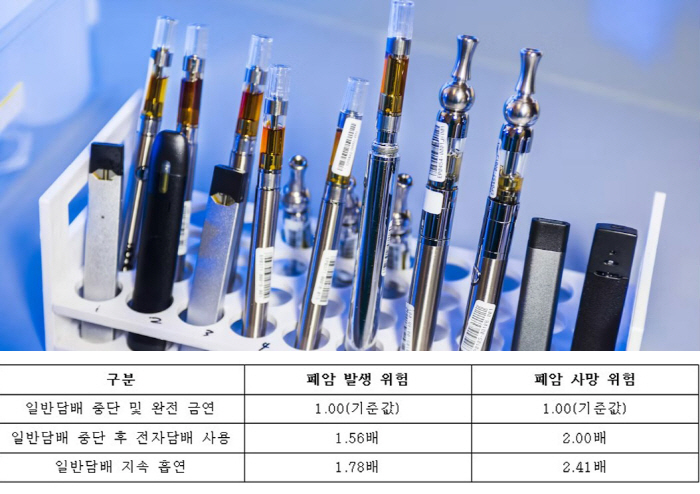
[Sportschosun Jang Jong-ho] A large-scale study has found that even if smokers quit combustible cigarettes and switch to e-cigarettes, their risk of developing and dying from lung cancer remains higher than that of people who quit entirely. A research team led by Professor Kim Yeon-wook of the Department of Pulmonology at Seoul National University Bundang Hospital analyzed 4,524,895 Korean adults with a history of combustible cigarette use. The study found that those who used e-cigarettes daily had a 1.56 times higher risk of lung cancer and a twofold higher risk of death from lung cancer than people who had quit both combustible cigarettes and e-cigarettes.
The findings were published in the international journal Nature Medicine.
E-cigarettes do not involve the combustion of tobacco leaves, so they are known to produce fewer harmful substances such as tar than conventional cigarettes. For that reason, they are often seen as less harmful and as reducing cancer risk. However, there has been little population-wide research on their long-term impact on lung cancer incidence or mortality. E-cigarettes also contain carcinogens such as formaldehyde, but it takes a long time to assess their effects, and the period of widespread use has been relatively short.
The research team selected 4,524,895 adults with a history of combustible cigarette smoking who underwent the national health screening in 2018. It also analyzed their health screening records from 2012 to 2014. The total follow-up period was 24,182,543 person-years, a measure that counts one person observed for one year as one person-year.
The analysis showed that people who quit combustible cigarettes but used e-cigarettes daily had a 1.56 times higher risk of lung cancer than complete quitters who used no tobacco products at all. Their risk of death from lung cancer was about twice as high. In the group that continued smoking combustible cigarettes, the risks of incidence and death were even higher, at 1.78 times and 2.41 times, respectively. This suggests that switching to e-cigarettes raises lung cancer risk compared with complete cessation, while the reduction in risk seen compared with continued smoking is weakened.
The difference between complete quitters and e-cigarette users was even greater among older adults who had smoked for many years. Among high-risk lung cancer groups aged 50 to 80 with a cumulative smoking history of at least 20 pack-years, switching to e-cigarettes was associated with a 1.91 times higher risk of lung cancer and a 1.92 times higher risk of death than complete quitting.
This study is significant from a public health perspective because it examined the link between e-cigarette use and actual lung cancer incidence and mortality in a large population that had already quit combustible cigarettes. It also provided evidence that, to clearly reduce cancer risk, people must do more than simply switch to e-cigarettes and should move away from all tobacco products.
Professor Kim Yeon-wook of Seoul National University Bundang Hospital said, "Many users who switch from combustible cigarettes to e-cigarettes come to believe that they are no longer smoking." He added, "In terms of lung cancer, e-cigarettes may be less risky than conventional cigarettes, but people must clearly recognize that they still fall within the category of smoking and exposure to harmful substances, and they should make every effort to quit completely."
Jang Jong-ho, bellho@sportschosun.com