

[Sportschosun, Reporter Jang Jong-ho] "Respect children’s boundaries and grow together with them."
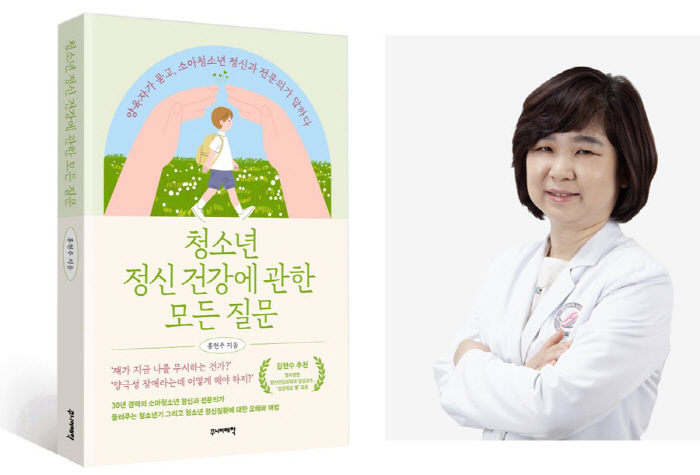
Hong Hyun-joo, a professor in the Department of Psychiatry at Hallym University Sacred Heart Hospital (President Hyung-Soo Kim), has published a new book, All Questions About Adolescent Mental Health, which offers insights into adolescent mental health and the role of parents.
Drawing on more than 30 years of experience meeting adolescents and parents in her clinic, as well as her expertise leading Korea’s first psychological autopsy study of a suicidal adolescent, the book answers the questions caregivers ask most often, from the emotional state of adolescence to major mental illnesses such as depression, bipolar disorder, Attention Deficit Hyperactivity Disorder (ADHD), and schizophrenia.
In the book, Professor Hong explains, "Being mentally healthy means being able to feel joy when something good happens, to grieve fully when something sad happens, and to face and work through difficulties when they arise." Her point is that mental health should be seen not as the absence of problems, but as the ability to experience a range of emotions in a healthy way and recover from them.
The book is divided into four chapters and is built around real-life cases involving adolescents and parents. It also includes rich illustrations, making it easy and approachable for readers of all ages.
Chapter 1, "The Adolescent Mind," interprets puberty not as rebellion or problematic behavior, but as part of the growth process. It explains resistance to parents, the desire for independence, and mood swings in connection with brain development, and scientifically describes adolescence as a period when a young person grows into a "new self."
Chapter 2, "Parents Who Are Burning Out," addresses the practical concerns that trouble parents most. It offers specific guidance on how parents should understand and respond to situations such as lethargy, aggression, smartphone overdependence, self-harm, suicidal thoughts, and school refusal. In particular, it stresses that self-harm and suicidal thoughts should not be dismissed as attention-seeking behavior, but viewed as "signals for help," while also explaining the importance of conversations that understand a child’s pain and help rebuild connection.
Chapter 3, "Common Mental Illnesses in Adolescence," covers depression, ADHD, bipolar disorder, schizophrenia, eating disorders, OCD, and panic disorder. It explains that mental illnesses in adolescents are not caused by a lack of willpower or personality flaws, but by problems in brain function and mental health, and presents symptoms and treatment in an easy-to-understand way.
Chapter 4, "More Questions About Psychiatric Treatment," answers social prejudice and misconceptions surrounding psychiatric care, including whether mental illness is hereditary, the side effects of psychiatric medication, disadvantages tied to treatment records, and the need for hospitalization. The chapter aims to reduce vague fears about psychiatric treatment and help people receive appropriate care.
Professor Hong describes adolescence as "the period when a child builds a world of their own" and uses a range of cases in the book to explain the meaning of boundaries and trust. She says, "A child is a different star," adding that "the role of parents during adolescence is to recognize the boundaries a child has begun to build in order to create their own world, and then step back and wait." She emphasizes that this waiting is not avoidance or neglect, but a mature form of patience that accepts what parents cannot do.
Hong Hyun-joo said, "Adolescent mental health is an issue that goes beyond the individual and the family and requires the attention of society as a whole." She added, "I hope this book helps readers understand the feelings hidden behind a child’s behavior and becomes an opportunity for parents and children to reconnect."
Hong Hyun-joo has spent more than 30 years researching child and adolescent mental health as a professor in the Department of Psychiatry at Hallym University Sacred Heart Hospital. She is known for leading Korea’s first psychological autopsy study of a suicidal adolescent and continues to work to improve adolescent mental health and public awareness of mental illness as a member of the Ministry of Gender Equality and Family (MOGEF) Youth Protection Commission and as head of the Hallym University Institute for Suicide and Student Mental Health, which is affiliated with the Ministry of Education of the Republic of Korea.
Jang Jong-ho