

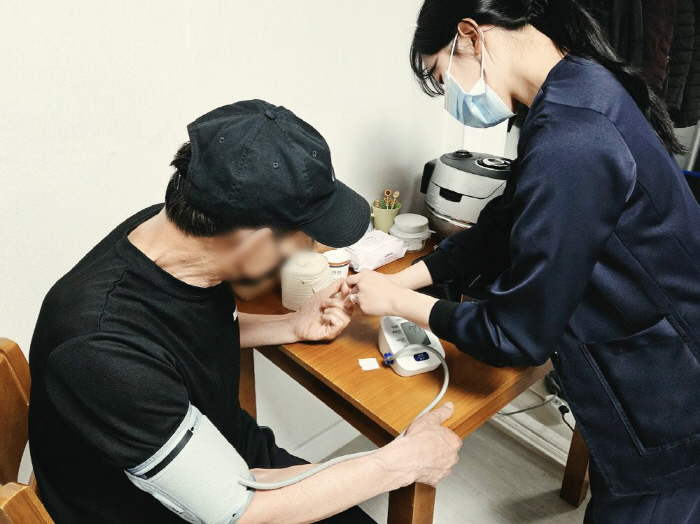
[Sportschosun Reporter Jang Jong-ho] Seoul Metropolitan Seonam Hospital, led by President Pyo Chang-hae, is reaching out to medical blind spots and serving as a health safety net for the local community.
The hospital said it will provide visiting medical services for medically vulnerable residents in southwestern Seoul from June 15 to July 31, in preparation for climate disasters such as summer heat waves and heavy rain.
The project is part of the Seoul Care-Seonam Hospital Health Care Network Project, which the hospital's Public Medical Headquarters has carried out with the Seoul Metropolitan Government for six consecutive years since 2020. It was designed to provide integrated care linking medical, welfare and daily safety services for about 100 elderly people living alone in semi-basement homes in Yangcheon District, Gangseo District, Guro District, Geumcheon District and Yeongdeungpo District in southwestern Seoul.
It is also a proactive public health effort to protect vulnerable groups from seasonal disasters such as heat waves and heavy rain. The initiative aligns with the policy emphasis Oh Se-hoon highlighted at a summer disaster preparedness meeting on June 4, his first official schedule since the local election, where he stressed protection for vulnerable groups and field-based responses.
Seoul Metropolitan Seonam Hospital, designated by the Ministry of Health and Welfare (MOHW) as the regional lead medical institution for southwestern Seoul, said the visiting care team will consist of multidisciplinary professionals, including doctors, nurses and social workers. The team will visit patients' homes directly to check their health conditions and provide specialized treatment and health counseling.
Medical staff will assess patients' health through basic physical examinations and vital sign checks, while also offering tailored health education and self-care counseling for each condition. If needed, the hospital will connect patients with community resources such as medical institutions, welfare facilities and administrative agencies to support integrated care. It also plans to distribute heatwave response health kits to help medically vulnerable residents stay safe and healthy during the summer.
According to the KDCA's 2025 Heat-Related Illness Emergency Room Surveillance System, a total of 4,460 heat-related illness cases were reported last year, up 20.4% from 3,704 the previous year. People aged 65 and older accounted for 30.1% of all patients, while the number of reported cases per 100,000 people was highest among those aged 80 and above. As a result, the need for proactive health management for medically vulnerable groups is growing.
In particular, older adults living in semi-basement housing face a higher risk of health deterioration and isolation during heat waves and heavy rain, making health management and daily safety checks even more important. Seonam Hospital said it will strengthen its community care system by examining not only health conditions but also housing environments and safety factors during home visits, so that it can respond quickly when disasters occur.
Jang Young-soo, head of the hospital's Public Medical Headquarters, said, "Heat waves and heavy rain are not just seasonal inconveniences for medically vulnerable people; they can become disasters that threaten health and life." He added, "Public healthcare should not wait for patients to come to the hospital. It must go first to the places where help is needed most."
Meanwhile, Seonam Hospital has continued to operate the Seoul Care-Seonam Hospital Health Care Network Project since 2020. Working with the Seoul Metropolitan Government, it has provided visiting care to 1,033 people, connected 563 cases with community resources and distributed 16,965 sets of health management supplies, taking the lead in closing medical blind spots and building a community health safety net as the regional lead medical institution for southwestern Seoul.
Hospital President Pyo Chang-hae said, "A public hospital should not be a medical institution that stays inside the clinic. It should be one that goes out into people's lives." He added, "Seonam Hospital will continue to strengthen field-based public healthcare so that citizens in medical blind spots can maintain healthy daily lives even in disaster situations, and we will fulfill our role as a community health safety net."
Reporter Jang Jong-ho, bellho@sportschosun.com