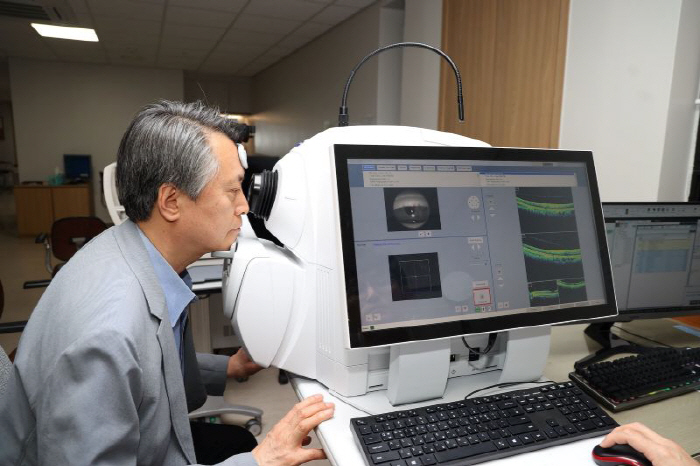


[Sportschosun Jang Jong-ho] A team of professors from the Department of Rehabilitation Medicine at Severance Hospital and Gangnam Severance Hospital is taking on the challenge of controlling a robot with brain signals and sending the robot’s sensory feedback back to the brain.
The project is being carried out as part of the Multi-Ministry Advanced Medical Device Research and Development Project, jointly promoted by the Ministry of Science and ICT, the Ministry of Trade, Industry and Energy, MOHW, and the Ministry of Food and Drug Safety. From this year through 2032, the government will invest a total of 940.8 billion won over seven years to support the development of world-first or world-class advanced medical devices and the localization of essential medical equipment. The large-scale interministerial project will support the entire medical device R&D process, from basic and foundational research to commercialization, clinical trials, and regulatory approval.
Led by the Department of Rehabilitation Medicine at Severance Hospital and Gangnam Severance Hospital, the project involves nine institutions, including DGIST. Over seven years, it will receive 20.25 billion won in state funding, and about 30 billion won including private-sector contributions. The goal is to develop a medical device for bidirectional brain-AI-robot integration that can read the movement intentions of patients with quadriplegia directly from the brain, move a robot accordingly, and send tactile, pressure, and posture information detected by the robot back to the brain.
Patients with paralysis in all four limbs due to cervical spinal cord injuries or amyotrophic lateral sclerosis (ALS) face severe limitations not only in motor function but also in sensory function. Current rehabilitation treatment has focused on making the most of remaining abilities and supplementing daily activities through assistive devices. Clinically restoring the biological circuits that connect movement and sensation has long remained one of rehabilitation medicine’s major challenges.
ANGEL ROBOTICS, the lead institution for the project, will oversee the development of a full-body exoskeleton robot for patients with quadriplegia, a so-called wearable humanoid.
DGIST and others will develop the brain interface technology, while KAIST will handle AI-based brain signal processing. Brain electrode implantation will be performed by the Neurosurgery Department at Seoul National University Hospital. The Department of Rehabilitation Medicine at Severance Hospital and Gangnam Severance Hospital will participate as core clinical partners alongside Samsung Medical Center and Pusan National University Hospital (PNUH), taking charge of verifying the exoskeleton robot’s clinical suitability, designing clinical trials, and establishing patient evaluation protocols.
Professor Na Dong-wook of the Department of Rehabilitation Medicine at Severance Hospital and Professor Choi Won-ah of the Pulmonary Rehabilitation Center at Gangnam Severance Hospital will play leading roles in validating the clinical applicability of the project, based on their top-tier experience in robot rehabilitation.
Severance Hospital established the country’s first robot-assisted gait rehabilitation center in 2011 and opened the first Robot Rehabilitation Therapy Center in 2018. Over the past 15 years, it has accumulated patient treatment experience and clinical data in the field of robot rehabilitation, helping drive the development of clinical robot rehabilitation in South Korea.
Gangnam Severance Hospital’s Pulmonary Rehabilitation Center is also joining the study to improve clinical safety for high-risk patients. Founded in 2009 as the first center of its kind in South Korea, it has specialized for the past 17 years in pulmonary rehabilitation for patients with severe respiratory failure caused by rare and incurable neuromuscular diseases such as ALS and high cervical spinal cord injuries. By closely evaluating and managing the respiratory function of study participants, the center will help ensure that the brain-robot integrated system can be safely applied in real clinical settings.
The development will proceed in three stages.
In the first stage, from 2026 to 2027, the team will secure core technologies for high-density cortical invasive electrodes and the brain-robot integrated system. In the second stage, from 2028 to 2029, it will integrate hardware and software and conduct clinical trials involving patients. In the third stage, from 2030 to 2032, the team will complete a combined medical device linking the brain interface, AI-based encoding and decoding technologies, and the full-body exoskeleton robot through ultra-low-latency communication, while pursuing regulatory approval from the Ministry of Food and Drug Safety and commercialization.
The Department of Rehabilitation Medicine at Severance Hospital will be responsible for designing clinical trial protocols, recruiting and evaluating patients, and verifying the usability and safety of the robot. In particular, it will play a key translational role in determining whether technologies developed in engineering labs can be applied to real patients. Based on Severance Hospital’s accumulated clinical experience and data in robot rehabilitation, the research team plans to systematically verify the safety and effectiveness of the brain-robot integrated system.
Jang Jong-ho, bellho@sportschosun.com