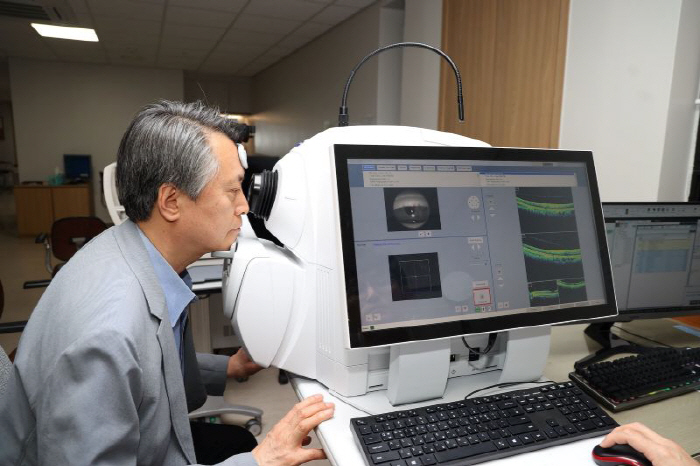


[Sportschosun, Jang Jong-ho] Professor Sung-Hoo Hong of the Department of Urology at The Catholic University of Korea, Seoul St. Mary's Hospital successfully treated an elderly kidney cancer patient with a tumor thrombus in the inferior vena cava using a single-port (SP) robot. It was the first case in Korea and the second in the world in which this highly complex surgery, which required removal of both the kidney tumor and the thrombus that had invaded the body's largest vein, was performed with single-port robotic surgery.
The patient was a man in his 70s, identified only by his surname Huh, who had worked as an educator. Even after retirement, he continued to exercise regularly and took care of his health. One evening, after finishing his workout, he noticed blood in his urine and visited a nearby hospital. An ultrasound there suggested that he needed treatment at a university hospital. Further tests later raised suspicion of right kidney cancer, and he came to Seoul St. Mary's Hospital for a more detailed examination.
Preoperative imaging showed an 8 cm kidney tumor and a thrombus in the right renal vein. Because he had previously undergone open surgery, he had extensive scars across his abdomen, and severe adhesions were expected, with the abdominal organs likely stuck tightly together. Hong's team therefore planned a single-port robotic operation to remove the right kidney through a retroperitoneal approach, entering from the flank behind the peritoneum rather than through the abdominal cavity.
During surgery on May 27, however, the renal vein thrombus was found to have progressed and extended into the inferior vena cava. Professor Hong decided to remove the tumor and the inferior vena cava thrombus at the same time without making any additional incision. After 2 hours and 20 minutes, the team successfully completed this highly demanding procedure through just one incision, a surgery that is difficult even with open surgery. The patient was discharged four days later.
Venous tumor thrombus is a common sign of vascular invasion in kidney cancer patients and is reported in about 4% to 10% of all cases. The inferior vena cava is the largest and thickest vein, carrying blood from the lower body below the diaphragm back to the heart. Because this large vessel must be clamped or opened and then reconstructed during surgery, massive bleeding can occur. If a thrombus breaks off during the operation, it can cause acute embolism in the lungs, brain, or major organs, which can be fatal during surgery.
Kidney cancer with an inferior vena cava thrombus is considered one of the most difficult and dangerous operations in urologic cancer surgery, yet it has continued to be attempted despite the risks. Without treatment, the one-year survival rate falls below 30%, but if the tumor and thrombus are completely removed, the five-year survival rate can rise above 50%. In the past, open surgery involving a large abdominal incision was the standard approach. Since the 2010s, advances in robotic techniques have led to attempts at thrombectomy using multi-port robotic platforms. Even so, the number of such procedures worldwide remains limited.
This case is especially significant because it used a retroperitoneal approach with single-port robotic surgery. Compared with a transabdominal approach, the working space is extremely narrow and there are fewer anatomical landmarks, making the procedure much more difficult. Still, it can be applied to patients with abdominal adhesions and offers the advantages of faster recovery, less pain, reduced blood loss, and fewer complications.
At his first outpatient visit after surgery on June 15, the patient said, "I had always exercised regularly and was confident in my health, but only after being diagnosed with kidney cancer did I realize that it is truly a cancer that comes silently." He added, "I cannot fully express how deeply grateful I am to the medical team for giving me a new life."
Professor Hong said, "The significance of this surgery is not simply that we removed a tumor thrombus with a single-port robot. It also proved that even in patients for whom abdominal access is difficult because of prior open surgery, highly complex kidney cancer surgery involving vascular invasion can be performed through a retroperitoneal approach." He added, "It was a difficult and risky operation, but completing it safely gave me great fulfillment as a doctor. I will continue to think constantly about new treatments and surgical techniques that can make patients' lives even a little more comfortable."
Jang Jong-ho, bellho@sportschosun.com