

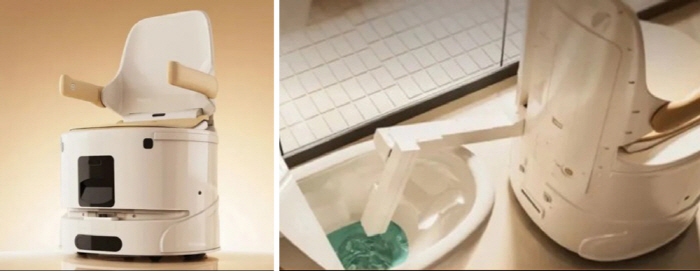
[Sportschosun reporter Jang Jong-ho] An AI-based robot toilet that moves on its own to people who need to use the bathroom has been unveiled in China, drawing attention.
It is expected to help reduce the burden of moving around for older adults, people with disabilities who have difficulty walking, and rehabilitation patients.
According to local media outlets, including IT Home, Chinese company Yueban recently unveiled its AI smart robot toilet, "Xiaoban," at the International Exhibition of Senior Care, Rehabilitation Medicine and Healthcare (AID) held in Shanghai.
Xiaoban's biggest feature is that it can move on its own to the bedside or any other desired location when called by the user.
The product is equipped with an AI-based 3D obstacle-avoidance system and LiDAR sensors, allowing it to recognize indoor environments and move around people and furniture.
After use, it automatically returns to a dedicated station to handle waste. The device connects to existing home plumbing systems and is designed to minimize clogs by disposing of waste through a low-noise grinding unit.
Its hygiene management features have also been upgraded. After disposal, Xiaoban automatically activates high-pressure water spray cleaning and ultraviolet radiation sterilization to keep the interior clean. It also includes a deodorizing system with an activated carbon filter and a foam-blocking device to reduce odor spread.
The selling price of Xiaoban in China has been set at about 28,999 yuan, or roughly 6.5 million won.
The company said it developed the product with a focus on reducing the inconvenience faced by older adults, people with disabilities, and long-term care patients who have difficulty getting to the bathroom. It added that the device is convenient to use thanks to large-button remote control, offline voice control, and an emergency call button, and that it is hygienic because it also comes with an automatic cleaning system.
As China rapidly ages and expands its rehabilitation and care industries, the market for smart caregiving devices is growing quickly. Experts expect AI-based mobility assistance and hygiene management technologies to spread further in elderly care and medical support fields in the years ahead.
Jang Jong-ho, bellho@sportschosun.com