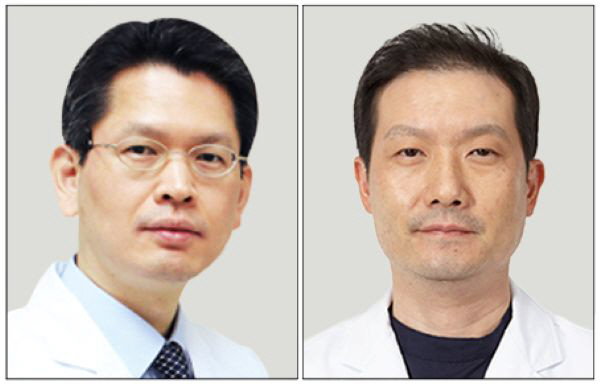


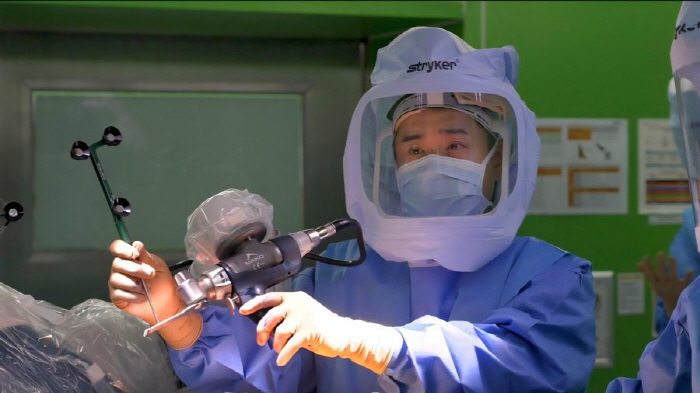
[Sportschosun Jang Jong-ho] A team led by Professor Kim Joong-il and Professor Jeong Ho-jeong of the Department of Orthopedic Surgery at Hallym University Kangnam Sacred Heart Hospital has developed a new robotic knee replacement surgery method, the minimal-incision and minimal-soft-tissue-injury (MISI) technique, which minimizes the incision range and soft-tissue damage, and has published the clinical results in an international journal.
Robotic knee replacement surgery for patients with degenerative knee arthritis offers high accuracy, but it often requires additional incisions in the thigh or calf, or a wider incision, to secure the robotic tracking device. As a result, it had a limitation in that soft-tissue damage and scarring could increase.
By contrast, the MISI technique co-developed by Professor Kim and Professor Peter Sculco of Hospital for Special Surgery (HSS) allows the procedure to be performed through a minimal incision of about 10 cm.
Its key feature is that it reduces soft-tissue damage by minimizing the additional incisions required in conventional robotic joint replacement surgery and by applying patient-specific functional alignment. While preserving the high precision of robotic surgery, it also reduces scarring and eases the burden of recovery for patients.
The core of the MISI technique is that it reduces the incision length from more than 15 cm in conventional robotic joint replacement surgery to about 10 cm, minimizing scarring and soft-tissue damage. By redesigning the position and angle of the pins used to fix the robotic tracking device, the team enabled stable fixation without any additional incision.
In addition, by applying patient-specific functional alignment, the team reflected each patient’s unique leg shape and joint condition as much as possible, achieving more natural and comfortable joint movement.
From April to December 2025, Professor Kim’s team performed MISI robotic knee replacement surgery on a total of 82 patients. The procedures were carried out with a minimal incision of about 10 cm and an additional incision of only about 5 mm. Among the 82 consecutive patients, there were no wound-healing complications or periprosthetic fractures related to pin insertion. At the one-month postoperative follow-up, all incision sites had healed well.
Professor Kim said, "When I meet patients in the clinic, many of them worry as much about the recovery process and scarring after surgery as they do about the surgical outcome." He added, "After thinking about how to help patients undergo surgery more comfortably and return to daily life more quickly, I developed the MISI technique." He continued, "I will continue to advance this as a surgical method that reduces the burden of recovery and helps restore more natural joint function through minimal incision and soft-tissue preservation."
The study was recently published in the international orthopedic journal Journal of Orthopaedic Surgery and Research (JOSR) under the title "Minimal-incision and minimal-soft-tissue-injury (MISI) technique for robotic total knee arthroplasty: a pilot study."
Meanwhile, Professor Kim opened the Hallym Robot Artificial Joint Training Center in December 2021, the first of its kind at a domestic medical institution, and has since trained more than 550 orthopedic surgeons from Korea and abroad in robotic knee replacement surgery. Over the past two years, he has also published more than 10 papers on robotic knee replacement surgery in leading SCI journals, drawing international attention in the field of robotic joint replacement.
Jang Jong-ho, bellho@sportschosun.com