

[Sportschosun Jang Jong-ho] A study has found that changes in gut microbes may help predict the stage and prognosis of liver disease.
In particular, the study confirmed through large-scale data analysis that oral bacteria can migrate to the gut and affect the prognosis of patients with cirrhosis and liver cancer.
The liver is often called a "silent organ" because it may show no clear symptoms until the disease has advanced significantly. As a result, research is actively under way to diagnose liver disease early and predict its progression. More recently, studies on early diagnosis and prognosis prediction using microbes have accelerated as it has become known that gut microbes can influence the onset and progression of liver disease.
Against this backdrop, a research team led by Professor Seok Ki-tae of the Department of Gastroenterology at Hallym University Chuncheon Sacred Heart Hospital suggested the possibility of predicting the stage and prognosis of liver disease by analyzing changes in gut microbes.
The team analyzed a total of 3,544 data sets by integrating 1,168 stool samples from healthy individuals and patients with fatty liver, hepatitis, cirrhosis, and liver cancer, along with 2,376 gut microbiome metagenome data sets stored in public databases around the world.
The results showed that microbial diversity in the gut gradually declined as liver disease progressed. In other words, the healthy gut environment broke down, leaving only certain bacteria behind.
What stood out was that the decline in diversity was not the only change; the functions performed by gut microbes also differed depending on the stage of disease. In the hepatitis stage, the activity of certain bacteria increased. In the cirrhosis stage, the production of harmful toxic substances rose. In the liver cancer stage, more substances related to cell damage were generated.
◇Oral bacteria migrate to the gut... worsening liver disease and raising the risk of death
One particularly notable finding was the migration of oral bacteria into the gut. The team confirmed that oral bacteria such as Veillonella and Ligilactobacillus were commonly increased in patients with cirrhosis and liver cancer.
In an analysis of 120 people from whom both saliva and stool samples were collected, Veillonella found in the mouth was also detected in the gut. This suggests that oral bacteria can actually migrate to the gut and establish themselves there.
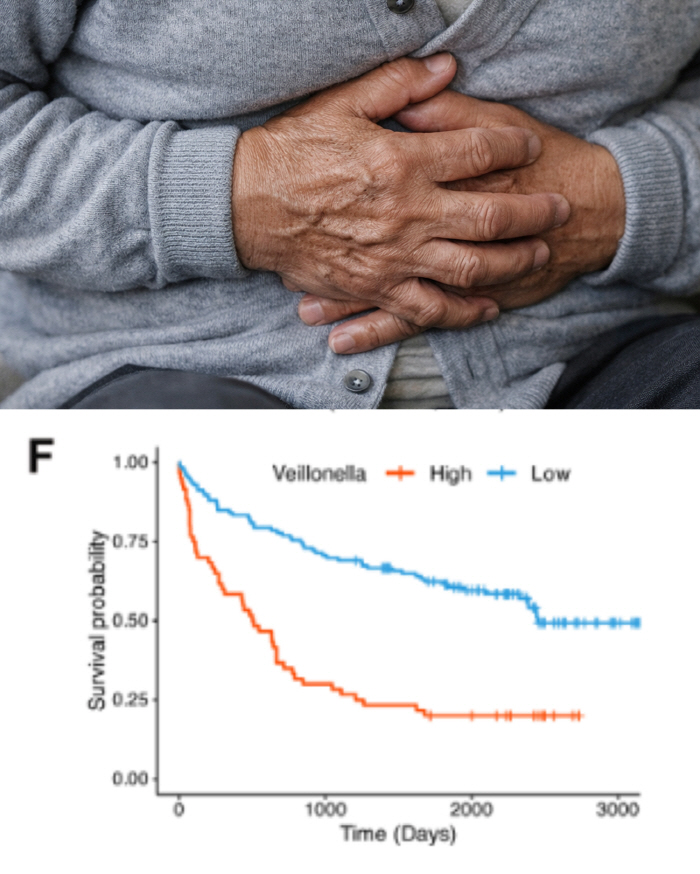
The survival analysis showed an even clearer difference. In an analysis of 183 patients with cirrhosis and liver cancer, the survival rate of the group with high levels of Veillonella detected in the gut remained in the low 20% range, while the rate for the low-level group was about 60%. The gap in survival between the two groups was more than threefold. Patients whose gut microbial diversity had dropped sharply, leaving only certain bacteria dominant, also had poor prognoses. Whether oral bacteria have settled in the gut and how balanced the gut microbiome remains may serve as important indicators for predicting the risk of death and prognosis in patients with liver disease.
◇Possibility of stool tests instead of liver tissue biopsies... hopes for personalized treatment
The team also built a machine-learning-based disease classification model using information on gut microbial composition and function. Area Under the Curve (AUC) is a measure used to evaluate how well a diagnostic or classification model can distinguish between categories, with values closer to 1 indicating better performance. The analysis showed that the model achieved high accuracy, with an AUC above 0.8, in advanced stages of liver disease such as cirrhosis and liver cancer. The researchers expect the findings could be used in the future to develop stool-based noninvasive tests and tools for identifying high-risk patients.
Professor Seok Ki-tae said, "This study is meaningful in that it comprehensively identified how the gut microbial ecosystem changes during the progression of liver disease," adding, "In particular, now that we have confirmed the possible link between oral bacteria, changes in the gut environment, and disease worsening, the findings could be used not only to develop safe, noninvasive stool-based diagnostic methods for liver disease, but also to create personalized prevention and treatment strategies that target microbes."
Meanwhile, the study was recently published in GUT, the international journal of the British Society of Gastroenterology, under the title "Analysis of Gut Microbial and Functional Changes According to the Preclinical Stages of Liver Disease."
Jang Jong-ho, bellho@sportschosun.com