

[Sportschosun reporter Jang Jong-ho] A path has opened for the early identification of people at high risk of Alzheimer's disease (AD) through blood DNA and RNA.
A research team led by Professors Park Young-ho and Byun Jeong-min of the Department of Neurology at Seoul National University Bundang Hospital, researcher Hwang Ji-yoon, and Professor Noh Gwang-sik of Indiana University said that integrating genomic information, which reflects innate genetic risk based on DNA, with transcriptomic information, which reflects current gene expression patterns based on RNA, can effectively distinguish patients with AD. The team added that this approach could provide a clue for developing early screening technology for high-risk groups in the future.
AD is a representative degenerative brain disease in which amyloid beta and abnormal tau proteins accumulate in the brain, gradually impairing memory and cognitive function. So far, medicine has had limited success in fully stopping the disease's progression or reversing already damaged cognitive function, and treatment has mainly focused on relieving symptoms and slowing progression.
The problem is that by the time cognitive decline becomes apparent, degeneration and damage associated with AD may already have been progressing for a long time. These changes can begin years, and in some cases more than 20 years, before clear symptoms appear. For that reason, identifying patients at the earliest possible stage is considered a major challenge.
However, PET scans and cerebrospinal fluid tests, which are currently used for precise diagnosis of AD, have practical limits when applied to the general population because of their high cost and invasive nature. That is why a simpler and cheaper way to identify high-risk groups is needed.
Recently, studies have been using gene-related information obtained from blood tests to distinguish patients with AD. The research team believed that combining genomic information, which shows innate genetic risk based on DNA, with transcriptomic information, which shows current gene activity based on RNA, could improve discrimination. In Korea, studies integrating the two types of information have been rare, and previous approaches that used each one separately had limited performance.
The team therefore conducted a study using blood genome and transcriptome test results from a total of 486 people, including 313 participants in the Alzheimer's Disease Neuroimaging Initiative (ADNI) in the United States and 173 participants at Seoul National University Bundang Hospital. The results were converted into AD risk scores and combined as indicators for distinguishing the disease.
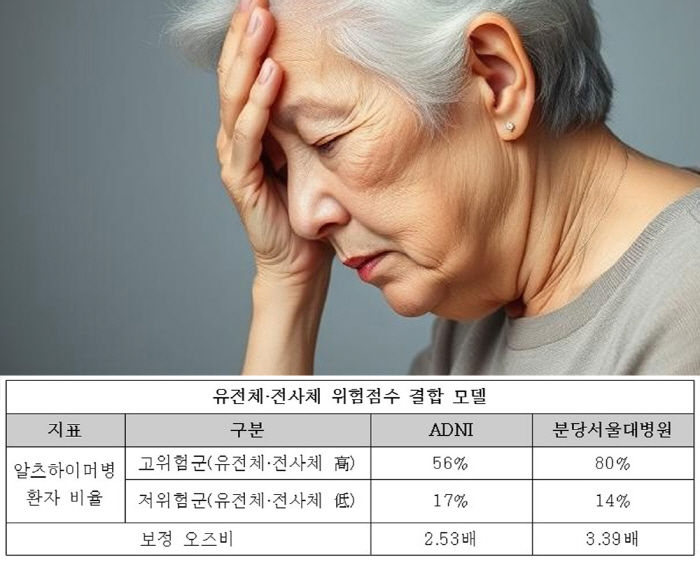
The analysis showed that in the high-risk group, where both genomic and transcriptomic risk scores were high, the proportion of patients with AD was 56% in ADNI and 80% at Seoul National University Bundang Hospital. In the low-risk group, where both scores were low, the actual patient rates were 17% and 14%, respectively, showing that the model could effectively distinguish patients.
Even after adjusting for variables such as age, the group with high scores on both measures was more likely to be diagnosed with AD than the low-score group. The adjusted odds ratio was 2.53 times higher in ADNI and 3.39 times higher at Seoul National University Bundang Hospital, indicating that the combined genome-transcriptome model had stronger discriminatory power than models using either measure alone.
This study is significant because it demonstrated the effectiveness of integrating inherited genetic vulnerability and current gene activity through blood testing. The findings showed consistent improvements in discrimination across two groups with different ethnic backgrounds, suggesting the potential for development into an early screening tool for AD risk groups.
Professor Park Young-ho of the Department of Neurology at Seoul National University Bundang Hospital said, "Genomic information can be described as an innate genetic blueprint, while transcriptomic information shows the current pattern of gene activity." He added, "We confirmed that a model analyzing both is more effective than one that analyzes only one in distinguishing actual patients."
Park added, "To detect AD early, we first need clues that can tell us whether someone is in a high-risk group." He said, "We will continue our research to see whether the combined genome-transcriptome model can be used in the future as a tool for selecting candidates for more precise testing."
Meanwhile, the study was published in the international journal Alzheimer's & Dementia.
Jang Jong-ho, bellho@sportschosun.com