

As the country enters a super-aged society and one-person households continue to rise, the number of older adults living alone is increasing sharply.
According to the National Data Office, people aged 65 and older accounted for more than 20% of the country's total population last year. That share is expected to keep rising, surpassing 30% in 2036 and 40% in 2050. As of 2025, households headed by someone aged 65 or older made up 27.6% of all households in the country. Among them, one-person households accounted for 37.8%, exceeding couple households at 35%, and more than doubling from 16% in 2000.
The share of older adults living alone rises with age. It stands at about 28% for those aged 65 to 74, around 43% for those aged 75 to 84, and roughly 61% for those 85 and older.
As the number of elderly one-person households grows, interest is also rising in overall life care, including independent living and caregiving. In particular, a range of solutions aimed at responding to sudden emergencies such as falls or cardiovascular disease is drawing attention.
The home appliance industry is also responding quickly to this demand by rolling out senior-friendly products tailored to older consumers. Moving beyond the traditional focus on convenience in household chores, companies are expanding into health monitoring and remote care for older households by combining artificial intelligence (AI) and Internet of Things (IoT) technologies.
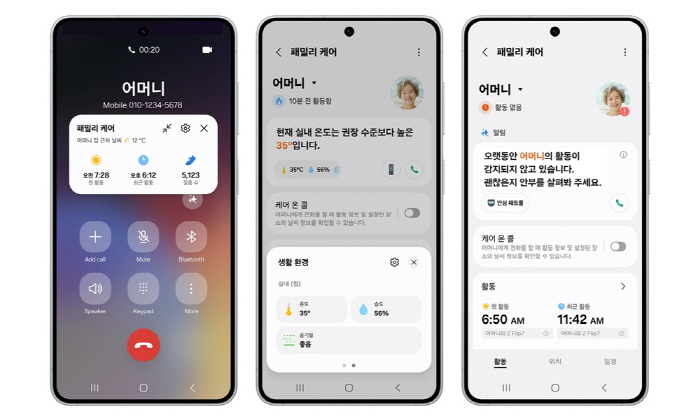
For Samsung Electronics, monitoring centered on Samsung SmartThings, the global smart home platform with more than 460 million subscribers worldwide, is a key focus.
The company recently carried out a major update to Samsung SmartThings and significantly expanded the new features in its Family Care service. Family Care links home appliances and mobile devices through SmartThings to provide activity alerts for family members living apart, reminders for medication and hospital visits, and location-based notifications. It also allows key SmartThings functions to be connected to Now Brief, the personalized briefing service on Samsung Galaxy mobile devices. The update will be rolled out sequentially to televisions released from 2024 onward and Samsung Family Hub refrigerators released from 2021 onward.
When a Family Care user calls a family member living separately, the newly introduced Care On Call feature displays a pop-up screen before the call begins, showing the family member's first activity time, recent activity time, and step count. This helps users respond more effectively if a problem arises. Samsung also added a function that continuously monitors appliances such as air conditioners, air purifiers, dehumidifiers, and humidifiers installed in a family member's home. It checks indoor temperature, humidity, and air quality, and immediately alerts a caregiver if abnormal usage patterns are detected, allowing the device to be controlled remotely. In the case of robot vacuums, if no signs of activity are detected for a certain period, the user receives an alert and a Safe Patrol launch button is activated so they can respond quickly. Through the camera built into the robot vacuum, users can also look for a person lying on the floor, and two-way conversations are possible through the speaker and microphone. In addition, the Care Insights feature has been applied to analyze whether indoor temperature and humidity fall outside appropriate levels or whether there are meaningful changes in activity levels and connected device usage compared with the previous week, then provide an alert.
This monitoring and remote control approach is closely aligned with the goals of Samsung Healthcare, which emphasizes proactive care. On the 19th local time, Samsung Electronics held a panel discussion at VivaTech 2026, Europe's largest startup and tech fair, in Paris, France, under the theme of Connected Care, Samsung Healthcare's vision based on open collaboration. The company made clear that it aims to support healthier and more active lives for more people through proactive care built on a connected ecosystem.
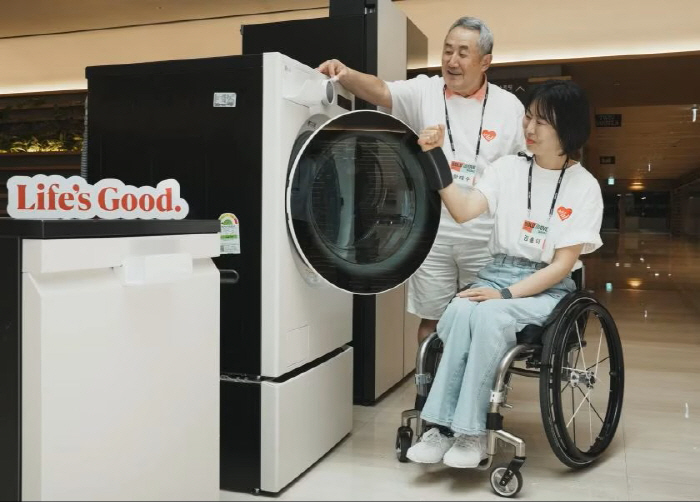
LG Electronics has been rolling out senior-friendly appliances and services focused on helping older adults overcome digital exclusion and improve ease of use.
Earlier this month, in the second season of its customer participation community Bold Move, the company expanded participation beyond customers with disabilities to include seniors and non-disabled customers. In particular, the Bold Move magazine, which introduces the company's brand philosophy and customer participation cases, will highlight the value of inclusive design this year with 'senior' as a key theme. Last month, LG also introduced the LG Comfort Kit, which helps senior and disabled customers with weak hand strength or limited finger dexterity open and close washing machines, dryers, refrigerators, and other appliances more easily.
Previously, LG Electronics launched the senior-tailored LG Easy TV last year, which greatly improved ease of use by enlarging the remote control text and font size and enhancing screen brightness and voice clarity. In March, it expanded the LG Buddy service, which supports family communication features such as video calls and content sharing as well as remote control, to the LG StanbyME 2 and other movable screens. If users press the Help button on the remote in an emergency, they can send a KakaoTalk message asking family members for help. The company also introduced a dedicated application service that lets seniors practice how to use kiosks like a game on a television screen.
An industry official said, "As the traditional home appliance market enters a period of stagnant growth, senior appliances with stronger care services are targeting a niche market," and added, "We believe the expansion of senior residences and AI care will drive this growth going forward."
Kim So-hyung