

[Sportschosun Jang Jong-ho] A large domestic cohort study has found that the type of meat people eat is more closely linked to the risk of dying from certain cancers than the total amount consumed. Among men, higher intake of red meat was associated with a lower risk of death from stomach cancer, while among women, higher intake of organ meats was associated with a higher risk of death from pancreatic and breast cancer.
A joint research team led by Min-sun Park, a professor in the Department of Family Medicine at Seoul National University Hospital, and Yoo In-sun, a professor in the Department of Family Medicine at Ewha Womans University Seoul Hospital, announced on the 25th that it had analyzed the association between intake by meat type and cancer-specific mortality in 147,562 adults aged 40 and older who participated in the Korean Genome and Epidemiology Study (KoGES).
Previous studies have mainly focused on total meat or red meat intake and cancer incidence in Western populations. This is the first domestic study to analyze cancer mortality by meat type in an Asian population.
The team classified meat into four categories: red meat (beef and pork), chicken, organ meats, and processed meat. Red meat, chicken and organ meats were divided into four groups based on intake levels, while processed meat was divided into consumers and non-consumers. The researchers then compared cancer-specific mortality risk after adjusting for age, BMI, smoking, alcohol consumption, education level, physical activity and total energy intake.
The analysis found no significant association between total meat intake and overall cancer mortality in either men or women. However, when the data were examined by meat type, different patterns emerged by sex.
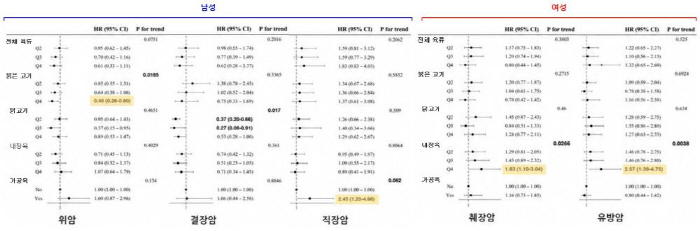
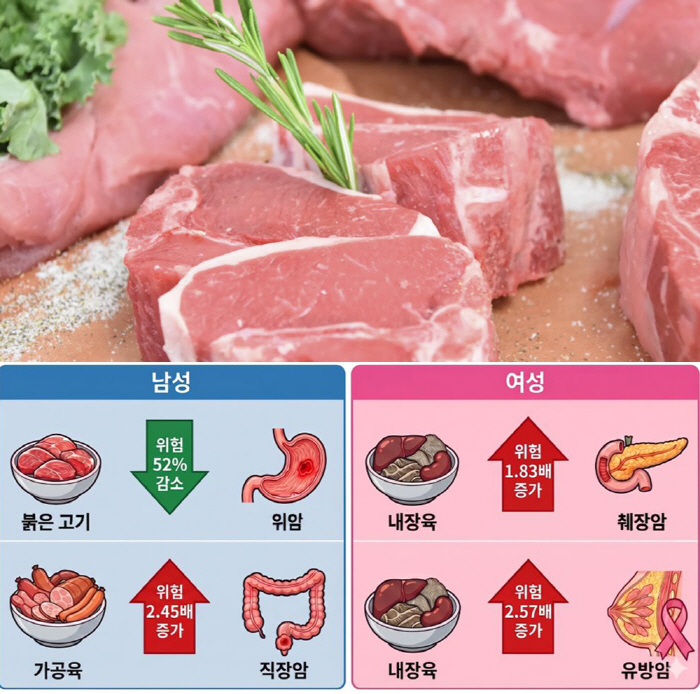
Among men, the group with the highest red meat intake (quartile 4) had a 52% lower risk of dying from stomach cancer than the group with the lowest intake (quartile 1), with a hazard ratio of 0.48. The trend was especially pronounced among men with a body mass index (BMI) below 25 and among those with a history of smoking. By contrast, people who ate processed meat had a 2.45 times higher risk of dying from rectal cancer than those who did not.
Among women, the group with relatively high organ meat intake (quartile 3) had a 2.57 times higher risk of dying from breast cancer and a 1.83 times higher risk of dying from pancreatic cancer than the group with the lowest intake (quartile 1). The association was more pronounced in women aged 60 or older, those with a BMI below 25, and non-smokers.
The research team pointed to Korean eating habits as a possible reason red meat in men was linked to a lower risk of stomach cancer death.
In Korea, most red meat is pork, and it is often consumed grilled rather than salted or smoked, as is more common in the West. As a result, exposure to salt and the composition of fat may differ. The team also suggested that groups with higher meat intake may have had relatively higher socioeconomic status and therefore may have been more likely to undergo stomach cancer screening.
Yoo In-sun, a professor in the Department of Family Medicine at Ewha Womans University Seoul Hospital, said, "Organ meats such as liver and intestines may contain higher levels of heavy metals, including arsenic, cadmium and lead, than ordinary lean meat." She added, "These substances may accumulate in fatty tissue and later be released into the bloodstream during weight changes or aging, potentially affecting women's cancer mortality risk."
Min-sun Park, a professor in the Department of Family Medicine at Seoul National University Hospital, said, "This study shows that the type of meat people eat may be more relevant to cancer health than the total amount of meat consumed." She added, "Rather than applying findings from Western studies directly to Asian populations, a sex-specific approach that takes dietary habits and living conditions into account is needed."
The team noted, however, that because this was an observational study, it is difficult to conclude a direct causal relationship between meat intake and cancer mortality. They added that further research is needed because the study could not account for cooking methods or long-term changes in diet.
The findings were published in a recent issue of the international journal Frontiers in Nutrition.
Jang Jong-ho