

[Sportschosun Reporter Jang Jong-ho] A study has found that the biggest threat to the health of families caring for cancer patients is not simply medical expenses, but 'psychological stress caused by financial hardship.' The study also identified 'social isolation' caused by being tied to caregiving as an independent factor that seriously undermines caregivers' mental health.
A research team led by Jo Bi-ryong of the Department of Family Medicine (FM) at Seoul National University Hospital and Yoo Shin-hye of the Palliative Care and Clinical Ethics Center, in collaboration with Professor Shim Jin-ah of The Catholic University of Korea, announced on the 29th the results of an analysis of 200 family caregivers of patients with advanced cancer. The study examined how financial burden, or financial toxicity, and social networks affect caregivers' health-related quality of life (HRQoL), anxiety and depression, and subjective health status.
As advances in cancer treatment have extended patients' survival, the economic and social burden on families has also grown. NHIS covers 95% of cancer treatment costs, but new anticancer drugs that are not listed for reimbursement must be paid in full by patients, and private caregiving expenses are not covered either. Even so, most studies have focused on patients, while caregivers' health problems have received relatively little attention.
The team used the COST-FACIT questionnaire to measure caregivers' financial burden, dividing it into material burden, such as difficulty paying medical and living expenses, and psychological stress, such as financial worry and a loss of control. Social networks were assessed by the frequency of contact with relatives, neighbors and friends, participation in social activities such as religion, leisure and volunteering, and levels of trust among neighbors. The team then used multivariate logistic regression analysis, controlling for confounding variables such as age, income and patient condition, to calculate the independent effect of each factor.
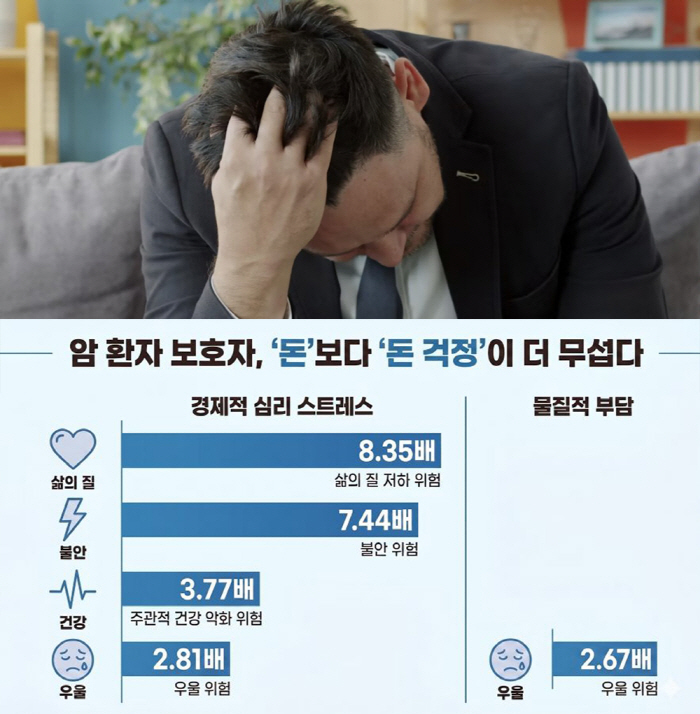
The analysis showed that 'psychological stress' stemming from financial hardship had a much broader and stronger impact on caregivers' health than 'material burden,' which refers simply to actual spending. Caregivers with high psychological stress were 8.35 times more likely to experience a decline in quality of life, 7.44 times more likely to face anxiety, 3.77 times more likely to report worsening subjective health, and 2.81 times more likely to suffer from depression than those without it. By contrast, material burden only raised the risk of depression, by 2.67 times.
'Social isolation' was also an independent factor threatening caregivers' health. Caregivers who had little contact with friends, defined as fewer than two times a month, were 2.36 times more likely to see their quality of life decline. Those who did not participate in social activities were 3.77 times more likely to experience depression, 3.32 times more likely to report worsening subjective health, and 2.49 times more likely to suffer from anxiety.
Conversely, caregivers who maintained social connections tended to experience lower psychological stress from financial hardship, suggesting that social networks may help buffer the impact of financial difficulties.
Professor Shim Jin-ah of The Catholic University of Korea said, "The financial burden on families of cancer patients should be approached not simply as medical expenses, but from the perspective of psychological stress and mental health." She added, "We hope this study will serve as evidence for integrated cancer care and support policies that consider families as well as patients."
Professors Jo Bi-ryong and Yoo Shin-hye of Seoul National University Hospital emphasized, "Families caring for critically ill patients often put their own daily lives and social relationships on hold." They added, "To protect caregivers' quality of life, it is urgent to establish concrete support systems that go beyond financial assistance and help them maintain social connections and support."
The team noted that this study has limitations in establishing causality and generalizing the findings because it was a single-center cross-sectional study, and that further longitudinal research is needed.
Meanwhile, the study was supported by the MOHW's Patient-Centered Medical Technology Optimization Research Project and was published in the latest issue of the international journal, the Journal of the National Comprehensive Cancer Network (JNCCN, IF 17.5).
Jang Jong-ho, bellho@sportschosun.com