

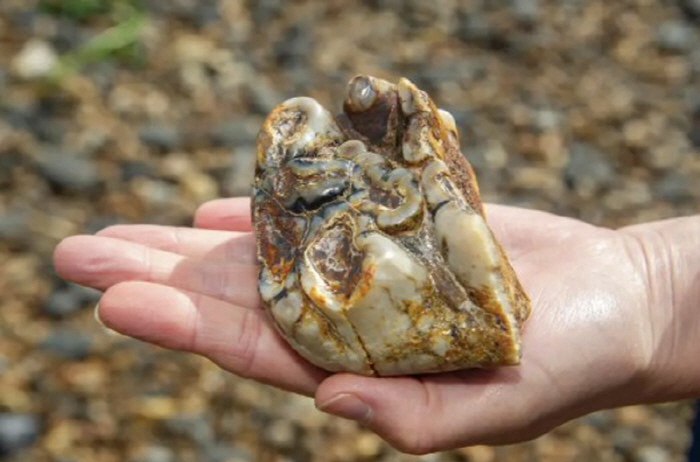
[Sportschosun, Jang Jong-ho] An 11-year-old boy who was walking with his family on a beach in Britain has drawn attention after accidentally discovering a fossilized tooth from an extinct elephant that lived about 1.8 million years ago.
According to foreign media outlets including SWNS and the New York Post, Charlie Orchard Risl, 11, was walking along East Lane Beach in Suffolk, England, when he recently spotted a stone-like object on the shore.
The boy's mother said, "We were walking along the beach as the waves came in when he noticed an object that stood out," adding, "It felt different from a stone, and I could tell right away that it was something special."
An expert assessment later confirmed that the object was the left upper molar of Anancus arvernensis, an extinct elephant that lived in Europe about 1.8 million years ago.
Anancus arvernensis was an ancient elephant related to today's African elephant. It is believed to have lived across Europe and western Asia about 2 million to 1.5 million years ago before going extinct.
The Natural History Museum, London, confirmed that the tooth was indeed a molar from Anancus arvernensis.
The fossil is about 10 cm wide, and the enamel on its surface was relatively well preserved after undergoing mineralization over a long period of time.
Experts believe the fossil broke away from a rock layer through erosion and was then washed onto the beach by waves.
What is remarkable is the conversation that took place just before the discovery.
Eleanor said, "Just 10 minutes before we walked on the beach, my son was saying that he really loves elephants," adding, "I never imagined that we would then find a tooth from an elephant that lived 1.8 million years ago."
She added, "I still can't believe that traces of an animal that roamed the Earth 1.8 million years ago could appear right there on the beach."
Experts explained that the East Coast of England is known for active coastal erosion, which often exposes ancient fossils, but it is extremely rare for a member of the public to accidentally find a well-preserved tooth from a large mammal like this.
Jang Jong-ho, bellho@sportschosun.com