


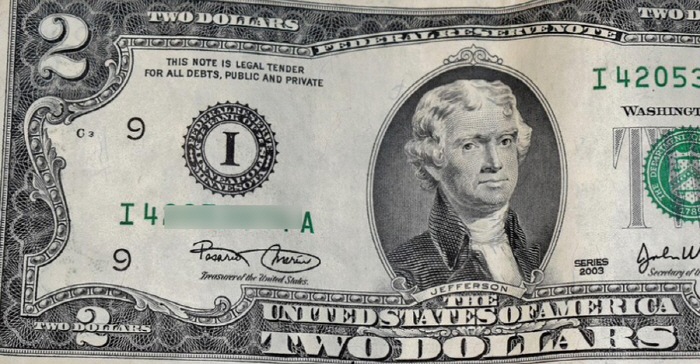
[Sportschosun reporter Jang Jong-ho] As the U.S. Department of the Treasury has effectively decided to stop new printing of the two-dollar bill this year, attention is turning to its scarcity and collectible value. Once seen as a "lucky bill," the two-dollar bill is drawing renewed interest after long being treated as "fake money" because it is rarely used.
According to U.S. media outlets including the New York Post, the Federal Reserve System (Fed), the U.S. central bank, set this year's printing order for two-dollar bills at "zero." That means there are no plans for new printing.
About 1.8 billion two-dollar bills are currently in circulation in the United States, the highest level in the past 20 years. About 2.4 billion $10 bills and about 3.7 billion $5 bills are also in circulation, suggesting that the relatively little-used two-dollar bill has been pushed down the priority list.
The two-dollar bill reappeared in 1976, the 200th anniversary of U.S. independence. Printing had been suspended for 10 years starting in 1966, and as its scarcity grew, people began to keep and collect the bills rather than spend them. As usage declined, demand to replace damaged bills also fell, reducing the need for additional printing.
Even so, the two-dollar bill holds a unique place in U.S. monetary history. Except for the 1966-1976 suspension period, it has been issued steadily for about 160 years. But because it is used so rarely, many Americans still find it unfamiliar.
On online communities, posts have appeared saying, "If you tip with a two-dollar bill, half the people like it, but the other half think it's counterfeit," or "I had to explain to retail workers that it is legal U.S. currency."
Some members of Generation Z (Gen Z) have also shared stories of being suspected of using counterfeit money when they tried to spend the bill in stores.
Still, expectations of a so-called out-of-print effect are also emerging. According to a U.S. currency collecting website, rare-year or well-preserved two-dollar bills can sell for hundreds to thousands of dollars. As of 2023, circulated bills were valued at an average of $2 to $2,500, while uncirculated examples have reportedly fetched as much as $4,500, or about 6.8 million won.
The figure printed on the U.S. two-dollar bill is Thomas Jefferson, the third president of the United States from 1801 to 1809. The back features an image of the signing of the Declaration of Independence.
Meanwhile, the United States Mint is scheduled to unveil coins with special designs next month on the 4th, local time, to mark the nation's 250th anniversary. The one-cent coin will be excluded, but new designs will be applied to the 10-cent, 25-cent, and 50-cent coins.
There have also been claims that the U.S. Department of the Treasury is considering producing a $250 bill featuring President Donald Trump's face and signature, but that has not been officially confirmed.
Jang Jong-ho, bellho@sportschosun.com