


[Sportschosun Jang Jong-ho] Common shoulder stiffness and neck pain in modern life may not be caused by simple fatigue alone.
The neck and shoulders are anatomically closely connected, so problems in the cervical spine often lead to pain that spreads to the shoulders. In particular, prolonged computer work or smartphone use, which keeps the head bent forward, places excessive strain on the cervical spine. If shoulder stiffness does not improve easily or pain in one shoulder keeps coming back, it may be an early sign of a cervical disc problem rather than simple muscle pain.
A healthy neck maintains a gentle C-shaped curve when viewed from the side. However, repeatedly leaning the head forward while looking at a smartphone or using a computer can cause forward head posture or a straight neck. The head weighs about 4 to 6 kilograms, and the load on the neck increases sharply as the head bends forward. If this condition continues for a long time, it can lead to chronic muscle tension around the neck, faster disc degeneration, and nerve compression.
In the early stages of a cervical disc problem, patients often feel stiffness in the back of the neck, shoulder tightness, and pain inside the shoulder blade. People often think of arm numbness or hand numbness first when they hear “herniated disc,” but depending on the disc location and the nerve root being compressed, pain may appear only in the trapezius area or inside the shoulder blade. Because the nerve roots from the cervical spine form pathways to the shoulders, arms, and hands, the real problem may be in the neck even though the pain first appears around the shoulder or shoulder blade.
Some patients also experience nerve symptoms such as numbness in the arm or fingers, and if nerve compression becomes more severe, arm strength may decline. Therefore, if trapezius pain or pain inside one shoulder blade persists for a long time, it should not be dismissed as simple muscle pain. It is important to check whether a cervical spine disorder is involved.
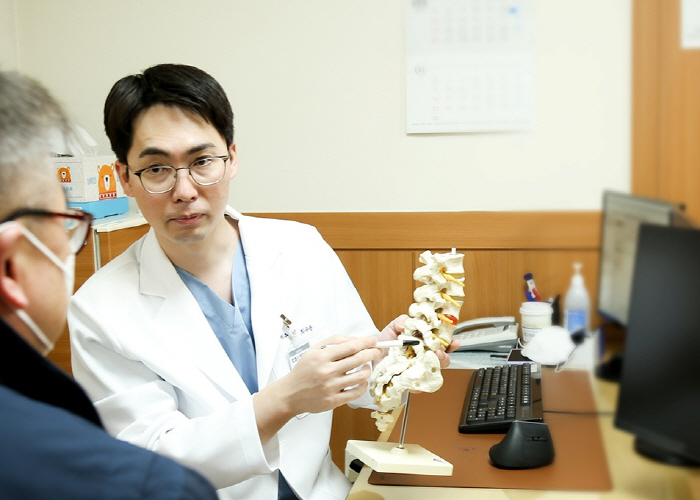
“Simple trapezius pain and cervical disc pain can be hard to tell apart. Pain caused by muscle fatigue usually improves relatively well with rest and is often broad and dull,” said Choi Soo-yong, head of the Spine Center at Seran General Hospital. “By contrast, early cervical disc pain often persists on one side of the neck, shoulder, or around the shoulder blade, and it worsens when the neck is bent backward or turned in a certain direction. In some patients, the pain can also spread to the shoulder and arm, or be accompanied by numbness.”
“In the early stages, treatment usually includes medication and physical therapy to relieve and relax muscle tension, and exercise therapy may be prescribed when necessary. However, if arm strength continues to weaken or severe nerve compression is confirmed, surgery may be considered,” Choi said. “If a cervical disc problem is detected early, most patients can expect improvement with non-surgical treatment and lifestyle changes alone. That is why it is important not to ignore recurring symptoms and to receive an accurate diagnosis.”
Jang Jong-ho, bellho@sportschosun.com