

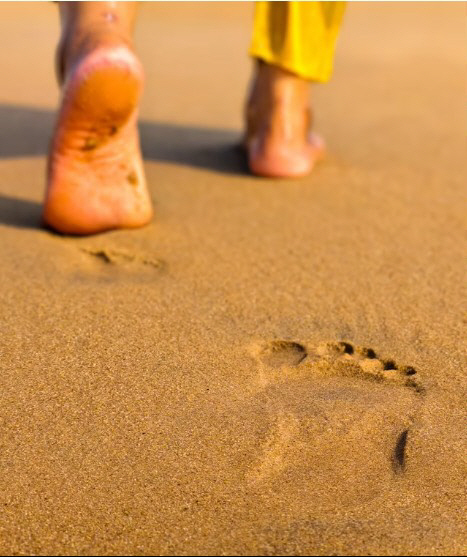
[Sportschosun, Jang Jong-ho] More people are walking barefoot on the red clay and dirt paths in parks. As awareness grows that walking with bare feet on the ground can improve blood circulation and benefit health, more related trails are being built.
However, experts say barefoot walking is not a good exercise for everyone. Depending on the condition of the feet, it can instead cause pain or injury.
Seo Jae-hyun, head of the Joint Center at Suwon Nanuri Hospital, said, "Rather than overgeneralizing the benefits of barefoot walking, it is important to first check the condition of your own feet." He added, "People whose foot function has weakened should be especially careful."
A typical example is patients who have had diabetes for a long time and have reduced sensation in their feet. They are advised to avoid barefoot walking.
As diabetic neuropathy progresses, many patients do not feel pain even when wounds develop on the soles of their feet, raising the risk of infection or ulcers.
Barefoot walking is also not recommended for older adults who develop sole pain as they age. As the fat layer under the foot becomes thinner and skin elasticity declines, the foot's ability to absorb impact decreases. In that condition, walking barefoot for long periods can place greater strain on the plantar fascia and joints.
On the other hand, barefoot walking may help people who do not have any specific foot disease and feel no pain or discomfort while walking.
It allows them to directly experience a variety of ground sensations that are hard to feel through shoes. That can activate the small muscles and sensory function of the feet and may also help improve balance.
Still, the duration of exercise should be properly controlled. Seo said, "Even if your feet are healthy, walking for more than an hour at a time can be excessive stimulation." He added, "It is better to start lightly for about 20 to 30 minutes and check the condition of your feet."
Choosing a safe place is also important. Broken glass, shells, and sharp stones can cause deep injuries to the soles of the feet.
In particular, because wounds on the sole, where body weight is concentrated, are not easy to heal, it is better to use well-maintained red clay paths, dirt paths, or dedicated walking trails.
More important than barefoot walking itself is the habit of maintaining foot flexibility and strength.
In fact, stretching and muscle-strengthening exercises are the basics for maintaining foot health.
One of the easiest methods is toe interlocking stretches. Insert your fingers between your toes, then slowly rotate the ankle or spread the toes for 30 seconds to one minute. This helps loosen the toe joints and small muscles.
Plantar fascia stretching is also effective. Sit in a chair, place one leg over the opposite knee, and slowly pull the toes toward your body until you feel a stretch in the sole. Hold it while breathing five times, counting slowly to three, then release. Repeating this three to five times on each side helps relieve tension in the plantar fascia.
Calf and Achilles tendon stretches should not be overlooked either. Place only the front part of your foot on the edge of a stair and slowly lower your heel. This naturally stretches the calf muscles and Achilles tendon. Holding the position for about 15 seconds and then rising again can help improve ankle flexibility and walking function. Alternating between a straight knee and a slightly bent knee can relax the calf muscles and Achilles tendon more effectively.
Especially after a day of a lot of walking, pulling a towel with your toes can strengthen the small muscles in the sole. Resting with your legs raised against a wall can also help reduce swelling and improve blood circulation.
Seo said, "Barefoot walking can be a good stimulus for people with healthy feet, but it should not be seen as a treatment or a cure-all for health." He added, "The key to foot health is not walking barefoot for long periods, but steadily maintaining flexibility and strength." He also advised, "Even simple stretching before and after walking can greatly reduce strain on the feet and help prevent pain."
Jang Jong-ho, bellho@sportschosun.com