

[Sportschosun Jang Jong-ho] A woman who wore a full-face UV-protection item to avoid strong sunlight ended up in the hospital after developing a skin rash and itching.
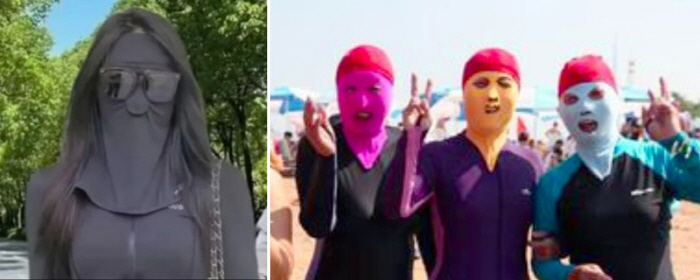
According to the South China Morning Post (SCMP), a woman identified as A, who lives in Jiangsu Province, recently applied sunscreen and then wore a hat and a mask-style UV-protection item that covered her entire face while traveling to minimize sun exposure. The product, which leaves only the eye area exposed and covers most of the face, has become a popular UV-protection item in China.
After finishing her day, however, she felt a burning sensation in her face and noticed that her skin had turned red. The next day, she developed a rash with itching across her face and went to the hospital.
Medical staff who examined her said it was a typical skin irritation reaction caused by excessive physical UV protection. They explained that her facial skin had been sealed for a long period and exposed to high heat and humidity, damaging the skin barrier.
In recent years, products designed to protect skin from strong ultraviolet rays have been launched one after another not only in China but also in South Korea. In particular, one-piece hat-and-mask products that cover the entire face except for the eye area are proving especially popular on online shopping malls.
These products are marketed as offering 'full-coverage UV protection' and highlight a range of features, such as cooling materials and improved designs that prevent makeup from smudging. Some products are also advertised as providing moisturizing benefits by using fabric infused with hyaluronic acid.
Such face-covering items are known in China as Facekini. The term originally referred to colorful full-face masks worn by middle-aged women at Chinese beaches more than 10 years ago, but it is now used as a general term for various types of UV-protection masks.
Experts point out that covering the entire face for long periods can trigger dermatitis or allergic reactions, and that reduced sunlight exposure may also lower vitamin D production. They also advise using breathable hats or parasols during the hot summer months and reducing outdoor activity between 10 a.m. and 4 p.m., when UV rays are strongest. If skin irritation or a rash occurs, they add, users should stop using the product immediately and seek medical attention.
Jang Jong-ho, bellho@sportschosun.com