


[Sportschosun Reporter Jang Jong-ho] A large real-world study has found that clopidogrel, an antiplatelet drug used as long-term maintenance therapy after coronary stent procedures (PCI), lowers the risk of both cardiovascular events and major bleeding more than aspirin, which had long been considered the standard treatment.
A research team led by Professors Jung Young-hoon and Jo Jun-hwan from the Cardiology Department at Chung-Ang University Gwangmyeong Hospital, headed by Director Jeong Yong-hoon, analyzed 133,454 patients who underwent stent procedures using South Korea's health insurance big data. The team found that in patients who had entered the stable phase after the procedure, clopidogrel monotherapy significantly reduced the risk of major cardiovascular events and major bleeding compared with aspirin monotherapy.
Patients with angina or myocardial infarction are kept on dual antiplatelet therapy (DAPT), which combines aspirin and a P2Y12 inhibitor, for a certain period after stent implantation to prevent thrombotic complications. They then continue with single antiplatelet therapy as long-term maintenance, but debate has continued over which drug is more effective and safer.
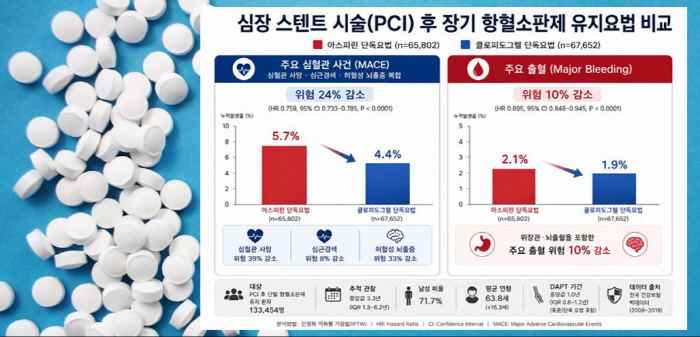
The research team tracked about 590,000 patients who underwent the procedure from 2009 to 2019 using big data from the National Health Insurance Service (NHIS). Among them, 133,454 patients who had maintained DAPT for a set period and then continued on either clopidogrel or aspirin monotherapy were selected for the final analysis. Of these, 67,652 were in the clopidogrel group and 65,802 in the aspirin group, and clinical outcomes were observed for up to 10 years.
The analysis showed that the incidence of major cardiovascular events, including cardiovascular death, myocardial infarction and ischemic stroke, was 4.4% in the clopidogrel group, lower than 5.7% in the aspirin group, indicating about a 24% reduction in risk with clopidogrel. The rate of major bleeding was also significantly lower in the clopidogrel group at 1.9%, compared with 2.1% in the aspirin group. More specifically, the risk of cardiovascular death fell by 39%, ischemic stroke by 33%, and myocardial infarction by 8%. The risk of major gastrointestinal and intracranial bleeding also declined by about 10%.
The effect was especially consistent in both patients with myocardial infarction and those with stable angina, and it remained the same regardless of the duration of dual antiplatelet therapy.
Professor Jung Young-hoon said, "This study shows that clopidogrel may be superior to aspirin in both preventing ischemic events and reducing bleeding risk." He added, "It is particularly meaningful because recent meta-analyses were based on about 30,000 patients, while this study followed more than four times that number over the long term."
Professor Jo Jun-hwan said, "This study examined long-term outcomes for up to 10 years in a large Korean population in a real-world setting." He noted, "We expect it to serve as important evidence for establishing personalized antiplatelet treatment guidelines in Korea that comprehensively consider both ischemic and bleeding risks."
Meanwhile, the findings were recently published in the international cardiovascular journal JACC Asia (Journal of the American College of Cardiology: Asia).
Reporter Jang Jong-ho bellho@sportschosun.com