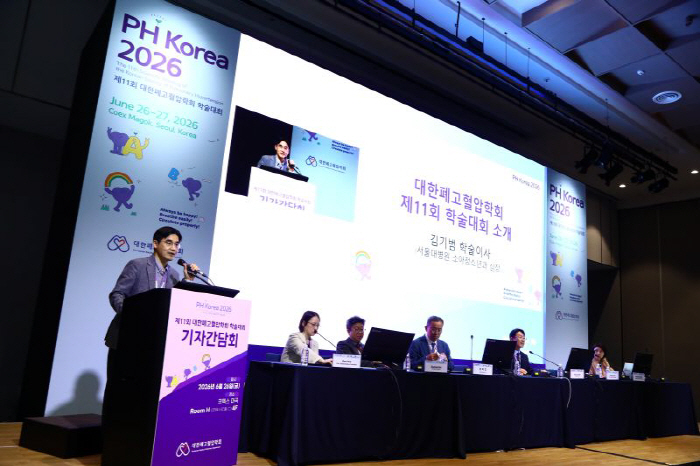


[Sportschosun reporter Jang Jong-ho] The Korean Society of Pulmonary Hypertension, led by President Jung Wook-jin, held the 11th Korean Society of Pulmonary Hypertension Congress (PH Korea 2026) at COEX Magok in Seoul on the 26th.
At the event, the society unveiled key policy tasks aimed at improving the domestic treatment environment for pulmonary hypertension and raising patient survival rates, along with its first clinical guideline since its founding.
The congress was held under the slogan, "Always be happy! Breathe easily! Circulate properly!" Pulmonary hypertension experts from Korea, the United States, Germany, Australia, Japan, Taiwan, and China attended to share the latest research findings and treatment strategies, and to discuss ways to overcome the disease.
In his welcome remarks, President Jung Wook-jin, a cardiologist at Gachon University College of Medicine, said, "PH Korea 2026, now in its 11th year, is a meaningful venue where domestic and international experts share the latest knowledge on pulmonary hypertension treatment and explore ways to cooperate." He added, "Treatment outcomes for patients with pulmonary hypertension in Korea have steadily improved, but there is still much room for improvement in access to new drugs and institutional support. I hope a system will be established in which the medical community, the government, and patients work together to improve survival rates and quality of life."
In the following presentation session, speakers outlined major tasks for improving the domestic pulmonary hypertension care environment.
Kim Ki-beom, academic affairs director at Seoul National University College of Medicine, gave the first presentation and introduced the significance of the 11th congress. He said, "This congress is a place where global experts share treatment experiences and research results from their respective countries, and we are discussing diagnostic and treatment strategies better suited to patients in Asia." He added, "Beyond academic exchange, I expect this will serve as an opportunity to further strengthen multidisciplinary cooperation at home and abroad."
The second speaker, Kim Gye-hoon, the incoming president from Chonnam National University Medical School, presented on the need for rapid drug introduction and insurance coverage.
Kim stressed that approval and health insurance listing procedures need to be operated more efficiently so that therapies proven clinically effective and safe overseas can be made available to Korean patients in a timely manner.
He specifically explained the need for the swift introduction and insurance coverage of Winrevair, a treatment for pulmonary arterial hypertension (PAH) with the active ingredient sotatercept; Veletri, with the active ingredient epoprostenol; Tyvaso, a treatment for interstitial lung disease-associated pulmonary hypertension (ILD-PH) with the active ingredient treprostinil; and Adempas, a treatment for chronic thromboembolic pulmonary hypertension (CTEPH) with the active ingredient riociguat.
Kim Dae-hee, the society's general affairs director from University of Ulsan College of Medicine, gave the third presentation on strengthening coverage for pulmonary hypertension patients through revisions to the Korean Standard Classification of Diseases (KCD).
Kim said, "The current disease classification system has limitations in that it does not fully reflect the clinical characteristics and disease burden of pulmonary hypertension patients." He added, "By revising the KCD, we need to systematize and clarify the classification of pulmonary hypertension-related diseases, thereby improving patients' access to care and strengthening health insurance coverage."
He also noted, "Reorganizing a classification system that fits the characteristics of the disease will also serve as an important foundation for advancing the national patient management system."
Finally, Kim Kyung-hee, chair of the guideline committee at Incheon Sejong General Hospital, outlined the direction for the society's first official pulmonary hypertension guideline and its publication plan.
Kim explained, "Pulmonary hypertension is a rare and intractable disease, and large-scale clinical evidence is limited, so we were cautious in waiting for Korean data to accumulate in order to secure the level of evidence behind our recommendations." She added, "In particular, current health insurance reimbursement standards differ greatly from international standards, and some therapies with proven clinical efficacy are still not reimbursed. Rather than applying overseas guidelines as they are, we sought to develop a Korean guideline that reflects the domestic diagnostic and treatment environment and use it as evidence for improving reimbursement standards."
She continued, "Through this process, we completed the development of the first guideline and plan to go through the society's approval process by mid-September." She also presented the schedule, including finalizing the Korean version and submitting the English version by mid-October, formally releasing the Korean printed edition during the Korean Society of Cardiology conference in November, and jointly publishing the English version in a domestic and international academic journal in January next year.
Kim said, "Today is a session to share the key direction and publication roadmap, and the formal announcement will take place in November." She added, "I hope the guideline will be used as evidence for clinical standardization and for improving reimbursement standards to meet international levels."
In the Q&A session that followed, participants discussed policy support to improve the domestic treatment environment for pulmonary hypertension, expand access to new drugs, and improve the care system.
Closing the meeting, Jung said, "Creating an environment in which pulmonary hypertension patients can be diagnosed more quickly and receive appropriate treatment is the society's most important goal." He added, "Going forward, the society will continue to work to improve patient survival rates by expanding access to new drugs, strengthening coverage, and standardizing care. In addition, based on the PHOENIKS precision medicine long-term cohort, which has been conducted for nine years with the Cardiovascular Disease Division of the Korea Disease Control and Prevention Agency (KDCA) National Institute of Health, we will seek to extend and deepen our efforts so that we can take one more step toward overcoming pulmonary hypertension."
In addition, the 12th Korean Society of Pulmonary Hypertension Congress (PH Korea 2027) and the 7th East Asia Pulmonary Hypertension Society Congress (EASOPH) are scheduled to be held at COEX Magok on June 18-19 next year, marking the society's 10th anniversary.
Pulmonary hypertension is a severe, rare, and intractable disease that affects about 1% of the global population, and the number of patients in Korea is estimated at around 500,000. Among them, pulmonary arterial hypertension (PAH), which falls under WHO Group 1, is estimated at about 6,000 cases.
The five-year survival rate for patients with pulmonary arterial hypertension in Korea is about 71.8%, and the average survival period is 13.1 years. While this is a major improvement from the past, there is still room for improvement compared with major advanced countries such as Japan.
Because the early symptoms are nonspecific, diagnosis is often delayed. In addition, the domestic introduction of some innovative therapies and their reimbursement coverage remain limited, creating a need for institutional support to improve patients' access to treatment.
Jang Jong-ho, bellho@sportschosun.com