

Sports tourism is being reexamined as an industry model that drives local economies, moving beyond simple leisure travel. Unlike in the past, when it was limited to watching games or taking part in sports activities, it is now rapidly expanding into long-stay tourism that combines lodging, experiences and education. This reflects a shift in the sports tourism paradigm.
Until now, sports tourism has largely involved traveling to watch games or participate in sports activities. Recently, however, its character has changed as complex experiences centered on sports have become more important than the activities themselves. Some observers say sports tourism is no longer about sports as the destination, but about staying and spending through sports as the medium. Participation in sports has become a basic element, and the field is expanding into complex content that combines tourism. Sports tourism is also becoming more segmented. Representative examples include 'sportcation,' which combines vacation and sports; 'sporteducation,' which combines education; and 'sportstainment,' which combines entertainment. This shows that sports tourism is evolving beyond a simple leisure activity into a lifestyle content industry.
Tourism experts point to long-stay infrastructure as the key factor determining the success or failure of sports tourism. They say that infrastructure capable of encouraging extended stays, such as lodging, transportation and linked programs, is more important than tourism content itself.
In particular, while developing region-specific content is relatively easy, building infrastructure that includes lodging, transportation and multi-purpose facilities requires cooperation between local governments and the private sector. Of course, expanding long-stay infrastructure is not easy for local governments. Budget securing, legal procedures and conflicts with local residents are all intertwined as complex challenges.
Even so, the importance of securing long-stay infrastructure can be seen through overseas examples. It is also regarded as an attractive alternative for revitalizing local economies by increasing the time visitors spend in a region, not only through sports tourism but also through broader stays by outsiders. In fact, overseas cases of customized urban regeneration centered on long-stay infrastructure are increasing, and efforts to convert existing idle facilities into long-stay tourism infrastructure are continuing.
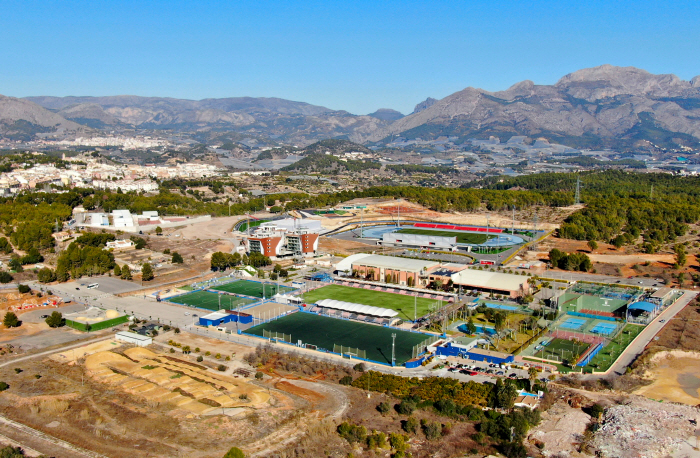
Camilo Cano Sports City, located in La Nucia, a small city in Alicante Province, Spain, is one of Europe’s sports tourism facilities. It is used as a training camp and competition venue for international professional teams and youth academies. Behind this is an assessment that development strategies reflecting consumer needs, including the creation of long-stay infrastructure, have proven effective. Well-equipped long-stay infrastructure is leading to a steady influx of visitors.
Melgaço, in the far north of Portugal, is also classified as a place where visitors can enjoy a sportcation, thanks to the combination of various training facilities and long-stay infrastructure. Melgaço is generating tourism revenue by combining athlete-focused infrastructure with local nature activities. Visitors can enjoy a wide range of sports, including rafting programs that take advantage of the Minho River’s abundant water and rapids, as well as canoeing, canyoning and mountain biking. While professional athletes train, accompanying family members and general leisure travelers can stay in the city for at least a week and enjoy nature, creating what amounts to a long-stay ecosystem.
Echigo-Tsumari, a small city in Niigata Prefecture with a population of 70,000, is running the art project 'Echigo-Tsumari Art Triennale' and is regarded as a successful case of urban regeneration through long-stay infrastructure built by repurposing closed schools and vacant homes. In the 1990s, it faced the risk of community collapse due to population decline and aging, but it has turned vacant houses and closed schools into sustainable long-stay infrastructure and now plays a central role in local tourism. Echigo-Tsumari is also presenting content that combines sports events with its long-stay infrastructure, such as linking the art festival with mountain trail running competitions.
An official in the tourism industry said, "Recently, more major local governments in Korea have been trying to use tourism as a tool to revitalize local economies and as a response to the risk of regional extinction," adding, "They are carrying out various tourism marketing activities, including sports marketing, but it is true that interest in long-stay infrastructure has not been very high." The official continued, "Long-stay infrastructure does not necessarily have to mean a large-scale facility that requires a huge budget," and added, "It is also worth considering ways to transform idle local assets such as closed schools and vacant homes into long-stay spaces by combining them with cultural elements or sports content that reflect local characteristics."
Tourism experts believe that the future competitiveness of sports tourism will depend not on the size of stadiums or whether a major event can be hosted, but on how much it can extend visitors' stays. They say that building a long-stay tourism ecosystem that goes beyond simple visits and leads to lodging, spending and cultural experiences is emerging as a key task for revitalizing local economies.
Kim Se-hyung, fax123@sportschosun.com