


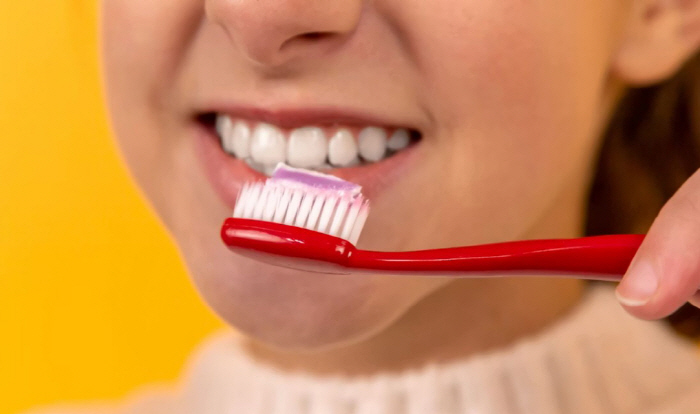
[Sportschosun reporter Jang Jong-ho] An expert has suggested that using your non-dominant hand while brushing your teeth could help prevent dementia.
According to the New York Post, Dr. Neil K. Shah, the lead researcher of a study supported by the National Institutes of Health (NIH), recently urged people on social media to "try using your non-dominant hand on purpose in daily life."
He used toothbrushing as an example.
For most adults, brushing their teeth is an automatic action they perform without much thought. Because they have repeated it for years, the brain has already learned the movement, and the muscles work almost unconsciously.
But switching hands changes the situation. Because the familiar motion must be carried out in a new way, the brain has to draw on more concentration and planning. Shah explained that this process activates several brain regions involved in motor control, attention and coordination.
Experts say this kind of stimulation may promote neuroplasticity. Neuroplasticity refers to the strengthening and reorganization of connections between brain cells through new experiences and learning.
Shah said that "cross-lateral movement," which uses the opposite side of the body from usual, can activate broad brain networks involved in attention, memory and motor control.
Such stimulation becomes even more important with age. The brain's ability to maintain function despite changes linked to aging, dementia and Alzheimer's disease (AD) is known as cognitive reserve. People with higher cognitive reserve tend to show symptoms later.
Experts say building cognitive reserve does not necessarily require expensive programs or special treatment. Learning new skills, exercising regularly, taking part in social activities and adding new challenges to familiar routines can all help.
In fact, several studies have reported that learning a foreign language may have a positive effect on long-term brain health. Natalie Phillips, a professor in the Department of Psychology at Concordia University in Montreal, Canada, said, "Older adults who use two or more languages show clear benefits against dementia."
A Japanese research team also reported that the risk of dementia could fall by as much as nearly 70% among older adults who cook at home. The effect was especially strong among those with less cooking experience who had to learn new preparation processes.
Experts advise that the brain, like a muscle, grows when it receives new stimulation, and that small changes in daily life can help maintain long-term cognitive health.
Jang Jong-ho, bellho@sportschosun.com