

[Sportschosun Jang Jong-ho] Gachon University Gil Hospital, led by President Kim Woo-kyung, saved a patient with a critical cardiovascular condition that occurred in Baengnyeongdo through a rapid transfer and emergency surgery.
The case once again demonstrated the importance of the Incheon Island Emergency Critical Care Cooperation System and multidisciplinary collaboration.
Oh, a 67-year-old woman living in Baengnyeongdo, suddenly felt severe chest pain and shortness of breath while dining with acquaintances on the evening of the 7th. At first, she thought it was simple indigestion, but when the pain continued, she went to a nearby hospital.
Medical staff at Baengnyeong Hospital immediately performed a computed tomography (CT) scan and diagnosed her with Acute Aortic Dissection, a life-threatening emergency. Aortic dissection occurs when the inner lining of the aorta, the body's largest artery that carries blood from the heart, tears and the vessel wall separates. If treatment is delayed, the condition carries a high risk of death.
The medical team determined that the patient was in extremely critical condition and immediately requested a firefighting helicopter. She was transferred to Gachon University Gil Hospital at around 12:10 a.m. on the 8th after an emergency transport process that involved both sea and land.
At the time, the dissection had spread beyond a simple aortic tear to the vessels leading to the brain and to the abdominal aorta. It was also accompanied by aortic valve regurgitation and bleeding into the pericardium, creating a situation that could have led to brain damage or worsening heart function.
Professor Choo Seung-hwa's emergency medicine team judged the patient's condition to be severe and quickly contacted Professor Park Cheol-hyeon of cardiothoracic surgery.
Professor Park Cheol-hyeon and the surgical team, including Professor Lee Ji-yeon of anesthesiology and pain medicine, performed an aortic graft replacement surgery to replace the dissected aorta with an artificial blood vessel. In the early hours of a weekend, while everyone else was asleep, the patient fought for her life on the brink of death and was able to greet the morning with hope thanks to the medical team's swift collaboration and surgery.
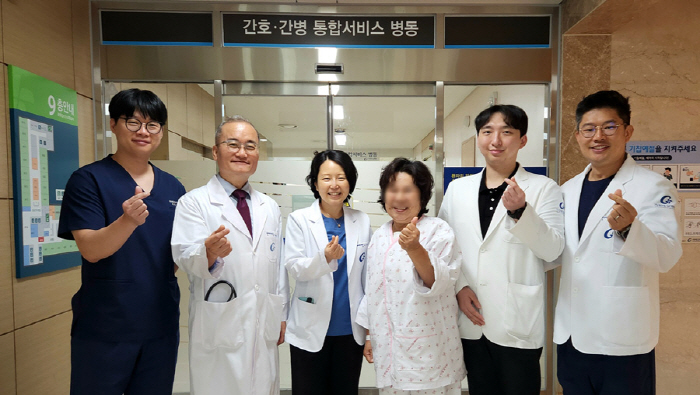
Oh said, "I was in such an urgent condition that I was told something could go wrong during the transfer when I had to go to the mainland at night for surgery. I am truly grateful to Baengnyeong Hospital for accurately diagnosing my difficult illness, to the firefighters who transferred me quickly at night, and to all the Gachon University Gil Hospital medical staff who operated and treated me promptly even in the early hours of a weekend." She was discharged on the 22nd after recovering from surgery.
Professor Park Cheol-hyeon said, "Aortic dissection is a representative emergency in which time after onset directly determines survival rates," adding, "This case was one in which the patient's life was saved through the combined efforts of Baengnyeong Hospital's rapid diagnosis and transfer decision, firefighting helicopter transport, and the immediate collaboration of Gachon University Gil Hospital's emergency medicine and surgical teams."
He added, "In particular, the patient was in a very critical condition, with cerebral vessel dissection, aortic valve regurgitation, and pericardial bleeding, so even a slight delay in treatment would have made resuscitation difficult."
This case is regarded as a representative example of how the treatment system for critically ill emergency patients in Incheon's island areas worked effectively in the field. As the Incheon Regional Responsible Medical Institution, Gachon University Gil Hospital maintains a close partnership with Baengnyeong Hospital to improve medical access for residents of the island areas, including Baengnyeongdo, the farthest island from Incheon.
As part of the Public Health and Medical Cooperation System Establishment Project for 2026, the hospital is promoting critical emergency transfer, referral, and treatment cooperation projects. It also visited the area on May 13 last month to hold a meeting with Baengnyeong Hospital medical staff, maintaining a year-round cooperation system.
Gachon University Gil Hospital also operates the country's first public-private partnership emergency medical Doctor helicopter, playing an important role in transferring emergency patients from medically underserved areas, including the Five West Sea Islands. It also runs a Remote Consultation System with Baengnyeong Hospital, allowing local medical staff to receive specialist advice when treating critically ill patients.
Kim Woo-kyung, president of Gachon University Gil Hospital, said, "We are continuously strengthening our emergency transfer and treatment cooperation system so that island residents do not miss the right time for treatment because of geographic limitations," adding, "Even after the patient is discharged, we plan to refer her to local health and welfare institutions and monitor her recovery."
Meanwhile, the main symptoms of aortic dissection include sudden, severe chest pain, back pain, and shortness of breath. Medical staff urged people not to dismiss such symptoms as simple indigestion or muscle pain, but to visit an emergency medical institution immediately for treatment.
Jang Jong-ho, bellho@sportschosun.com