

[Sportschosun Reporter Jang Jong-ho] Four in 10 adults use generative AI every day, and about one in five experience withdrawal symptoms when they cannot use it.
The Addiction Forum, led by Shin Young-cheol, and a research team headed by Professor Cho Seon-jin of The Catholic University of Korea said they recently surveyed 500 adults who had used generative AI within the past month to examine usage patterns and the impact on mental health. The study, titled "Generative AI Use Experience and Mental Health: A Survey on AI Literacy and Perceptions of Mental Health," was released at the forum's 14th anniversary seminar.
The survey was conducted to comprehensively examine generative AI usage behavior, perceptions of its benefits and side effects, psychological distress such as depression, anxiety and loneliness, and factors related to dependence on generative AI. It was also designed to provide baseline data for future policies to improve AI literacy and protect mental health. MicroMill Embrain carried out the online survey from May 13 to May 26, 2026, targeting 500 generative AI users nationwide aged 20 to 64.
◇ Four in 10 users use AI almost every day
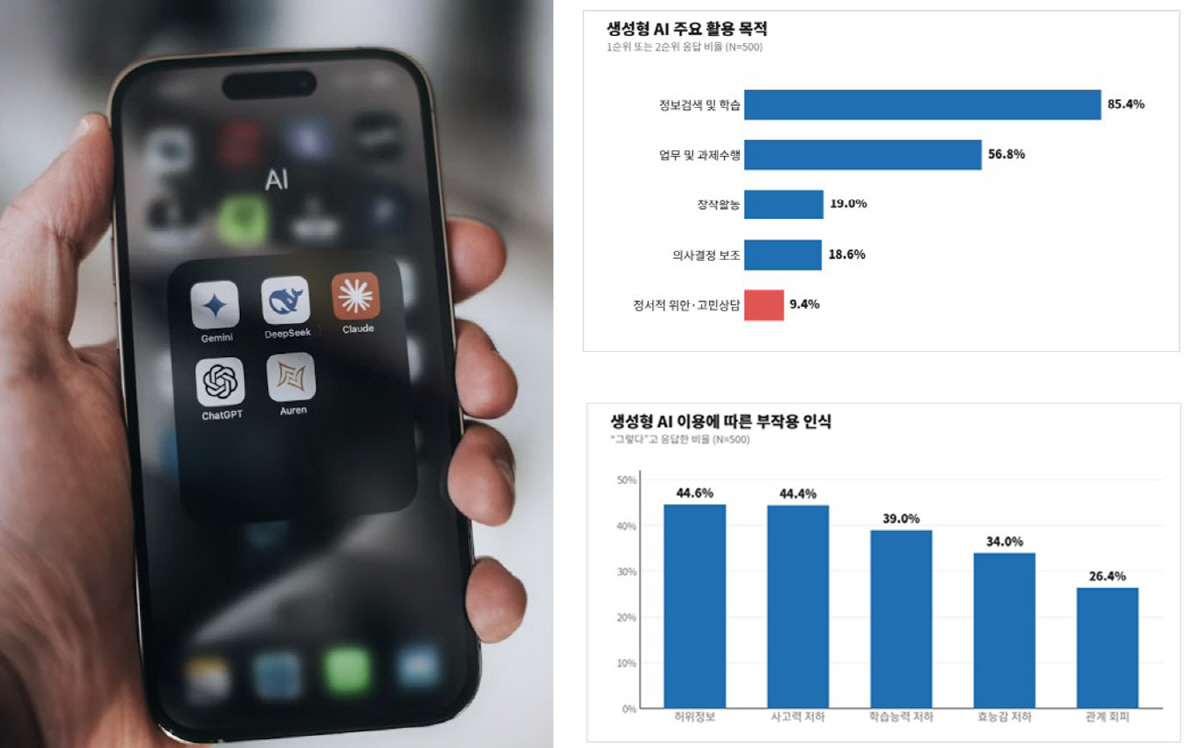
The survey found that 41.4% of respondents used generative AI almost every day. The main purpose was information search and learning, cited by 85.4% of respondents, followed by work and assignments at 56.8%, creative activities at 19.0%, and decision support at 18.6%. Some 9.4% said they had used generative AI for emotional comfort or to discuss personal concerns, suggesting that its use is expanding beyond a simple productivity tool into the emotional sphere. People in their 20s and 30s used it more often and for longer periods than other age groups, while women were more likely than men to use it for emotional purposes.
◇ Seven in 10 adults say AI could help mental health
Expectations for generative AI's potential in mental health were high. A total of 76.8% of respondents said the anonymity of AI counseling would be helpful, while 75.4% said it could improve access to mental health services. In addition, 72.8% said generative AI would be helpful for improving mental health, and 64.2% said they would be willing to use it for counseling in the future.
The researchers said these results show public expectations that generative AI could improve access to mental health services and serve as a resource for psychological support.
◇ "Concerns over reduced thinking ability and misinformation" ... side effects also identified
At the same time, respondents reported a number of side effects and concerns linked to the growing use of generative AI. Some 44.6% said they had experienced problems related to misinformation, 44.4% cited reduced thinking ability, and 39.0% pointed to weaker learning ability.
People in their 20s and 30s were more likely than other age groups to experience a range of side effects in relational, emotional and cognitive areas, including reduced desire for relationships, avoidance of relationships, loneliness, negative emotions and diminished thinking ability. Longer use of generative AI was also associated with higher levels of relational, emotional and cognitive side effects.
◇ Longer use linked to higher levels of depression, anxiety and loneliness
The analysis of psychological distress showed that the longer the average daily use of generative AI, the higher the levels of depression, anxiety and loneliness. In particular, among those who used it for two hours or more a day, 41.2% were in the depression-risk group and 35.3% were in the anxiety-risk group, both higher than in other user groups.
Those who frequently used generative AI for emotional purposes also showed clearly higher levels of depression, anxiety and loneliness. Instrumental use was also associated with depression and anxiety, but the link was stronger in emotional use.
◇ Emotional use is the strongest predictor of AI dependence
A total of 86 respondents, or 17.2%, reported withdrawal symptoms such as anxiety or restlessness when they could not use AI, meaning that about one in six users showed clear signs of dependence. Dependence increased with more frequent use of generative AI, and emotional usage patterns such as seeking emotional support, discussing worries, relieving loneliness and using AI as a conversation partner were identified as the strongest factors explaining AI dependence. Depression, anxiety and loneliness were also found to raise the level of dependence on generative AI.
The researchers said these findings suggest that dependence risk may rise when generative AI is used in ways that partially replace human relationships and emotional needs.
◇ "Need to establish AI literacy and mental health protection policies"
The researchers emphasized that generative AI is showing new possibilities not only in information search and productivity improvement, but also in mental health support. At the same time, they said society must pay attention to emotional dependence and mental health risks.
Professor Cho, who led the study, said, "Generative AI has both the potential to become a new resource for mental health and risk factors, and the 20s and 30s, who use it most actively, are both the biggest beneficiaries and the group most exposed to risk." He added, "We need AI literacy education centered on self-regulation, so users can assess and control not only their AI skills but also their purpose and duration of use. At the design stage of AI services, safeguards are also needed to prevent excessive emotional dependence and, when necessary, connect users to professional mental health services."
◇ Addiction Forum discusses "mental health and addiction response strategies in the age of AI literacy"
Meanwhile, the Addiction Forum held a commemorative seminar on June 26 to mark its 14th anniversary under the theme, "Mental Health and Addiction Response Strategies in the Age of AI Literacy: Focusing on Evidence-Based Perception Research and Building a Korean-Style Treatment Delivery System."
The seminar was organized to discuss preventive interventions for changing public perceptions of mental health and addiction issues in the rapidly expanding era of AI literacy. In particular, it sought ways to build an effective Korean-style addiction treatment delivery system by comprehensively analyzing international treatment standards and domestic conditions.
The seminar featured three main presentations and a panel discussion. In "AI Literacy and Mental Health Perception Research," Professor Cho Seon-jin of the Department of Addiction Studies at The Catholic University of Korea Graduate School presented survey results on public perceptions of mental health risk factors and preventive interventions in AI environments. In "A Record of Clinical Experience with Addiction Patients: Reflections on Treatment and Recovery," Professor Shin Young-cheol, chairman of the Addiction Forum and a doctor at Kangbuk Samsung Hospital, shared candid insights from the field on the realities of addiction treatment and recovery. In "A Plan for Building a Tiered Korean-Style Addiction Treatment Delivery System: Focusing on Substance Addiction," Professor Lee Sang-gyu of Hallym University Chuncheon Sacred Heart Hospital outlined a systematic direction for building a science-based Korean treatment delivery system.
The panel discussion that followed focused on "strategies to link treatment and rehabilitation for building an addiction treatment delivery system." It was moderated by Professor Lee Hae-guk of Uijeongbu St. Mary's Hospital, with Professor Baek Hyeong-ui of Eulji University, Professor Jang Seok-yong of Yonsei University Graduate School of Convergence Health and Medicine, and Kim Jeong-hwa, head of the Gwangju Buk-gu Addiction Management Integrated Support Center, joining as panelists to discuss a range of solutions.
Shin Young-cheol, chairman of the Addiction Forum, said, "For the past 14 years, the Addiction Forum has consistently worked to view addiction not as an individual's responsibility, but as a social and public health issue." He added, "We hope this seminar will serve as an important turning point for establishing more effective, evidence-based addiction response strategies in the rapidly changing era of AI."
Reporter Jang Jong-ho bellho@sportschosun.com