


[Sportschosun reporter Jang Jong-ho] A new echocardiographic marker has been proposed that can help predict in advance the severe decline in heart function seen in patients with hypertrophic cardiomyopathy.
The marker assesses the flexibility of the left atrium and is expected to help identify high-risk patients early, preventing progression to the end stage and the resulting sudden death or heart failure.
Hypertrophic cardiomyopathy is a hereditary heart disease in which the heart muscle becomes abnormally thick. In the early stages, it may not greatly affect daily life, but over time it can worsen into an end stage, defined as a left ventricular ejection fraction below 50%, when the heart's pumping function declines. Once the disease reaches that stage, the risk of serious cardiovascular events such as heart failure or sudden death rises sharply, making it important to identify high-risk patients before the condition worsens. However, left ventricular ejection fraction, which has been widely used, tends to remain normal in the early stages and only falls after substantial cardiac remodeling has already occurred, limiting its usefulness for early detection of deterioration.
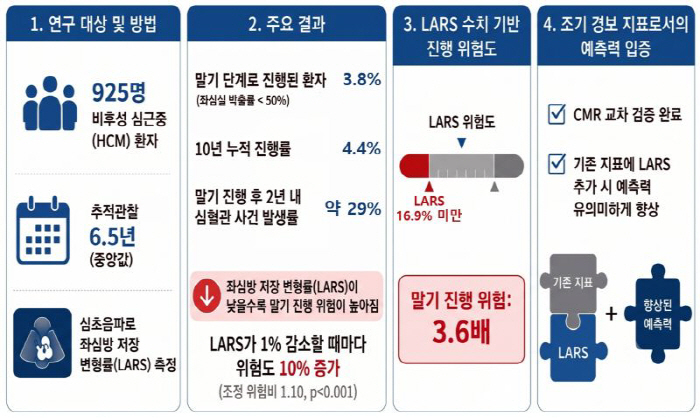
Against this backdrop, a research team led by Professors Kim Hyung-kwan and Kwak Soon-gu of the Cardiology Department at Seoul National University Hospital announced on the 7th the results of a study that followed 925 patients diagnosed with hypertrophic cardiomyopathy between 2007 and 2023 and who underwent echocardiographic follow-up for more than one year. The median follow-up period was 6.5 years.
The study found that 35 of the 925 patients, or 3.8%, progressed to the end stage, and the cumulative 10-year progression rate was 4.4%. Among patients who progressed to the end stage, about 29% experienced fatal cardiovascular events within a little over two years, underscoring the need to detect warning signs early before the disease worsens.
The team compared traditional indicators such as left ventricular ejection fraction with a new imaging marker called left atrial reservoir strain.
Left atrial reservoir strain measures how flexibly the left atrium moves as it temporarily stores blood before sending it to the ventricle. As the heart muscle thickens and strain builds, the left atrium also becomes stiffer. Left atrial reservoir strain can reflect that burden earlier, even while left ventricular ejection fraction remains normal, allowing it to serve as an early warning system that is more sensitive than conventional markers.
The analysis showed that traditional indicators alone made it difficult to precisely identify progression to the end stage, whereas left atrial reservoir strain was more effective in detecting progression risk.
In the study, every 1 percentage point decrease in left atrial reservoir strain was associated with about a 10% increase in the risk of end-stage progression. This means that even a slight drop in the value steadily adds to the risk. Based on the findings, the team identified 16.9% as the cutoff for risk stratification. Patients with a value below 16.9% had a 3.6 times higher risk of progression than those at or above that level. Even after accounting for other risk factors such as age, heart failure symptoms, left ventricular ejection fraction, left atrial size, and apical ventricular aneurysm, left atrial reservoir strain alone independently predicted progression risk.
To verify the reliability of the findings, the team conducted an additional analysis of 491 patients who also underwent cardiac magnetic resonance imaging (CMR). Because late gadolinium enhancement, which indicates the degree of myocardial fibrosis, is already known as a risk factor, the key question was whether left atrial reservoir strain could still independently predict risk after accounting for it.
The analysis showed that left atrial reservoir strain remained an independent predictor even after considering the extent of myocardial fibrosis. When left atrial reservoir strain was added to a prediction model built only with left ventricular ejection fraction and late gadolinium enhancement, the model's predictive power improved significantly, with statistical significance (p=0.005).
As the first author, Professor Kwak Soon-gu of Cardiology, said, "Because it is important to closely monitor the progression of hypertrophic cardiomyopathy, patients' active efforts to regularly check and manage their heart condition through echocardiography are especially important."
Corresponding author Professor Kim Hyung-kwan of Cardiology stated, "This marker has great practical value in clinical settings because it can be assessed with routine echocardiography alone, without expensive advanced testing." He added, "We expect it will help more precisely identify high-risk patients and provide the best treatment at the right time, improving outcomes." The study was published in the latest issue of the international journal European Heart Journal-Cardiovascular Imaging.
Jang Jong-ho, bellho@sportschosun.com