[Sportschosun Reporter Jang Jong-ho] Scientists have uncovered the gene-regulation mechanism that determines whether a cell survives or dies when under stress.
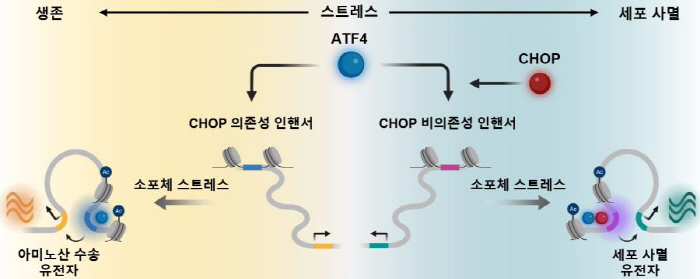
A research team led by Professor Kim Hyeong-pyo of the Department of Tropical Medicine at Yonsei University College of Medicine and Joo Jeong-sik, a research assistant at the Yonsei Institute of Life Science, said on the 10th that they confirmed ATF4 and CHOP, the core regulatory proteins in the cellular stress response, activate enhancers, which are gene-regulatory regions, and form three-dimensional links between enhancers and genes that play a crucial role in determining cell fate. The findings were published in the international journal Nucleic Acids Research (IF 15.0).
Cells in the human body are constantly exposed to stress from a variety of causes, including nutrient deficiency, inflammation and toxic substances. In particular, when the endoplasmic reticulum, the organelle that makes and processes proteins inside cells, develops problems, endoplasmic reticulum stress occurs as improperly folded proteins accumulate.
In such situations, cells first activate defense systems to restore damaged functions and survive. But if the stress is severe or prolonged, they give up recovery and choose the process of self-destruction. This response is closely linked to the development and progression of various diseases, including cancer, diabetes mellitus, degenerative brain diseases and liver disease. Until now, many studies have examined which genes are turned on and off when endoplasmic reticulum stress occurs. However, it has not been clearly established which genes among the many involved support cell survival, which induce cell death, or how genes are regulated so that cells choose different fates.
Going beyond conventional approaches that only examine gene expression, the team comprehensively analyzed enhancer activity, the binding of stress-response proteins and the three-dimensional connections formed in the nucleus between genes and regulatory regions.
First, the researchers induced endoplasmic reticulum stress in human cells and then examined changes in gene expression and genome structure. They found that enhancers that regulate the activity of specific genes became activated, and that close connections between enhancers and genes appeared broadly. Enhancers are like switches that control gene activity. Although they are far from the gene on the DNA sequence, when DNA folds inside the nucleus and brings them into contact with the gene, they help the gene work more strongly.
The team confirmed that when endoplasmic reticulum stress occurs, these connections between gene-regulatory switches and genes change significantly.
They then compared the functions of several proteins involved in the cellular stress response. As a result, they found that ATF4 plays a central role in turning on gene-regulatory switches under stress and in creating connections between switches and genes. In cells lacking ATF4, many of the connections between regulatory regions and genes that should be activated in response to stress were not properly formed.
Another protein, CHOP, selectively regulated some of the responses driven by ATF4. While ATF4 activates the cell's overall stress-response system, CHOP helps certain genes related to cell death work more strongly.
By contrast, some genes needed for cells to endure stress and survive, such as those that transport amino acids into the cell, were activated by ATF4 even without CHOP. This showed that the stress response induced by ATF4 can be divided into an adaptive response for survival and a cell-death response depending on whether it cooperates with CHOP.
The team also conducted experiments to directly inhibit gene-regulatory switches. In addition, by measuring in images how close genes and regulatory switches come to each other inside the cell nucleus, they confirmed that the three-dimensional connection between genes and regulatory switches is necessary for actual gene activity.
This study showed that when cells are under stress, they do not simply turn genes on and off. Instead, they alter the three-dimensional connections between genes and regulatory switches in the nucleus to control the gene programs needed for survival or death.
Professor Kim said, "This study explains, from the perspective of genome architecture, how cells can choose different fates even when they receive the same stress signal." He added, "We expect it will serve as basic data for developing treatment strategies that strengthen survival responses in diseases where cells need to be protected, and that promote death responses in cells that should be eliminated, such as cancer."
Meanwhile, the study was carried out with support from the Mid-career Research and Bio-Medical Technology Development Project funded by the Ministry of Science and ICT through the National Research Foundation of Korea (NRF), as well as Yonsei University College of Medicine's SCL in-house research fund.
Jang Jong-ho, bellho@sportschosun.com