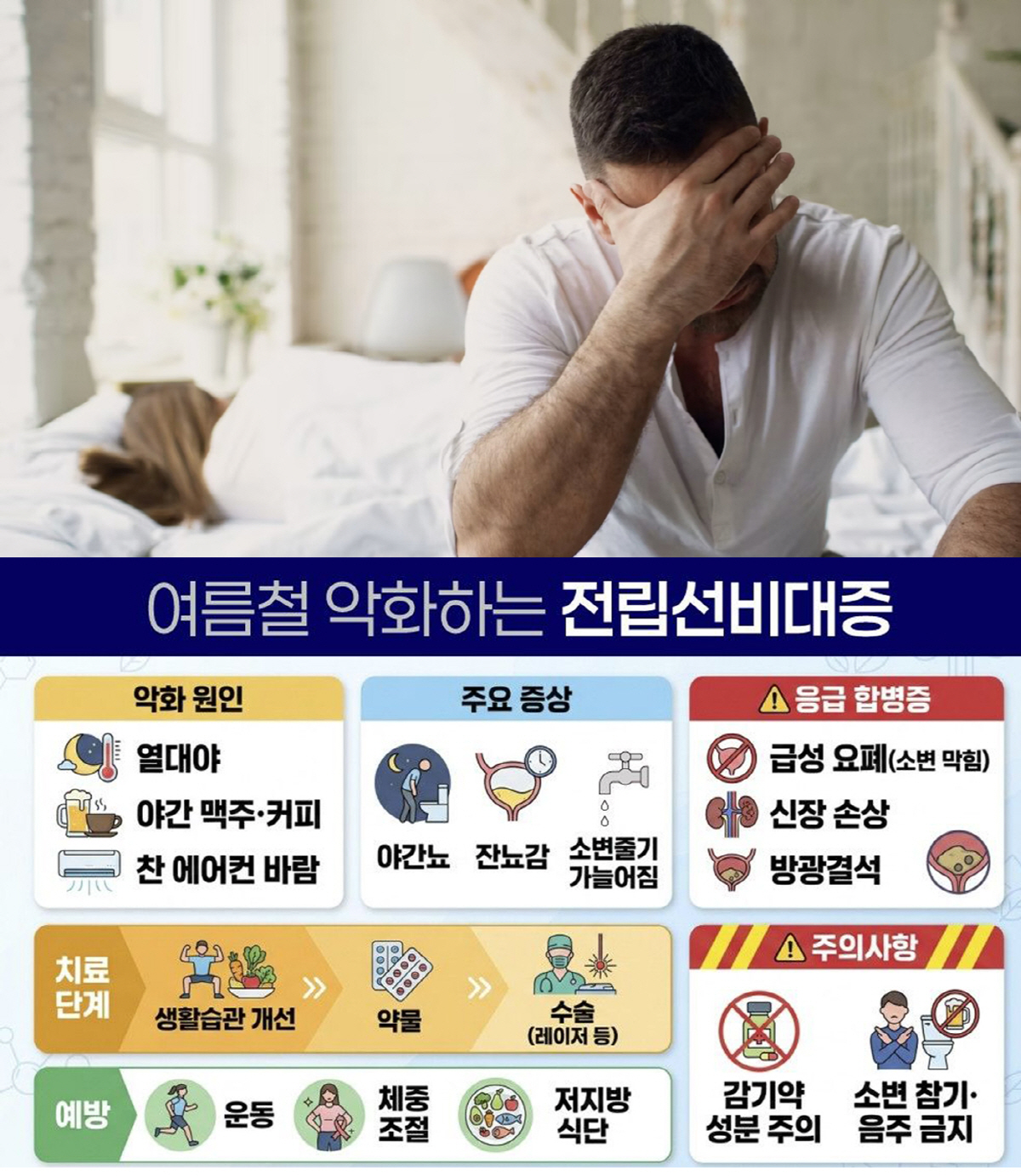
[Sportschosun, Reporter Jang Jong-ho] As the heat wave continues, more middle-aged men are losing sleep because of a lingering feeling of incomplete urination and frequent urges to urinate. When nighttime temperatures stay high, the brain has a harder time getting deep sleep. For patients with benign prostatic hyperplasia, even a small amount of urine in the bladder can trigger sensitivity and send them to the bathroom. Late-night beer or coffee, along with excessive air conditioning that cools the lower body and causes the bladder to contract, can make symptoms worse.
Benign prostatic hyperplasia usually begins gradually after the age of 40. It affects 60 to 70 percent of men in their 60s and most men over 70, making it a very common condition. According to data from HIRA, the number of patients rose from 1,304,329 in 2020 to 1,583,627 in 2024.
The prostate is an organ located just below the bladder and surrounding the urethra. As the prostate enlarges and presses on the urethra, benign prostatic hyperplasia becomes a representative cause of male urinary problems. In severe cases, chronic urinary difficulty can even develop into an emergency.
Jeon Jun-seong, a urology specialist at H Plus Yangji Hospital, warned, "If an enlarged prostate completely blocks urine flow, an emergency catheter may be needed to drain the urine."
◇Often asymptomatic at first... if left untreated, it can lead to complications such as bladder stones
In the early stages, benign prostatic hyperplasia may cause no noticeable symptoms. But as the prostate gradually enlarges, the urine stream becomes thin and weak, and it may stop and start. Many patients also feel that they have not fully emptied their bladder, or they need to strain before urine comes out. Nocturia, in particular, can significantly reduce quality of life.
It should not be dismissed as nothing more than an inconvenience when urinating. If the condition worsens, it can lead to a range of complications. When the bladder is not fully emptied after urination, stagnant urine raises the risk of urinary tract infections and bladder stones. In severe cases, it can also lead to kidney damage and hematuria.
An enlarged prostate does not always require immediate treatment, but therapy should be actively considered if it interferes with daily life or if complications such as urinary tract infections occur. The goal of treatment is also to prevent complications by stopping the disease from progressing.
If symptoms are mild, doctors usually recommend watchful waiting with follow-up once or twice a year. During this period, the focus is on lifestyle changes, such as reducing fluid intake after dinner to lessen nighttime urination. If symptoms worsen, medication is used. If drug treatment does not improve the condition or complications develop, surgery should be considered.
◇Be careful with cold medicine ingredients that can impair urination
Surgical options for benign prostatic hyperplasia include endoscopic prostate surgery and prostatectomy. Endoscopic prostate surgery involves inserting an endoscope through the urethra and shaving away the enlarged prostate tissue blocking the urinary passage, widening the channel for urine flow.
When the prostate is very large, prostatectomy may be considered to completely remove the enlarged tissue within the prostate capsule. In the past, open surgery was the main approach, but it required longer hospitalization and recovery, and there were greater concerns about bleeding and pain before and after the operation.
More recently, surgeons have been minimizing complications through prostatectomy using holmium laser, laparoscopy, or robotic systems. Holmium laser surgery has the advantage of lowering recurrence rates because it separates the enlarged prostate tissue from the outer capsule and removes it.
If you have been diagnosed with benign prostatic hyperplasia, you should avoid holding in urine for long periods. Heavy drinking and strong tea or coffee should also be avoided. Some ingredients in cold medicine can reduce urination function, so patients should inform medical staff about their history of benign prostatic hyperplasia when receiving a prescription.
Jeon Jun-seong said, "Benign prostatic hyperplasia is caused by hormone changes associated with aging, so it is difficult to block the root cause itself." He added, "Beyond hormones, studies suggest that high-fat and high-cholesterol foods are also risk factors for benign prostatic hyperplasia. Maintaining a healthy weight through diet and exercise can help prevent it."
Jang Jong-ho, bellho@sportschosun.com

This article has been translated by GripLabs Mingo AI.