Yonhap News [Sportschosun Reporter Jang Jong-ho] As hot and humid weather persists during the summer, heat-related illnesses such as heat exhaustion and heatstroke are on the rise. According to the 'Heat-Related Illness Incidence Statistics' released by the Korea Disease Control and Prevention Agency, the number of heat-related illness patients in 2025 is projected to reach 4,460, an increase of over 20% compared to 3,704 in 2024.
Furthermore, an analysis by the National Fire Agency of 119 ambulance activities for suspected heat-related illness patients revealed that from 2021 to last year, the number of dispatches reached 11,368, and the number of patients transported totaled 9,761. 7-fold from 819 to 3,034 during the same period.
Accordingly, those with jobs requiring them to stay outdoors for long periods or those engaging in outdoor sports, as well as the elderly, children, pregnant women, individuals with underlying conditions such as cardiovascular and cerebrovascular diseases, and people with disabilities who are vulnerable to heat-related illnesses, need to take more thorough precautions. Our bodies regulate body temperature primarily through various heat exchange processes, including radiation, convection, evaporation, and conduction.
Among these, radiant heat from sunlight has a significant impact on outdoor activities during the summer. Even at the same temperature, prolonged exposure to direct sunlight significantly raises the perceived temperature and increases the burden on the body's thermoregulation system.
16 times when the temperature reaches 38 degrees Celsius, the level designated for a "Severe Heatwave Warning. " Typical activities involving prolonged outdoor stays include outdoor sports such as golf and soccer, as well as events and field work.
In particular, a single round of golf typically takes about 4 to 6 hours, and a significant portion of this time involves direct exposure to sunlight, which can increase the risk of rising body temperature and dehydration. The most effective solution in this situation is installing shade canopies.
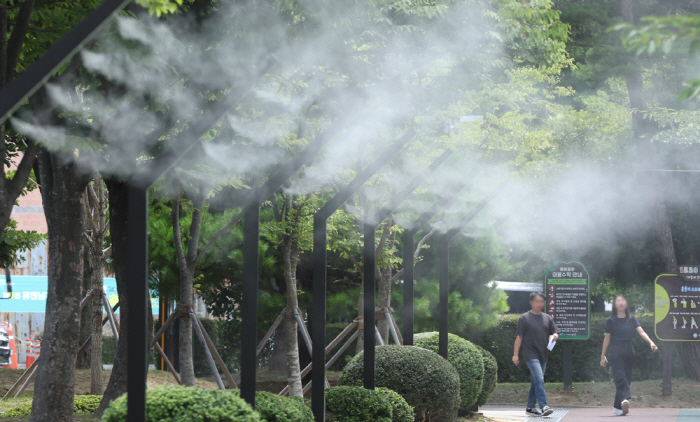
Shade canopies block sunlight, reducing exposure to radiant heat and helping to lower the perceived temperature. In fact, having shade in outdoor spaces can lower the perceived temperature by 5 to 10 degrees.
In spaces where people stay for extended periods, such as golf courses, outdoor sports facilities, parks, and event venues, it is advisable to install shade canopies considering the movement patterns of users and the direction of sunlight. On a personal level, parasols or sunshade umbrellas should be actively used.
Especially on days when a heat wave advisory is in effect, when moving outdoors, it is more effective to reduce exposure to radiant heat by using a parasol or sunshade umbrella to cover not only the face and head but also part of the upper body, rather than a hat. To prevent heat-related illnesses, one must also follow guidelines such as: ▲ consuming fluids regularly even if one does not feel thirsty; ▲ avoiding prolonged outdoor activities during the hottest hours (12 PM to 5 PM); ▲ taking periodic breaks in the shade; ▲ wearing breathable, light-colored clothing; ▲ checking daily temperature and heat-related illness forecasts; and ▲ immediately stopping activities if symptoms such as dizziness, headache, nausea, excessive sweating, or muscle cramps appear.
Professor Kim Ho-joong of the Department of Emergency Medicine at Soonchunhyang University Bucheon Hospital stated, "Shade canopies and sunshade umbrellas are the simplest yet surest ways to save lives during summer outdoor activities. " "This is a preventive measure.
Vulnerable groups, such as the elderly, children, pregnant women, and those with chronic diseases, must be aware of the severity of heat-related illnesses and take precautions.
If outdoor activities are unavoidable in sweltering weather, they must strictly follow the guidelines for preventing heat-related illnesses," he said.
Reporter Jang Jong-ho bellho@sportschosun.

This article has been translated by GripLabs Mingo AI.