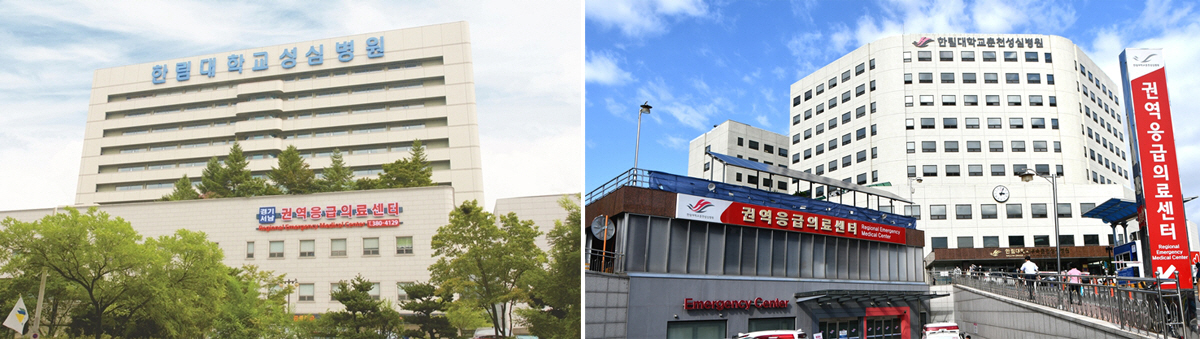
[Sportschosun Jang Jong-ho] Hallym University Sacred Heart Hospital, under Hallym University Medical Center, and Hallym University Chuncheon Sacred Heart Hospital were reappointed as Regional Emergency Medical Centers in an evaluation announced by the Ministry of Health and Welfare (MOHW) on the 15th. Since first being designated in 2016, the two hospitals have been reappointed for the third consecutive time, once again proving their capabilities as key medical institutions responsible for severe emergency care in the region.
The newly designated Regional Emergency Medical Centers will serve as the core of emergency care in their respective regions for three years, from Nov. 1, 2026, to Oct. 31, 2029.
Regional Emergency Medical Centers are key institutions in the local emergency care system, providing 24-hour specialized and systematic emergency treatment. They handle definitive care for critically ill emergency patients and work with local emergency medical institutions, fire authorities and local governments to build patient transfer systems. During disasters or emergencies, they also serve as the regional command center for emergency medical response. In this designation process, MOHW focused not only on standards for facilities, equipment, personnel and treatment, but also on each hospital's ability to provide definitive care for severe emergency conditions.
◇Responsible for everything from transporting critically ill emergency patients to definitive treatment
As the Regional Emergency Medical Center for the southwest Gyeonggi region, Hallym University Sacred Heart Hospital is responsible for definitive treatment of critically ill emergency patients in Anyang, Gunpo, Uiwang and Gwacheon, among other areas in southwestern Gyeonggi.
The hospital has an intensive care unit, ward and pediatric emergency care system dedicated to emergency patients. Through multidisciplinary cooperation among departments including emergency medicine and critical care medicine, it operates a definitive care system that quickly connects initial treatment, emergency surgery and intensive care.
Hallym University Sacred Heart Hospital has led the treatment of critically ill patients since opening the country's first ECMO center in 2015. It successfully carried out the world's longest ECMO treatment for 112 days and became the first in South Korea to perform a lung transplant on a COVID-19 patient, demonstrating top-tier capabilities in critical care.
The hospital also serves as a key institution in MOHW's project to build an interhospital transfer system for critically ill patients in Gyeonggi Province. It operates a Mobile ICU for critically ill patients. A dedicated team of emergency physicians, nurses and emergency medical technicians is on standby 24 hours a day, and the vehicle is equipped with critical care devices such as a ventilator and a high-flow oxygen therapy system. As a result, even patients on ECMO can be safely transferred between hospitals with medical staff accompanying them.
In 2025, when the hospital began full-scale operation of the Mobile ICU, it safely transferred 339 critically ill patients, including newborns requiring oxygen saturation management. It also demonstrated advanced transport capabilities by successfully moving an ECMO patient about 140 kilometers from Jecheon, North Chungcheong Province, to Anyang during heavy snowfall.
To strengthen prehospital emergency care, the hospital also operates the Brain Saver system in cooperation with fire authorities. The system helps secure the golden hour for suspected stroke patients and connects them quickly to definitive treatment.
◇Upgrading the emergency care safety net in Gangwon through a remote consultation platform
Hallym University Chuncheon Sacred Heart Hospital has operated the Regional Emergency Medical Center for the Chuncheon area of Gangwon since 2016, serving as the center of the local emergency care safety net.
The roughly 1,220-square-meter Regional Emergency Medical Center is equipped with a surgery room, intensive care unit, ward and pediatric emergency room dedicated to emergency patients. It was the first in the country to operate all beds in the general emergency patient area as single rooms, strengthening infection control and patient safety. A dedicated medical team, including emergency medicine specialists, is on duty at all times, providing a treatment system that quickly connects severe emergency care to surgery and hospitalization.
In particular, since 2023 the hospital has built a digital emergency care safety net that connects medically underserved areas with the Regional Emergency Medical Center in real time through its remote consultation platform. Specialists can review CT images and patient conditions from local medical institutions in real time to immediately decide whether emergency surgery or transfer is needed. Before the patient even arrives at the hospital, staff in the emergency room, operating room and intensive care unit begin preparing treatment. This system shortens diagnosis and treatment times for severe cerebrovascular diseases such as cerebral hemorrhage, cerebral infarction and ruptured cerebral aneurysm, where securing the golden hour is critical. It also helps narrow regional medical disparities in Gangwon, where mountainous terrain and long travel distances between regions limit access to care.
The hospital also operates an acceptance system for critically ill emergency patients transported by the 119 Emergency Medical Service, treating severe emergency cases such as cardiovascular and cerebrovascular diseases and major trauma from Chuncheon-si, Hongcheon County, Yeongwol County and Jeongseon County in central and southern Gangwon. Based on the Korean Triage and Acuity Scale (KTAS), it quickly assesses patient severity and runs dedicated staffing to manage emergency room length of stay, continuously maintaining an emergency care system focused on patient safety and efficient treatment.
With the reappointment of both hospitals, Hallym University Medical Center will continue to serve as a medical institution responsible for regional emergency care systems spanning both the Seoul metropolitan area and Gangwon. The medical center said it plans to further strengthen definitive care capabilities for critically ill emergency patients on the front line of protecting lives, while enhancing cooperation with local medical institutions and the 119 Emergency Medical Service to build a stronger emergency care safety net that protects the golden hour. It also plans to actively participate in the government's efforts to reform regional transfer systems and disaster response systems, continuing its role as a trusted public emergency care hub for the community.
Jang Jong-ho, bellho@sportschosun.com
This article has been translated by GripLabs Mingo AI.