[Sportschosun, Jang Jong-ho] A study has found that while ambulance use has risen over the past 10 years, arrival within the golden hour has not improved.
A research team led by Professors Kim Jun-yeop and Bae Hee-jun of the Department of Neurology at Seoul National University Bundang Hospital released findings that comprehensively analyzed how stroke care in Korea and its outcomes have changed over the past decade.
Stroke is a disease in which blood vessels in the brain become blocked or rupture, damaging brain cells, and how quickly treatment begins determines the prognosis. That is why every step in stroke care matters, from getting patients to the hospital quickly to providing appropriate treatment after arrival. Over the past 10 years, stroke care in Korea has continued to advance through the spread of newer treatments and improvements in emergency medical systems. However, there had been insufficient research on whether those changes actually led to shorter hospital arrival times and better outcomes.
To examine this, the team linked data from HIRA's assessment of acute stroke care with claims and mortality data from NHIS, and analyzed records from 136,191 stroke cases between 2013 and 2023.
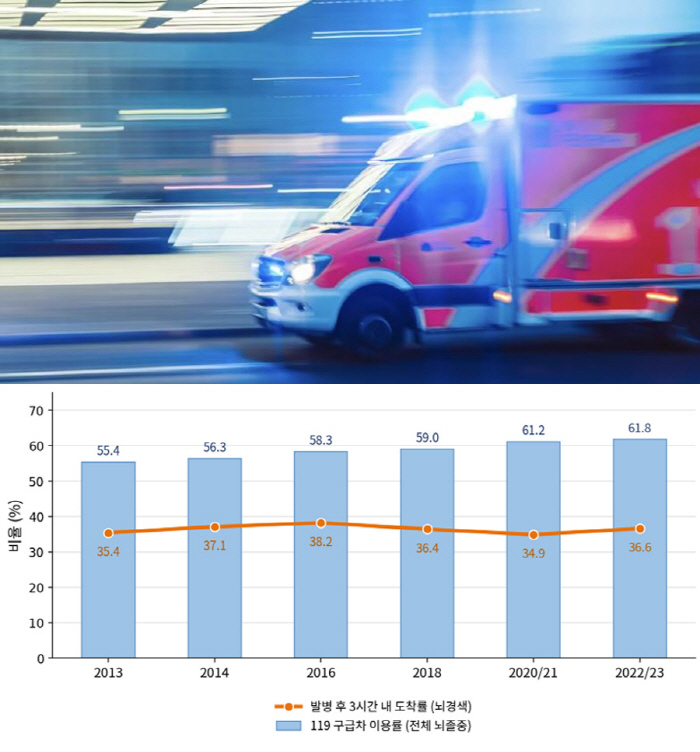
The results confirmed a pattern in which ambulance use increased, but arrival within the golden hour did not improve. The 119 emergency ambulance use rate rose from 55.4% to 61.8%, and the share of patients directly transported to hospitals capable of specialized stroke treatment also increased from 55.8% to 78.2%.
However, despite these improvements in transport systems, the time from symptom onset to hospital arrival changed little, from 4.0 hours to 3.9 hours. The proportion of patients arriving within three hours, the golden window for ischemic stroke, also showed no meaningful change, standing at 36.6% compared with 35.4% a decade earlier.
The team said the lack of improvement in overall arrival time was largely driven by increasing delays among patients who did not use 119 emergency ambulances. For ambulance users, the time from symptom onset to hospital arrival fell slightly from 2.5 hours in 2013 to 2.3 hours in 2023. By contrast, for patients who used other means such as private cars or taxis, the time increased from 7.9 hours to 9.8 hours. The researchers said patient awareness and response systems need to be strengthened so that suspected stroke symptoms lead more quickly to 119 ambulance use.
Clear progress was seen in treatments provided after hospital arrival. In particular, the rate of thrombectomy, a procedure that directly removes clots blocking blood vessels in ischemic stroke patients, more than doubled from 5.3% to 11.6%, and rose from 18.3% to 41.1% among severe cases. In subarachnoid hemorrhage, a type of hemorrhagic stroke, the rate of coil embolization, which blocks a ruptured brain aneurysm from inside the vessel to prevent rebleeding, increased from 36.0% to 63.4%.
However, changes in treatment did not immediately translate into better patient outcomes. Stroke mortality declined until 2018, then rose again after the COVID-19 period, forming a U-shaped pattern. This rebound remained even after statistical adjustments for factors that could affect mortality, such as age, sex, and stroke severity. The team suggested that the increase in very elderly patients, the burden of chronic disease, and strain on the medical system caused by the COVID-19 pandemic may have combined to produce this result.
Co-corresponding author Bae Hee-jun said, "Stroke care has clearly advanced over the past 10 years, but how to sustain those gains remains a challenge," adding, "The stagnation of emergency care outside the hospital and the post-pandemic rebound in mortality show that we need a sustainable stroke care system that can hold up even in crisis situations."
First author Kim Jun-yeop said, "This study is significant because it precisely identified changes in stroke care using national-level data that included general hospitals and tertiary hospitals across the country," and added, "Going forward, we need to examine more closely the process from symptom onset to hospital arrival and identify why patients are not reaching treatable hospitals in time."
The findings were published in the international stroke journal Journal of Stroke (IF 11.0).
Jang Jong-ho, bellho@sportschosun.com