[Sportschosun reporter Jang Jong-ho] As the country enters a super-aged society and the number of people undergoing knee replacement surgery continues to rise, demand for revision arthroplasty, or repeat surgery to replace the artificial joint, is also increasing. Knee replacement is a representative treatment for reducing pain and restoring walking function in patients with end-stage degenerative arthritis, but revision surgery may be needed if the implant reaches the end of its lifespan or if infection, loosening, wear, or fracture occurs.
According to statistics from HIRA, the number of total knee replacement surgeries in South Korea rose from 64,515 in 2010 to 106,149 in 2024. Over the same period, knee revision arthroplasties also increased from 1,085 to 2,354.
Against this backdrop, seven Himchan Hospitals — in Gangseo, Mokdong, Incheon, Bupyeong, Gangbuk, Busan, and Changwon — recently released an analysis of knee revision arthroplasty cases performed over 15 years from 2010 to 2024. The analysis found that about 7 out of every 100 knee revision arthroplasties performed in South Korea for patients in their 70s and older were carried out at Himchan Hospital. The figure is seen as evidence that Himchan Hospital accounts for a significant share of the country's high-difficulty revision procedures for elderly patients and has built up extensive clinical experience over the years.
◇ 1,386 procedures performed in patients in their 70s and older... 7.2% of all knee revision arthroplasties in South Korea
In the survey, which was conducted to examine long-term trends in knee revision arthroplasty and compare annual and age-group data, the seven Himchan Hospitals performed a total of 1,831 knee revision arthroplasties from 2010 to 2024. That accounts for about 6.3% of the 29,229 total knee revision arthroplasties performed nationwide during the same period.
The share of revision surgeries among elderly patients was especially notable. Of the knee revision arthroplasties performed at Himchan Hospital, 1,386 cases involved patients in their 70s and older. By age group, there were 886 cases in their 70s, 442 in their 80s, and 58 in their 90s and older. Compared with HIRA statistics for the same period, this represents about 7.2% of the 19,253 total knee revision arthroplasties performed in South Korea for patients in their 70s and older. Revision surgeries for patients in their 80s and older, numbering 500 cases, accounted for about 10.9% of the 4,595 total knee revision arthroplasties in that age group nationwide.
Lee Gwang-won, director of the Orthopedic Surgery department at Gangbuk Himchan Hospital, said, "Recently, more and more patients who previously underwent joint replacement surgery at other hospitals have been visiting us because revision surgery is needed for various reasons, including the end of the implant's lifespan."
Elderly patients often have weakened bone quality due to osteoporosis, as well as bone loss around the existing implant, deformities, and soft tissue adhesions. Many also have underlying conditions such as hypertension, diabetes, and cardiovascular disease, which require careful management throughout anesthesia, surgery, and recovery. Therefore, a high number of revision surgeries in elderly patients is considered an indicator that a hospital has accumulated extensive clinical experience, along with strong capabilities in diagnosis, surgical planning, and postoperative recovery management for complex patient groups.
Baek Ji-hoon, director of the Orthopedic Surgery department at Mokdong Himchan Hospital, said, "Knee revision arthroplasty in elderly patients involves more variables than the first surgery, and a personalized surgical plan must be developed by taking into account the patient's physical limitations and bodily characteristics in multiple ways." He added, "Even for super-aged patients, surgery can be made safer and quality of life can be improved if systematic preoperative testing and thorough recovery management are in place."
◇ Causes of repeat surgery vary, including infection, loosening, and wear... More difficult than the first operation
There are many reasons why knee revision arthroplasty may be needed. In addition to the end of the implant's lifespan, infection, loosening, liner wear and fracture, and implant instability can all lead to the need for revision earlier than expected. Thanks to advances in implant materials and robotic surgery, the lifespan of artificial joints is now longer than in the past. Total knee replacements are reported to last more than 25 years, while partial replacements last about 20 years. However, the actual duration varies depending on the patient's activity level, body weight, bone condition, postoperative care, and whether infection occurs.
Revision surgery is more difficult than the initial operation. Bone loss can occur while removing the existing implant, and in many cases the bone is already weakened or deformed. Adhesions in the surrounding soft tissue make it difficult to identify anatomical structures, and the type of implant and fixation method that can be used also depends on the amount and quality of the remaining bone. For that reason, revision arthroplasty is not simply a procedure to insert a new implant. It is a high-difficulty surgery that requires a comprehensive approach, including identifying the cause, assessing bone defects, and restoring joint alignment and stability. This is why choosing a medical team and hospital with extensive clinical experience is so important.
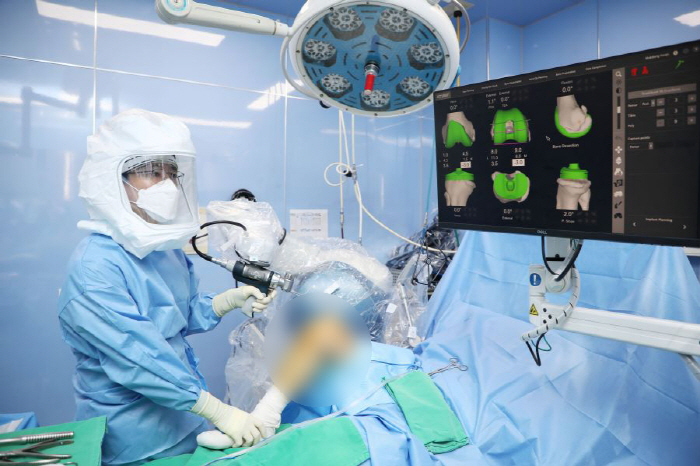
In some revision procedures, robotic systems are now used to improve surgical precision. However, in patients who previously underwent total knee replacement, the use of robotic surgery may be limited because of changes in anatomical structure.
By contrast, in cases where revision surgery is performed after partial knee replacement, robotic systems can be used to more precisely plan the extent of bone cutting and the alignment of the implant, depending on the patient's bone condition and surgical requirements.
Kim Yoo-geun, hospital director of the Orthopedic Surgery department at Bupyeong Himchan Hospital, emphasized, "If new pain develops after joint replacement surgery, or if swelling and warmth in the knee persist, or if pain worsens when moving and the joint feels unstable, patients should not dismiss it as simple aging or temporary pain. They should visit a hospital as soon as possible to check the condition of the implant." He added, "If the right time for revision surgery is missed, bone damage and functional decline can worsen, so early diagnosis is important."
Jang Jong-ho, reporter bellho@sportschosun.com