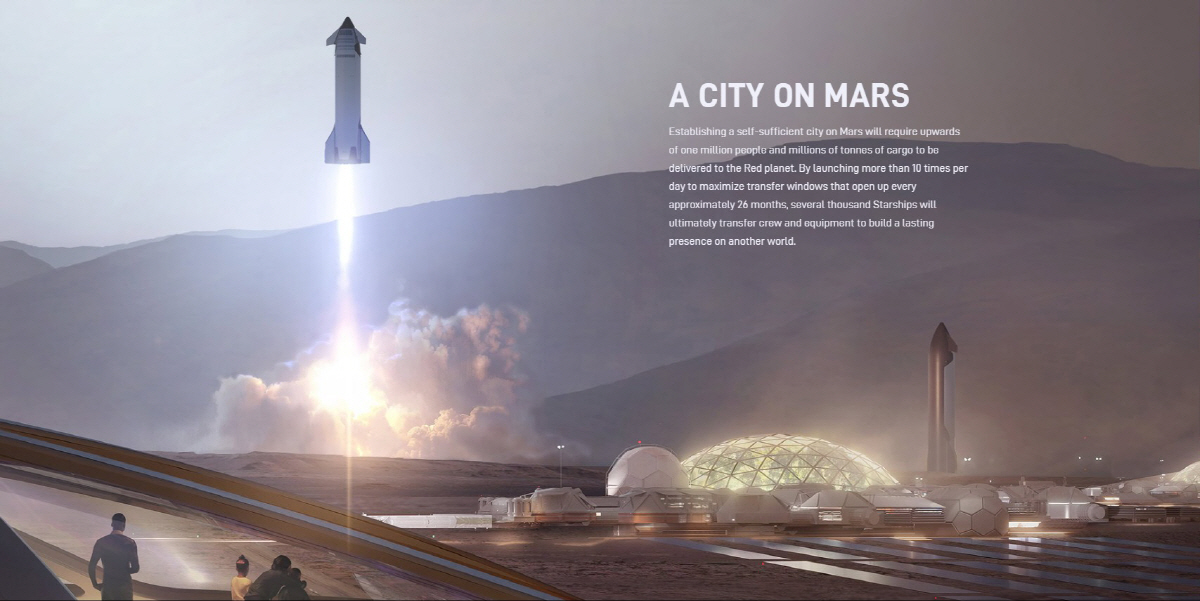
[Sportschosun Jang Jong-ho] Tesla CEO Elon Musk is fleshing out a long-term blueprint to move humanity beyond Earth and build self-sustaining cities on the Moon and Mars. Under the plan, construction materials would be sent to the Moon and Mars starting in late 2026. Robots would build the infrastructure first, and people would settle afterward. Musk has ultimately set a goal of establishing a self-reliant city on Mars between 2045 and 2055.
According to foreign media outlets including the New York Post, Musk recently said he is adjusting SpaceX's development direction to focus first on building a city on the Moon, which is closer than Mars. He aims to create a city where people can live permanently on the Moon within the next 10 years. At the same time, he expects SpaceX could begin sending construction materials to Mars within the next seven years.
To that end, SpaceX has submitted a plan to the Federal Communications Commission (FCC) to build a next-generation satellite network of about 100,000 satellites. The company said the network would greatly improve communications between Earth and space. It would also provide the large-scale infrastructure needed for billions of Artificial Intelligence (AI)-based devices operating on Earth and the Moon.
Jim Cantrell, a co-founder of SpaceX, said, "Rather than putting high-performance AI on every robot individually, we will use a centralized computing system built in space." He added, "Robots will build the settlements before humans arrive."
The plan moved a step further recently when SpaceX successfully launched 29 Starlink satellites into low Earth orbit using its reusable Falcon 9 rocket. The Falcon 9 first stage used in the launch has now completed 36 reusable flights, underscoring the reliability of reusable launch vehicle technology.
Musk's vision also calls for a next-generation super-heavy transport rocket that would be much larger than the Starship currently under development, in order to carry large construction equipment to the Moon and Mars.
Musk chose the Moon first because it is far more accessible than Mars. It takes about three days to reach the Moon, while Mars currently requires about six months with today's technology. The Moon also offers the advantage of allowing a quick return or resupply if problems arise.
Settling the Moon and Mars would require power, water, oxygen, living space and fuel. Solar power could be set up relatively easily, but the Moon has long nights, and most of Mars' water is believed to exist as underground ice, making mining technology necessary. Producing rocket fuel from the Martian atmosphere and generating oxygen through electrolysis are also seen as key elements.
Most of the early construction work is expected to be handled by Tesla's humanoid robot Optimus. Cantrell said, "Humans need food, water and oxygen, but robots only need electricity and basic maintenance." He added, "By combining AI and humanoid robot technology, it will become possible to build space colonies in ways never seen before."
Musk's vision still faces many technical hurdles, but his plan to connect reusable rockets, satellite communications, AI and humanoid robots into a single ecosystem could accelerate the rapid growth of the space industry.
Jang Jong-ho, bellho@sportschosun.com