[Sportschosun Reporter Jang Jong-ho] As the use of obesity treatments rises rapidly worldwide, more people are achieving short-term weight loss. However, the benefits of rapid weight loss can come with a higher risk of gallbladder diseases such as gallstones and cholecystitis, so caution is needed. Experts stress that rapid weight loss can promote gallstone formation, making a safe pace of weight loss and balanced nutrition especially important when using obesity medications.
In fact, surgeries for gallbladder diseases have been steadily increasing. According to the National Health Insurance Service (NHIS)'s 2024 Major Surgery Statistics Yearbook, the number of cholecystectomies rose from 86,274 in 2020 to 97,470 in 2024.
◇Most cases of cholecystitis are caused by gallstones
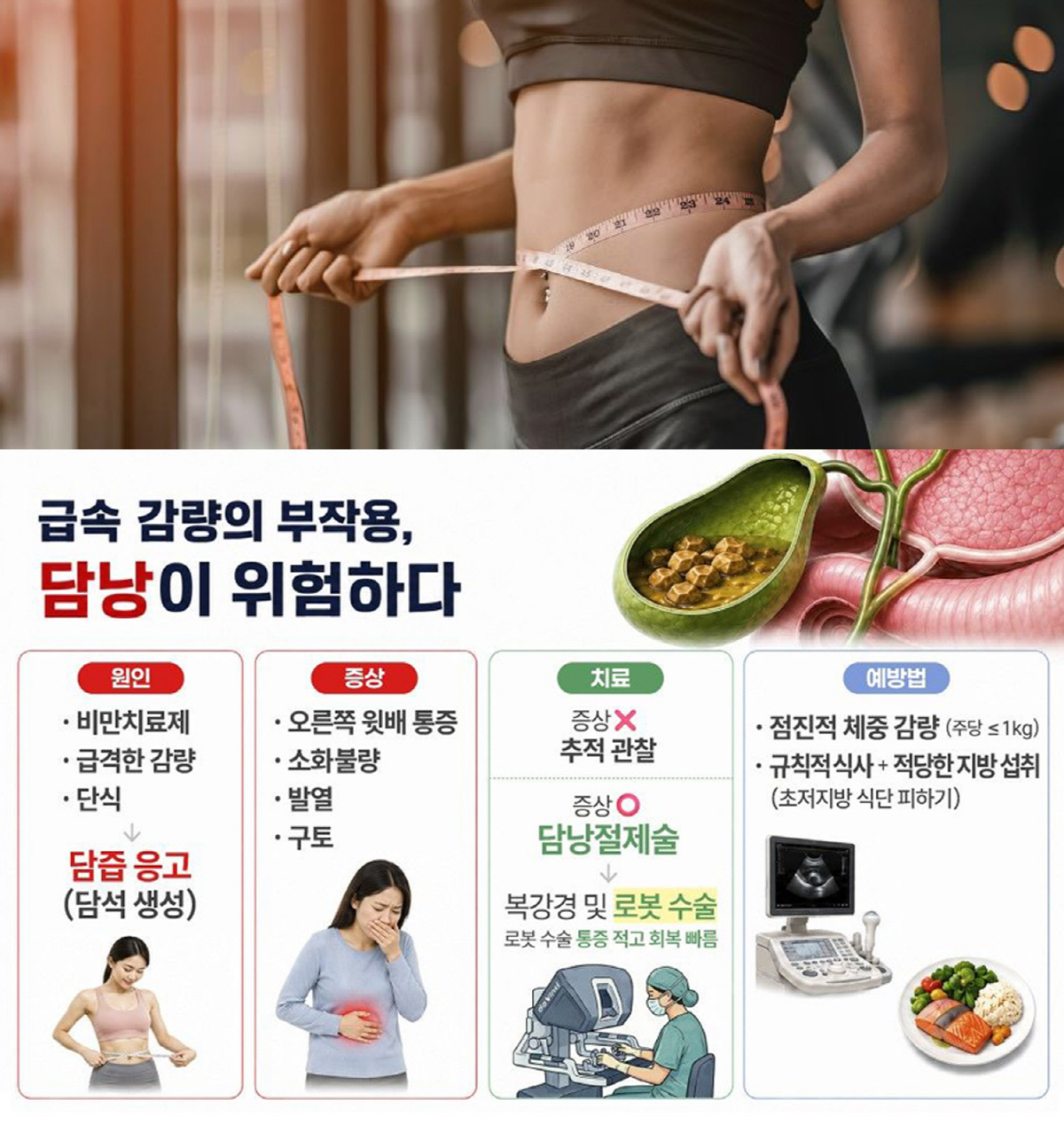
The gallbladder stores bile produced by the liver and releases it when fat needs to be digested. Gallstones are formed when cholesterol and other substances in bile harden into stone-like masses. If a gallstone blocks the flow of bile, it can lead to cholecystitis. When cholecystitis develops, symptoms include pain in the upper right abdomen, fever, nausea, and vomiting. In severe cases, it can progress to emergencies requiring surgery, such as perforation or intestinal obstruction.
Jeong Yuna, a general surgeon at H Plus Yangji Hospital, said, "The major risk factors for gallstones are obesity, diabetes, and rapid weight loss." She added, "Because about 90 to 95 percent of cholecystitis cases are caused by gallstones, it is important to understand and prevent situations that make gallstones more likely to form."
◇Why does rapid weight loss cause gallstones?
The gallbladder concentrates and stores bile, then releases it into the duodenum when needed to help digest and absorb fat. But if a gallstone blocks the cystic duct, bile cannot be released. Pressure inside the gallbladder rises, the organ expands, and inflammation develops.
Gallstones become more common with age, and prevalence among women is known to be about twice that of men. The risk of complications also increases as people get older. In particular, when body weight drops sharply over a short period, the amount of cholesterol secreted into bile by the liver increases. On the other hand, when food intake falls significantly, gallbladder contraction weakens and bile remains in the gallbladder for longer. As the bile becomes more concentrated, the likelihood of gallstone formation rises.
Recent studies have also suggested that obesity medications themselves may raise the risk of gallbladder disease. Large clinical trials and meta-analyses of GLP-1 receptor agonists and GIP/GLP-1 dual agonists have reported that patients taking these drugs face a higher risk of gallstones and cholecystitis than those in the control groups.
Even when gallstones are found, most asymptomatic cases are monitored with regular abdominal ultrasound exams. However, if symptoms of cholecystitis such as pain or fever appear, surgery, or cholecystectomy, is generally recommended first. For patients who are not suitable for surgery or who do not want it, medication may be considered, but it is only limitedly effective for small, non-calcified cholesterol gallstones. Drug treatment also has a low cure rate, and even after treatment is completed, the recurrence rate within five years reaches about 50 percent, so long-term follow-up is necessary.
◇The key to preventing cholecystitis is 'safe weight loss'
If acute cholecystitis causes severe pain, if symptoms do not improve with medication, or if complications develop, cholecystectomy is necessary. To reduce the risk of recurrence and improve treatment outcomes, surgery may be considered early once symptoms begin. If inflammation has spread widely around the gallbladder or complications such as pancreatitis are present, open surgery may be performed. If the inflammation is confined to the gallbladder, laparoscopic surgery is usually used. Recently, robotic surgery has also been expanding, especially for high-difficulty cases. Robotic surgery offers a high-definition view and precise operation, while minimizing incisions, which means less pain and faster recovery.
Obesity medications are effective treatments for preventing and managing chronic diseases such as obesity and diabetes, but excessively rapid weight loss can negatively affect the gallbladder and pancreas. Therefore, the more important question is not how much weight is lost, but how safely it is lost.
Jeong Yuna emphasized, "Even when using obesity medications, you should avoid extreme fasting or excessive weight loss and maintain a balanced diet." She added, "If pain in the upper right abdomen or the upper middle abdomen repeatedly appears after meals, or if fever and nausea occur, do not dismiss it as a simple digestive problem. It is necessary to check for gallbladder disease through ultrasound and blood tests."
Jang Jong-ho, bellho@sportschosun.com