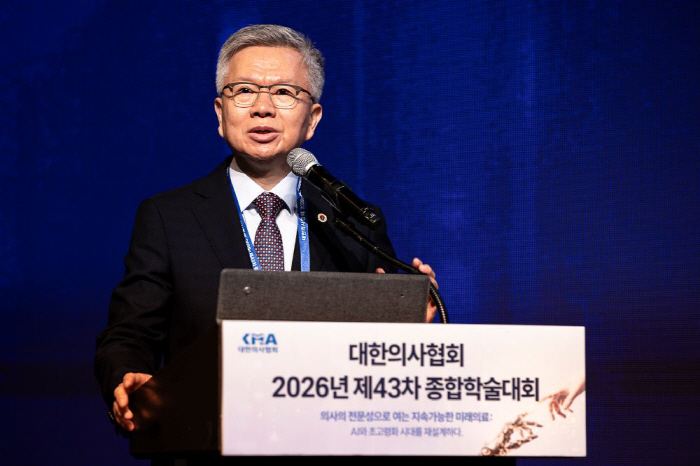
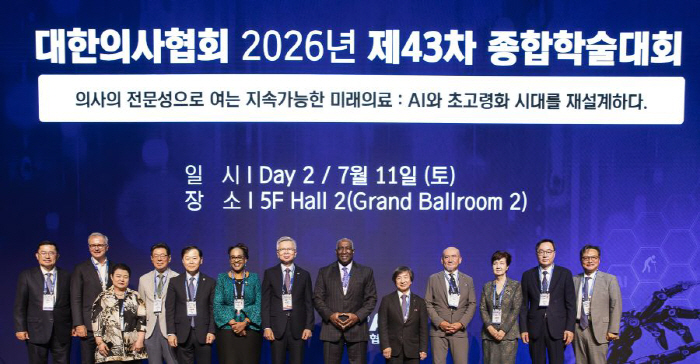
[Sportschosun Reporter Jang Jong-ho] The Korean Medical Association (KMA), led by President Kim Taek-woo, held the '2026 43rd General Academic Conference' from Oct. 10 to 12 at Grand InterContinental Seoul Parnas in Gangnam-gu, Seoul.
The conference was held under the theme, 'Sustainable Future Medicine Opened by Physicians' Expertise: Redesigning the AI and Super-Aged Era.' It was the association's first fully in-person academic gathering for all members in seven years since the COVID-19 pandemic. The event was organized to assess major issues facing the medical community in a rapidly changing healthcare environment and to explore the direction of sustainable future medicine.
A total of 1,355 people took part in the conference, and 25 academic programs were run over three days. In all, 197 people participated, including 190 domestic speakers, moderators and panelists, and seven overseas speakers and moderators. Medical experts from five countries, including the United States, Republic of Kenya, Austria, Japan and South Korea, discussed major healthcare issues and future response strategies.
Through the conference, the KMA presented four key agendas: AI medical technologies and digital healthcare innovation centered on clinical practice; sustainable healthcare policy governance and institutional safeguards; innovation in medical education and advancement of self-regulation in the medical community; and stronger emotional trust between the public and physicians. Beyond academic and policy issues, the conference also broadened its scope to include medical education, career paths for young doctors, public communication, and culture and the humanities.
At the core program, the Plenary Leadership Session, participants discussed how AI and a super-aged society will change clinical settings and the healthcare system, as well as the role the medical community must play in response. Medical leaders from home and abroad stressed that for advanced technologies to improve patient safety and the quality of care, technical performance alone is not enough. Medical standards, ethical principles and physicians' professional judgment must also be firmly established.
The AI Future Medicine session covered the clinical application of advanced medical technologies such as artificial intelligence and the Clinical Decision Support System (CDSS). Participants examined the conditions needed for medical AI to be used safely in real-world care settings and shared examples of domestically commercialized medical AI solutions, their entry into National Health Insurance reimbursement, and the current state of AI use in healthcare.
In particular, participants argued that AI should not be used as a technology to replace medical professionals, but as a tool that supports clinicians' judgment during diagnosis and treatment and helps them secure more time to communicate with patients. They also discussed the need for standards and infrastructure that take into account the clinical effectiveness of AI, patient safety, privacy protection, and legal and ethical responsibility.
Policy-related sessions addressed a sustainable healthcare system, sound health administration governance, the medical delivery system, legal and institutional safeguards for medical accidents, and ways to strengthen essential regional healthcare. In the geriatric medicine session, which focused on responses to a super-aged society, participants discussed clinical and policy challenges for providing safe and integrated care to older patients.
Programs on regional healthcare and the medical workforce examined structural problems in the field, including a decline in public health physicians and staffing shortages in medically underserved areas. Participants agreed that institutional measures, including workforce deployment and support systems, are needed so that people can reliably access necessary medical services regardless of where they live.
Medical education and programs for future generations also received significant attention. Sessions on medical school education and resident training, as well as the medical education innovation session hosted by the Korean Association of Medical Colleges, discussed how to improve education and training systems so they can respond to changes in the healthcare environment. The role of physician-scientists in expanding clinical problems into research, and the importance of cultivating future medical talent, were also highlighted.
In the 'Dear Junior' program for medical students and young doctors, senior physicians active in fields ranging from clinical care and research to the medical industry shared their experiences and career choices. Medical students, residents and public health physicians from the next generation exchanged views with senior doctors on the skills required in a changing healthcare environment, training conditions and the role of physicians.
A session on professionalism and self-regulation discussed physicians' social responsibilities and the future direction of the license management system. Participants said the medical community must establish its own ethical standards and build an independent, systematic license management and self-regulation system to strengthen public trust and protect physicians' professionalism.
Special programs on social change and public communication also drew strong interest. In 'KMA Insight Talk 1,' author Song Gil-young presented directions for how individuals and organizations can respond to a changing social structure under the theme 'Forecast of the Era: The Birth of a Lightweight Civilization.' In 'KMA Insight Talk 2,' Doctor Friends shared how they produce medical content and communicate with the public while maintaining medical accuracy and considering public interest and perspective.
The special session 'Klimt and Medicine,' which highlighted the intersection of medicine and art, featured Vienna Medical University President Markus Müller, who introduced the medical and scientific culture of Vienna in the 1900s, which formed the background to Gustav Klimt's art. Yim Joo-yim, a professor at Korea University College of Medicine, then interpreted the body images and anatomical symbols appearing in Klimt's works from a medical perspective. The session offered a humanistic view of medicine as a discipline that goes beyond treating disease to understanding the human body, life, history and art.
Programs with direct participation from members and the public were also held. The AI video contest recognized and awarded works that creatively expressed the value of medicine and health using artificial intelligence and video content. An exhibition and awards ceremony for the 'Drawing Our Healthy Bodies' contest also gave children and families an opportunity to engage with medicine and health in a friendly way. The 70th anniversary program of the Korean Medical Women's Association was attended by senior members and medical community figures, adding meaning to intergenerational exchange and solidarity.
Lee Woo-yong, head of the KMA Organizing Committee's academic committee, said, "This 43rd General Academic Conference is meaningful because physicians from all sectors gathered in one place for the first time in seven years to jointly explore the future direction of medicine in the AI and super-aged era." He added, "It is important to set standards for Korean medicine so that the benefits of advanced medical technologies can be safely realized in people's lives and in clinical settings, while also upholding physicians' professionalism and social responsibility throughout that process."
He continued, "Another meaningful achievement of this conference was that not only private practitioners, hospital-employed physicians and researchers, but also future generations such as medical students and residents took part and broadly shared views on academics, policy, education, and culture and the humanities." He added, "The KMA will continue to play its role so that the discussions that began at the conference can lead to real changes in clinical practice, medical education and healthcare policy."
The KMA plans to use the key agendas discussed at this general academic conference, along with opinions from the medical field, in future healthcare policy proposals, improvements to medical education and training systems, and efforts to strengthen communication with members. It also plans to continuously expand academic and cultural programs involving the medical community, the public and future generations, developing the general academic conference into a flagship medical event that discusses the future direction of Korean healthcare.
Jang Jong-ho, Reporter, bellho@sportschosun.com
This article has been translated by GripLabs Mingo AI.