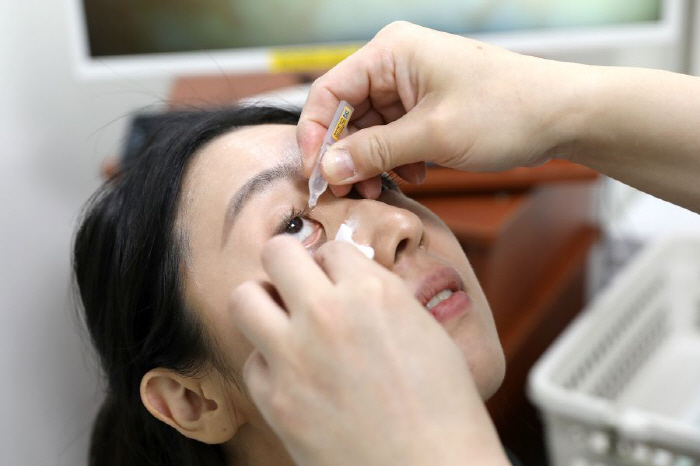
[Sportschosun Reporter Jang Jong-ho] During the hot summer months, the use of air conditioners rises and people spend more time on smartphones and computers, leading to an increase in dry eye syndrome and conjunctivitis cases. Lower indoor humidity from air conditioning and fewer blinks make the tear film more unstable, which can easily damage the eye’s surface. In addition, high temperatures and humidity encourage the activity of bacteria and viruses, while swimming and outdoor activities increase the incidence of infectious conjunctivitis. Experts stress that redness, itching, or a foreign-body sensation in the eyes should not be dismissed as simple fatigue or heat, and that the cause must be identified accurately.
◇"My eyes are red" ... a sign of disease, not just a simple symptom
The conjunctiva is a thin mucous membrane that covers the white part of the eye and the inside of the eyelids. It protects the eye from external irritants and bacteria. Inflammation of this tissue is called conjunctivitis.
Conjunctivitis is divided into infectious conjunctivitis, caused by bacterial or viral infection, and noninfectious conjunctivitis, caused by external irritants such as pollen, fine dust, and ultraviolet rays, or by allergic reactions.
In summer, not only does infectious conjunctivitis increase because of the high temperature and humidity, but the dry indoor environment created by air conditioning and strong ultraviolet rays can also irritate the eyes and worsen symptoms.
Professor Lee Do-hyung of the Department of Ophthalmology at Inje University Ilsan Paik Hospital said, "Conjunctivitis is not just a symptom of red eyes. It is a disease whose treatment differs depending on the cause," adding, "The most important thing is to identify the cause through an accurate diagnosis."
◇Rubbing the eyes repeatedly raises the risk of corneal damage and secondary infection
Rubbing itchy eyes with your hands is a typical habit that makes symptoms worse. Rubbing can damage the corneal epithelium, and bacteria on your hands can be transferred to the eyes, increasing the risk of secondary infection.
In particular, infectious conjunctivitis spreads easily through contact, so people should also be careful when using shared items such as towels, pillows, and door handles.
Blindness caused by conjunctivitis alone is rare, but if the inflammation spreads to the cornea, keratitis or a corneal ulcer can develop. In severe cases, it can progress to corneal perforation, in which the cornea is pierced. Even after treatment, corneal opacity may remain and vision may not recover.
Professor Lee explained, "Because the conjunctiva is the outermost protective layer of the eye, leaving inflammation untreated can affect the cornea as well."
◇Dry eyes but more tears? It is due to 'reflex tears'
Recently, attention has also focused on the fact that dry eye syndrome and conjunctivitis can influence each other.
Dry eye syndrome is not simply a condition in which there are too few tears. It is an eye-surface disease in which inflammation develops because the balance of the tear film breaks down.
Tears are made up of a lipid layer, an aqueous layer, and a mucous layer. When this balance is disrupted, tears evaporate more easily and the eye’s surface becomes damaged.
The problem is that when conjunctivitis develops, the mucous membrane function declines, making it difficult to maintain tears properly and worsening dry eye syndrome. Conversely, dry eyes increase friction and irritation, creating a vicious cycle that worsens conjunctivitis again.
Professor Lee said, "There are cases in which the eyes feel dry, yet tears keep flowing," adding, "These are reflex tears, which are temporarily produced in large amounts because the eyes are irritated. Their composition differs from the basic tears that normally protect the eyes, so they do not provide enough protective function." He added, "Having many tears does not mean you do not have dry eye syndrome."
◇Artificial tears are not better when used in large amounts
When dry eye syndrome develops, many people use artificial tears frequently, but excessive use may not actually help eye health.
In particular, repeated use of artificial tears containing preservatives can damage corneal cells, and using them too often may wash away beneficial components in the tears as well.
Using saline instead of artificial tears should also be avoided. Saline does not contain the mucus and nutrients found in tears, so it can actually make the eyes drier.
Professor Lee advised, "In general, using them about four times a day is appropriate, and if you need to use them frequently, preservative-free artificial tears are better."
◇Summer eye health depends most on daily habits
Experts emphasize that dry eye syndrome and conjunctivitis should not be managed separately. Instead, the tear film and the eye surface should be cared for together.
To protect eye health in summer, it is important to follow habits such as not rubbing the eyes with your hands, washing your hands thoroughly, not sharing towels or other personal items, avoiding direct airflow from air conditioners, blinking often and resting your eyes while using smartphones or computers, and using artificial tears properly.
Professor Lee urged, "If redness, a foreign-body sensation, or pain keeps recurring, do not dismiss it as simple fatigue or a temporary symptom. Visit an ophthalmologist to identify the exact cause." He added, "Managing the tear film and the eye surface together is the most important way to protect eye health in summer."
Reporter Jang Jong-ho bellho@sportschosun.com
This article has been translated by GripLabs Mingo AI.