


[Sportschosun, Reporter Jang Jong-ho] Hip arthritis, which mainly affects middle-aged and older adults, does not simply appear as a disease that only hurts when you walk, unlike knee arthritis. In many cases, the earliest sign is not pain but a change in movement. If it becomes increasingly difficult to lift your leg to put on socks or trim your toenails, rotate your leg outward to get out of a car, tie your shoelaces, or cross your legs, you may want to suspect a hip problem.
The hip joint connects the pelvis and the thigh bone and is involved in most lower-body movements, including walking, sitting, standing up, and changing direction. When degenerative changes occur in this joint, the cartilage and surrounding tissues gradually become damaged, leading to pain and limited movement. This condition is called hip arthritis. It most commonly affects people in their 50s to 70s. In particular, women who have lost muscle mass after menopause may experience symptoms more easily or see them worsen because the muscles supporting the hip become weaker.
Hip arthritis is often mistaken for other conditions because the pain location is not always clear. Since the hip sits deep inside the body, pain can spread not only to the groin but also to the buttocks, lower back, front of the thigh, and around the knee. For that reason, many patients are treated for a herniated disc, sciatica, or a knee disorder before hip arthritis is diagnosed.
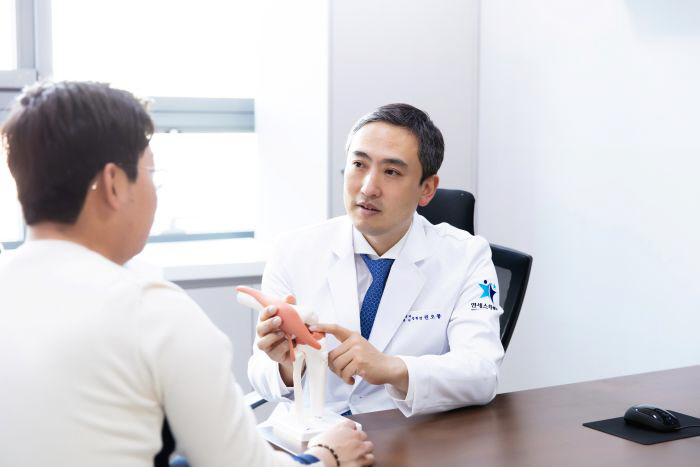
Kwon Oh-ryong, director of Yonsei Star Hospital and an orthopedic specialist, said, "If you feel pain deep in the groin and find it uncomfortable to lift your leg or rotate it inward and outward, you should check for a hip problem." He added, "If your first step feels unusually heavy after sitting for a long time, if the distance you can walk gradually gets shorter, or if you start limping while walking, these can be signs of hip arthritis."
Treatment is determined by considering the extent of joint damage, walking ability, and how much the condition interferes with daily life. In the early stages, it is important to reduce the load on the hip joint. Along with weight management, strengthening the muscles in the buttocks and thighs can help support the joint more stably. When pain occurs, doctors focus on controlling it and preserving joint function through medication, physical therapy, and extracorporeal shock wave therapy.
However, the hip is not a joint for repeated injection treatments like the knee. Because it is located deep inside the body and surrounded by complex structures, the treatment approach is different. For that reason, hip arthritis should be managed not just by temporarily easing pain, but by reducing stress on the joint, maintaining muscle strength, and slowing disease progression.
On the other hand, if pain continues despite conservative treatment, becomes severe enough to disrupt sleep at night, or makes basic daily activities such as walking difficult, joint replacement surgery may be considered. Hip replacement surgery replaces the damaged joint with an artificial one, helping reduce pain and restore walking function and quality of life.
Director Kwon said, "Hip arthritis is often discovered only after the pain becomes severe, but in reality it is a disease in which the range of motion and walking function gradually decline." He advised, "If you keep living with the pain, your walking posture can break down and the strain can spread to your lower back and knees as well. That is why, if you have hip pain, it is important to get an accurate diagnosis and determine whether it is time to manage it with conservative treatment or consider surgery."
Reporter Jang Jong-ho bellho@sportschosun.com