

[Sportschosun Reporter Jang Jong-ho] Bucheon Sejong Hospital recently successfully performed a right axillary thoracotomy on infants with congenital heart disease who were older than two months and weighed between 4 and 6 kg after they were diagnosed with ventricular septal defect.
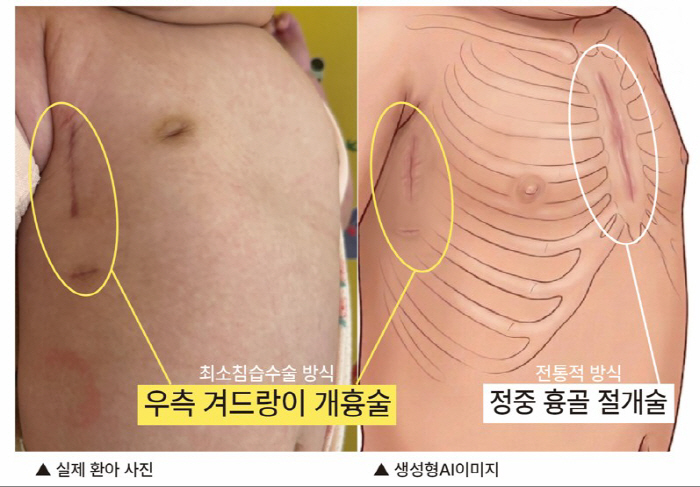
Minimally invasive cardiac surgery is a procedure in which surgeons create an access route between the ribs, either by making a partial incision in the sternum or without cutting the sternum at all. It offers cosmetic benefits, including faster recovery and smaller scars. A right axillary thoracotomy is one type of minimally invasive cardiac surgery that accesses the heart through an incision made under the right armpit and between the ribs.
Traditional congenital heart surgery has typically relied on median sternotomy, in which the sternum is cut through the center of the chest. While this method has proven safe and effective, it has been criticized for leaving a scar in the middle of the chest and for the possibility of chest wall deformities, such as pectus carinatum or pectus excavatum, as children grow.
By contrast, a right axillary thoracotomy places the incision under the armpit, making the scar less visible. Because the sternum is not cut, it can also reduce the risk of bleeding and infection. Another advantage is that it may lower the chance of future chest wall deformities. In particular, it can help address the drawbacks of a right anterior thoracotomy, which may affect breast development in girls.
Parents of children who underwent the procedure also expressed high satisfaction. The mother of a 4-month-old boy, identified only as A, said, "I was deeply worried when I learned that my 2-month-old baby needed heart surgery, but after the operation he became much more energetic, even crying much louder, and his recovery was so fast that I could feel relieved." She added, "Even in the 100-day commemorative photos, the surgical scar is barely visible from the front, so I am very satisfied." She also said, "I expect the scar will gradually fade as my child grows."
The procedure is relatively common overseas, but it is not yet widely used in South Korea. Bucheon Sejong Hospital has been performing various minimally invasive cardiac surgeries for adolescent and adult patients with congenital heart disease, and since last year it has applied right axillary thoracotomy to congenital heart disease patients. Since early this year, it has expanded the procedure to infants and young children and confirmed its safety.
In particular, for infants with ventricular septal defect, the hospital confirmed that the procedure can be performed safely without major differences from conventional sternotomy in terms of surgical visibility and access.
So far, Bucheon Sejong Hospital has performed right axillary thoracotomy on infants with congenital heart disease, including babies weighing 4 to 6 kg, and postoperative recovery has also been favorable.
Lee Chang-ha, medical director at Bucheon Sejong Hospital and a specialist in pediatric cardiovascular and thoracic surgery, said, "Median sternotomy remains a safe and standard surgical method, but right axillary thoracotomy is also a good treatment option that can be safely applied to infants and young children with ventricular septal defect." He added, "Because it does not require cutting the sternum, it is highly meaningful in that it minimizes scarring and reduces the risk of future chest wall deformities."
He continued, "Right axillary thoracotomy cannot be applied to all congenital heart diseases, but it is a surgical option that can be fully considered for relatively simple conditions such as ventricular septal defect and atrial septal defect." He added, "We expect it will help not only improve cosmetic satisfaction for patients, but also reduce the emotional burden on parents."
Jang Jong-ho, Sportschosun, bellho@sportschosun.com