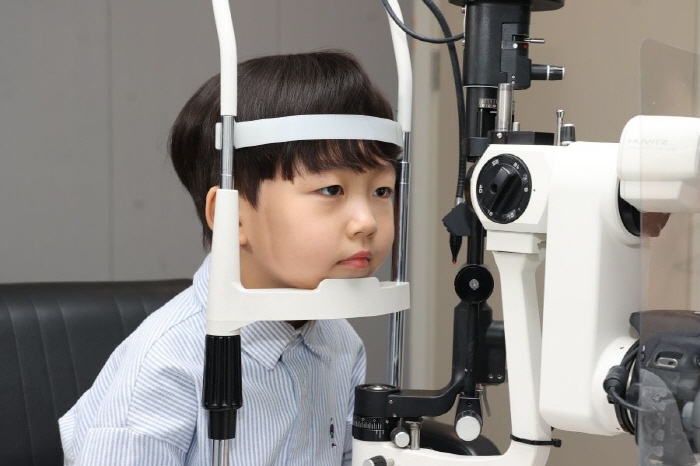
[Sportschosun Reporter Jang Jong-ho] Summer vacation is a good time to plan eye exams and treatment for children.
In particular, parents of children with strabismus often wonder whether surgery is necessary and, if so, when it should be done. Treatment varies depending on the type and severity of the condition, and even when surgery is needed, the timing can differ from child to child.
Strabismus refers to a condition in which the two eyes are not properly aligned. When it appears in growing children, it can affect binocular vision and the development of depth perception. Therefore, if strabismus is suspected, it is important to obtain an accurate diagnosis and determine whether treatment is needed.
Treatment for strabismus varies depending on the cause and symptoms.
For some children, symptoms may improve with non-surgical treatments such as wearing glasses or patching therapy.
A typical example is accommodative esotropia caused by hyperopia. When the eyes turn inward because of excessive focusing effort while looking at nearby objects, wearing glasses that correct hyperopia often improves the strabismus as well. In such cases, glasses are usually tried before surgery.
By contrast, intermittent exotropia, the most common type of pediatric strabismus in South Korea, is a condition in which the eyes are normally aligned but one eye turns outward when a child is tired or less focused. At first, the symptoms appear only occasionally, but if they become more frequent, visual function, including depth perception, may decline. In such cases, surgery is considered.
Patching therapy may also be used, in which the stronger eye is covered for a certain period so that the weaker eye can be used more. It is not necessary for all strabismus patients, but depending on the patient's condition, it may be used to improve symptoms or as an adjunct treatment after surgery to enhance visual function.
Many parents believe that strabismus surgery must be performed before elementary school or before a certain age, but the child's eye condition is more important than age. The decision on whether and when to operate is made after comprehensively evaluating how often the strabismus appears, the angle of deviation, and the development of binocular vision. If symptoms are severe, surgery may be performed at a young age. In other cases, doctors may first choose observation or non-surgical treatment.
Some parents also expect that strabismus surgery will improve vision as well. However, strabismus surgery is intended to correct eye alignment and improve binocular vision. It is not a procedure that corrects refractive errors such as myopia or hyperopia. Therefore, if a refractive error is present, glasses may still be needed after surgery. Regular eye exams and timely updates to the prescription can help maintain the eye condition after the operation.
Dr. Kim Dae-hee of the strabismus and pediatric ophthalmology center at Kim's Eye Hospital advised, "Strabismus is not simply a problem of eye alignment; it can affect binocular vision in growing children," adding, "Because the type and progression of strabismus differ from child to child, if it is suspected, it is important to establish an appropriate treatment plan based on an accurate diagnosis."
Jang Jong-ho, bellho@sportschosun.com