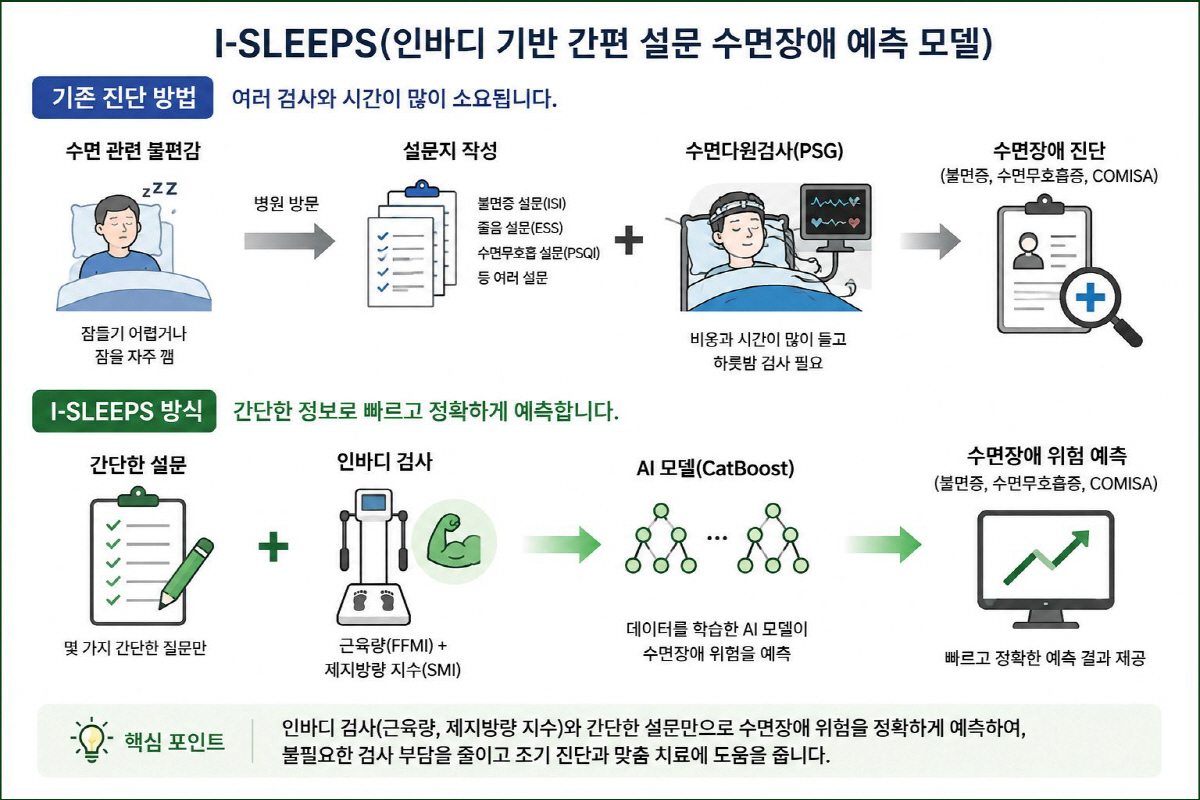
[Sportschosun Reporter Jang Jong-ho] An artificial intelligence (AI)-based screening model for sleep disorders has been developed that can predict the risk of insomnia and sleep apnea with high accuracy using only InBody body composition testing and a simple questionnaire, without the need for polysomnography.
A joint research team led by Professor Bae Hee-won of the Department of Neurology at Inje University Ilsan Paik Hospital, Professor Joo Eun-yeon of Samsung Seoul Hospital, and Professor Kim Jae-kyung of KAIST developed an AI model called I-SLEEPS (InBody-based SimpLE quEstionnairE Predicting Sleep Disorders), which uses muscle mass and body fat data measured in InBody tests to predict sleep disorder risk more accurately than existing methods.
The findings were published in the latest issue of Sleep, the official journal of the World Sleep Society.
Sleep disorders are typically represented by insomnia and obstructive sleep apnea. COMISA, a combined sleep disorder in which the two conditions occur together, is known to increase the risk of cardiovascular disease, diabetes and other metabolic disorders, as well as cognitive decline. However, an accurate diagnosis currently requires polysomnography, an overnight hospital test, and the cost and time involved often delay diagnosis.
◇ Sleep disorder risk can differ even at the same body weight
Existing sleep disorder prediction models assess risk using age, sex, body weight, BMI (Body Mass Index), and sleep-related questionnaires. But BMI is calculated only from height and weight, so it cannot distinguish between muscle and fat composition. Even with the same BMI, a person with more muscle and a person with more body fat may have very different health conditions.
Based on this, the research team incorporated the skeletal muscle index (SMI) and fat-free mass index (FFMI), both measurable through InBody testing, into the AI model. This led to the development of a new prediction model, I-SLEEPS, built on 10 variables in total.
In an analysis of patients with obstructive sleep apnea whose BMI ranged from 20 to 30, the team found that muscle mass and body composition varied greatly even at the same BMI. The researchers concluded that BMI alone is not enough to fully explain sleep disorder risk.
◇ Prediction accuracy improved over existing models
The team developed the AI model by analyzing data from 3,291 people who underwent both polysomnography and InBody testing. After validating the model in a separate patient group, they found that prediction accuracy improved for insomnia, obstructive sleep apnea, and COMISA compared with existing prediction models.
In particular, prediction performance improved from about 93% to 96% for insomnia, from 90% to 93% for obstructive sleep apnea, and from 94% to 97% for COMISA. The model also showed high accuracy in conditions that are difficult to predict because of small patient numbers, confirming its stability and reliability.
Additional validation using 195 patients from an outside hospital also maintained high predictive accuracy, suggesting strong potential for use at other medical institutions.
◇ Sleep disorder risk patterns vary by body composition
The research team also confirmed a link between body composition and sleep disorders through AI analysis. The results showed that lower SMI and FFMI were associated with a higher risk of insomnia, while higher SMI and FFMI were associated with an increased risk of obstructive sleep apnea.
The team explained that in insomnia patients, prolonged sleep deprivation can reduce muscle mass through chronic inflammation and hormonal changes. In contrast, for sleep apnea patients, increased muscle mass around the neck and torso may narrow the airway and contribute to the disease. This suggests that body composition may have different clinical meanings depending on the type of sleep disorder.
They also said that because COMISA is a complex condition that combines the characteristics of both insomnia and sleep apnea, body composition data could help shape future personalized screening and treatment strategies.
◇ "InBody testing shows potential for early detection of sleep disorders"
Professor Bae Hee-won of Ilsan Paik Hospital said, "Polysomnography is the standard test for diagnosing sleep disorders, but it is costly and time-consuming, making it difficult for everyone to undergo the test easily. Through this study, we confirmed the possibility that combining InBody testing with a simple questionnaire can effectively identify high-risk groups for insomnia and sleep apnea before polysomnography."
Professor Bae added, "In particular, we found that body composition data such as muscle mass and fat-free mass explain sleep disorder risk more accurately than BMI, which reflects only body weight. If further validation is carried out in various medical settings, we expect this approach to help screen for sleep disorders earlier and more easily, and to support the development of personalized treatment strategies for patients."
Jang Jong-ho, bellho@sportschosun.com
This article has been translated by GripLabs Mingo AI.