Kumho Petrochemical Group will fully launch its "Endangered Migratory Bird Habitat Improvement Project" to help preserve biodiversity and respond to the climate crisis in Yeosu, South Jeolla.
Five affiliates, including Kumho Petrochemical, Kumho P&B Chemicals, Kumho Mitsui Chemicals, Kumho Polychem, and Kumho T&L, will jointly take part in the project.
In partnership with climate-tech company ThanksCarbon, the group will invest a total of 260 million won over the next three years to carry out a wetland restoration project on farmland near Gasari Ecological Park in Yeosu.
The project will begin with about 1,200 pyeong in the first year, expand to 2,400 pyeong in the second year, and grow to as much as 3,400 pyeong in the third year.
The area near the Yeosu plant is a key ecological hub adjacent to Suncheon Bay Wetland, and it has long served as a stopover and wintering site for migratory birds traveling long distances in winter.
However, as industrialization and regional development have advanced, the reduction in farmland has worsened habitat conditions for migratory birds.
In response, Kumho Petrochemical Group has created a "mudflat field" by maintaining a certain water depth on farmland during the winter off-season, providing an environment where migratory birds can stay safely and feed.
Mudflat fields are drawing attention as an ecological restoration method that can support biodiversity conservation and climate change response at the same time, as they provide habitats for a wide range of species and store carbon effectively in the soil.
The restored habitat will be continuously monitored using advanced equipment such as unmanned sensor cameras to track migratory bird populations and changes in the environment, and the accumulated data will be used to establish a more systematic habitat management strategy.
The project is also significant because local farmers will directly take part in its operation.
Local farms are supplying feed such as rice seeds and sweet potatoes once a week during the winter to help migratory birds feed in a stable environment.
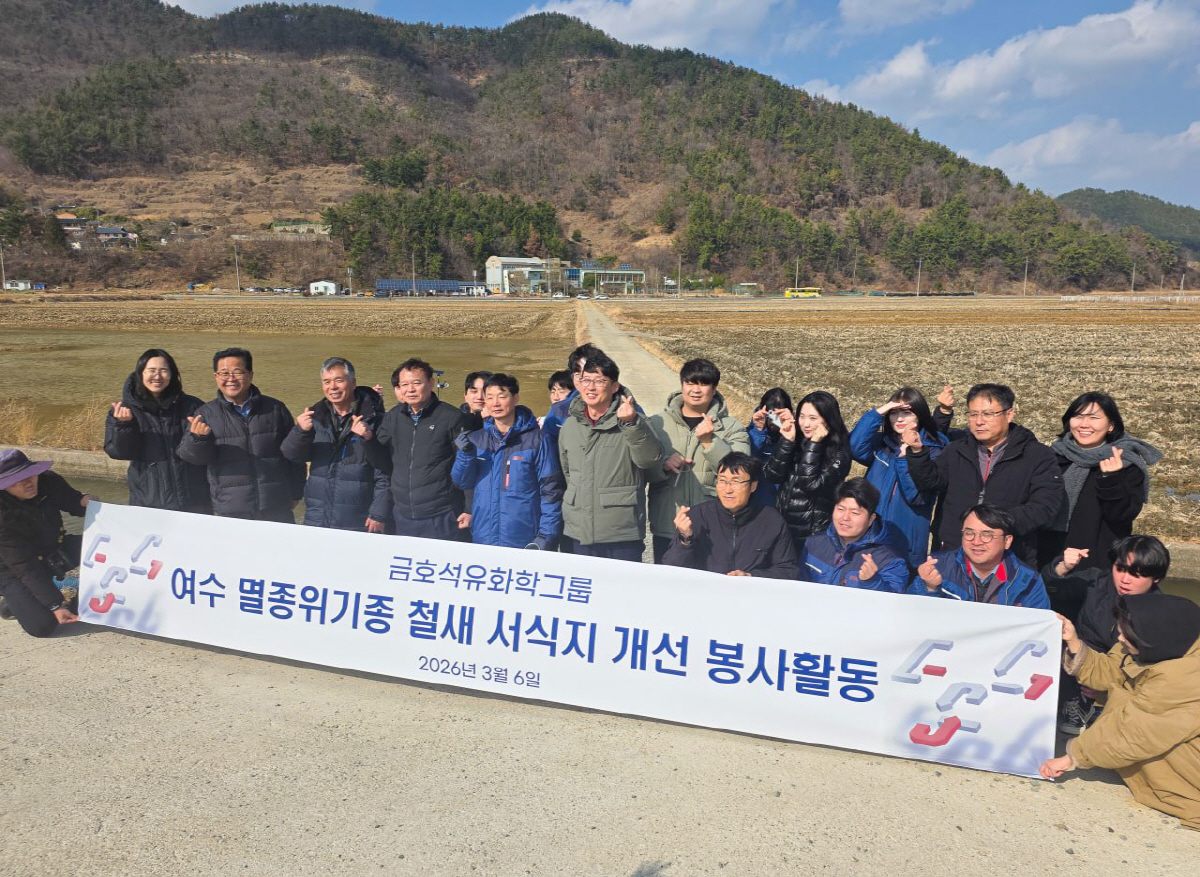
In March, employees of Kumho Petrochemical also joined on-site activities to support ecosystem conservation, and the company plans to continue such efforts through a regular social contribution program.
A Kumho Petrochemical official said, "Preserving Yeosu's ecological value and protecting biodiversity is a responsibility that naturally falls to a company that has grown together with the local community," adding, "We will continue to deepen our ESG management through sincere efforts."
Meanwhile, Kumho Petrochemical has steadily carried out biodiversity conservation efforts, including planting 210 Parasenecio firmus, a native species of Jeju that once faced extinction and is designated as a Grade II endangered wild plant, at Kumho Jeju Resort near its natural habitat after employees nurtured the plants for nine months, underscoring its commitment to corporate social responsibility.
This article has been translated by GripLabs Mingo AI.