[Sportschosun, Reporter Jang Jong-ho] An octogenarian identified as A went to the emergency room after suddenly developing blurred vision and weakness in his arms and legs. Detailed tests found metastatic cancer in the center of the pons, part of the brainstem. His consciousness gradually clouded, and strength in both arms and legs rapidly declined. He also developed diplopia, in which objects appeared doubled. The problem was the tumor’s location. The lesion was in the brainstem’s core, which controls breathing, heartbeat, consciousness, eye movement, and sensation in the arms and legs.
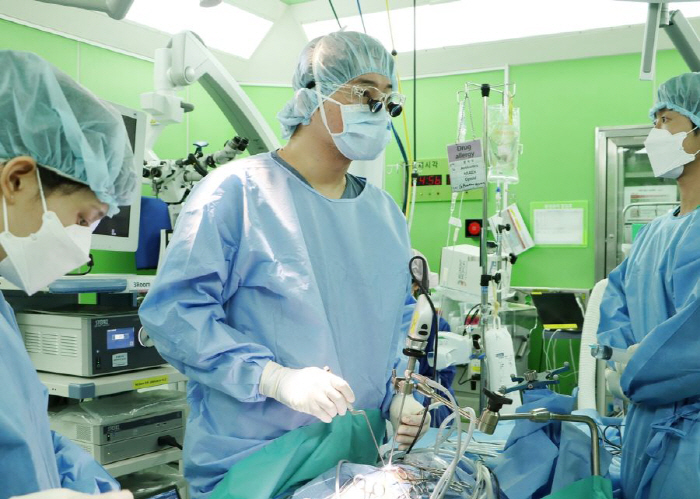
A team led by Professor Jeon Chi-man of the Department of Neurosurgery at Hallym University Sacred Heart Hospital, headed by Hyung-Soo Kim, carefully considered the patient’s condition from multiple angles and performed minimally invasive endoscopic surgery on A. The tumor was successfully removed, and A’s motor impairment and double vision improved. He is now well enough to walk on his own.
The brainstem is the passage connecting the cerebrum and the spinal cord, and it houses the core functions needed to sustain life. It is involved in breathing, heartbeat, blood pressure regulation, consciousness, eye movement, facial sensation, and movement and sensation in the limbs. Because vital nerve nuclei and fibers are densely packed in the brainstem, even a small injury can cause paralysis, sensory loss, double vision, swallowing difficulties, or reduced consciousness. In severe cases, it can also affect breathing and heartbeat.
For that reason, the brainstem is regarded by neurosurgeons as one of the most delicate surgical areas. The surgical approach is narrow, and there is almost no margin between normal neural tissue and the lesion. To remove a tumor, surgeons must reach the lesion precisely, but touching normal brainstem tissue during the approach can cause devastating aftereffects. For years, brainstem tumors have therefore been seen as difficult to operate on and risky to touch.
In general, treatment for metastatic brainstem cancer is decided by weighing the size and location of the lesion, along with the patient’s condition, to determine whether radiation or surgery is appropriate. Radiation therapy works by concentrating radiation on the tumor without opening the skull. However, radiation alone is not enough for every patient. If the tumor grows quickly or compresses the brainstem, causing neurological symptoms to worsen rapidly, it is difficult to wait for radiation to take effect. When the lesion is large or accompanied by internal bleeding, swelling, or pressure symptoms, surgical removal may be necessary.
A was such a case. The tumor was already deep in the pons, and his consciousness was declining while motor impairment in both arms and legs was progressing rapidly. Professor Jeon decided that radiation alone would not be enough to reverse the worsening neurological symptoms immediately, and chose surgical removal.
Jeon’s team performed a keyhole craniotomy, a minimally invasive procedure that requires only a coin-sized incision rather than a large opening in the skull. They then approached the brainstem lesion using an endoscope alone, instead of a microscope. Endoscopes provide a wide and bright field of view even in narrow spaces, making them well suited for precise surgery between critical structures such as those in the brainstem.
By contrast, conventional microscopic surgery may require a wide opening of the skull or retraction of the cerebellum or temporal lobe to secure the field of view, which carries a risk of postoperative complications such as brain swelling, dizziness, and speech disorders. Endoscopic surgery has the advantage of reaching the lesion while minimizing traction on brain tissue.
Using minimally invasive endoscopic surgery, Jeon’s team precisely removed the tumor deep in the pons while preserving normal neural structures as much as possible. The operation was successful, and the patient has now recovered to the point where he can walk on both feet.
Professor Jeon said, "Patients with brainstem tumors or brainstem cavernous malformations are sometimes advised to undergo radiation therapy or simply be observed because surgery is considered difficult," adding, "But for patients whose symptoms are progressing, surgery can be an important treatment option or even the only solution."
Beyond brainstem endoscopic surgery, Jeon has also performed advanced brain tumor operations using an endoscopic approach through incisions in the eyebrow and eyelid, including surgeries for hippocampal brain tumors, pediatric craniopharyngiomas, optic gliomas, and meningiomas. At the 2nd International Orbital Endoscopy Conference held in Hong Kong last November, he presented the world’s first clinical results of orbital endoscopic surgery for pediatric brain tumors. He also reported, for the first time in the world, that tumors in the temporal lobe and skull base, including the hippocampus, can be effectively accessed and removed in pediatric patients without the need for a large craniotomy, scalp incision, or head shaving. The findings drew attention for suggesting a new minimally invasive treatment option for pediatric brain tumors that can reduce surgical scarring and patient burden while also improving cosmetic outcomes.
Professor Jeon Chi-man specializes in minimally invasive endoscopic surgery for deep-seated lesions such as brainstem, thalamic, and pineal tumors, as well as brainstem and thalamic cavernous malformations. He is expected to offer a new treatment alternative for patients who previously had few options beyond radiation therapy.
Jang Jong-ho, bellho@sportschosun.com

This article has been translated by GripLabs Mingo AI.