[Sportschosun Jang Jong-ho] A research team led by Professor Hwang Ho-sik at Catholic University Yeouido St. Mary's Eye Hospital has developed the world's first device dedicated to measuring the tear film lipid layer in mice, making it possible to analyze a key cause of dry eye disease.
Dry eye disease is broadly divided into two types: one caused by insufficient tear production and the other by excessive tear evaporation. The tear film lipid layer, located at the outermost part of the tear film, acts as a barrier that suppresses moisture evaporation. Understanding the condition of this layer is central to diagnosing and treating dry eye disease.
At present, a variety of commercial devices for analyzing the tear film lipid layer in humans are widely used in clinical settings.
However, in mouse models, which are essential for drug development and disease mechanism studies, the eye is too small to directly image and measure the lipid layer, and no dedicated device had existed. As a result, it was difficult to accurately assess evaporative dry eye disease in animal experiments.
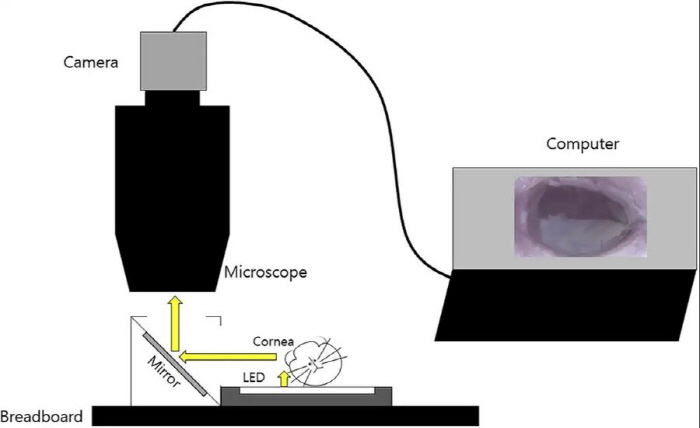
Instead of using an off-the-shelf device, Professor Hwang's team designed and built a compact interferometer system combining an LED panel, mirrors and an optical microscope. When a specific wavelength of LED light is directed at the eye surface with the mouse eyelid held open, light reflected from the upper and lower surfaces of the lipid layer interferes with itself and creates distinctive color patterns. The team captured these interference patterns with microscope images and calculated the lipid layer thickness in nanometers by analyzing the relationship between the color pattern and wavelength. The invention has been registered as a domestic patent under the name 'Mouse Tear Film Lipid Layer Observation Device.'
With this device, changes in lipid layer thickness can now be directly quantified in mouse dry eye models. Until now, researchers had relied on indirect indicators such as corneal staining and tear secretion to assess the severity of dry eye in mice, but they can now add lipid layer thickness as a direct measure. The device is expected to allow more detailed evaluation of the effects of candidate drugs and eye drops in animal studies, improving the quality of preclinical research.
Professor Hwang, the corresponding author, said, "Until now, the lack of a device for measuring the tear film lipid layer in mice has placed major limits on basic research into evaporative dry eye disease, but this device has made it much clearer to identify the cause of the disease and evaluate drug efficacy." He added, "We hope this technology will be widely used as a useful tool in preclinical research for developing treatments for various intractable eye diseases."
The study was recently published in CORNEA, an international journal in the field of ophthalmology.
Jang Jong-ho, bellho@sportschosun.com

This article has been translated by GripLabs Mingo AI.