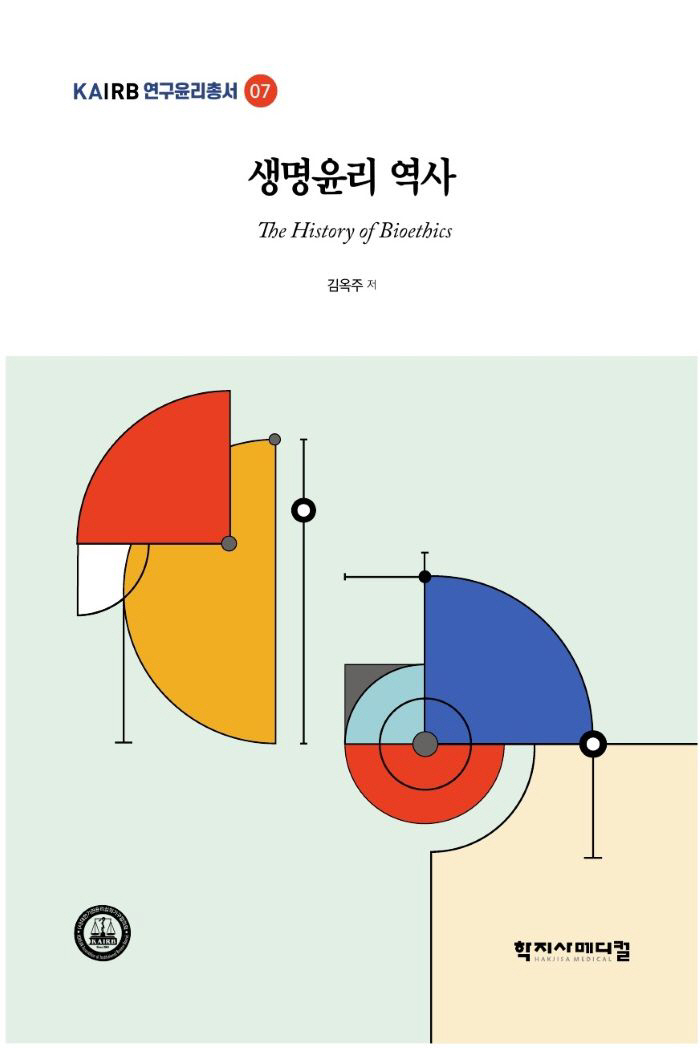
[Sportschosun Jang Jong-ho] Kim Ok-joo, a professor in the Department of the History of Medicine and Medical Humanities at Seoul National University College of Medicine (SNUCM) and head of the Clinical Research Ethics Center at Seoul National University Hospital, has published a new book, "The History of Bioethics."
The book traces the major developments in modern medical ethics over the past 80 years. It presents each event not as an isolated case, but as part of a larger historical current, showing that today's principles of research ethics were shaped through past failures and social reflection.
Beginning with Nazi inhumane human experiments, the book unfolds across 10 chapters, covering Unit 731 and human experimentation in Imperial Japan, the formation and evolution of the Helsinki Declaration, the Tuskegee case and the Belmont Report, the AIDS crisis and the shift in research ethics, the Jesse Gelsinger case and the institutionalization of the Human Research Protection Program (HRPP), and the 21st-century transformation of research ethics through revisions to the U.S. Common Rule, the EU Clinical Trials Regulation, and the General Data Protection Regulation (GDPR).
This historical thread extends to Korea as well. The book examines the institutionalization of bioethics in Korea, beginning with the Hwang Woo-suk case and the formation of related systems, then moves on to the establishment and spread of Korea's ethical framework, and finally to future strategies for Korean governance amid global shifts in bioethics. In doing so, it places Korea's experience within the broader global history of bioethics.
In particular, the book does not simply introduce Unit 731 as a war crime. For the first time in Korea, it comprehensively organizes the entire process, from human experimentation to war crimes trials, from an ethical perspective. It examines the institutional background that made the experiments possible, the postwar immunity deal between the United States and Japan, and how responsibility was not properly established at the Tokyo Trials. It also follows the subsequent Khabarovsk Trial and the Shenyang war crimes trial, offering a multidimensional account of a history in which justice was never fully realized.
In the process, Professor Kim personally visited the U.S. National Archives and Records Administration (NARA) to uncover and analyze primary sources on Unit 731 that had not been sufficiently known in Korea. She also reconstructed, in historical context, the decision-making process that buried postwar responsibility.
Professor Kim Ok-joo said, "Bioethics is not a set of rules meant to slow scientific progress, but the foundation that ensures science remains for humanity." She added, "At a time when life science technologies such as gene editing and advanced regenerative medicine are advancing rapidly, this book will serve as a guide to understanding the historical experiences through which modern bioethical principles were formed."
Meanwhile, Kim previously served as president of the Korean Society for the History of Medicine and the Korean Bioethics Association, and currently chairs the National Bioethics Committee. Since 2004, she has contributed to building the IRB at Seoul National University Hospital and its research participant protection system. She also took part in the World Medical Association's work to revise the Helsinki Declaration.
Jang Jong-ho bellho@sportschosun.com
This article has been translated by GripLabs Mingo AI.